
Abstract
This research is an investigation of the link between teachers’ perception of job satisfaction and the different management styles of principals of secondary schools in Pakistan. This study has targeted the secondary school teachers of Pakistan’s Sindh province with a sample of 600 teachers. The statistical techniques, Pearson and Spearman revealed that job supervision, remuneration, advancement and responsibility are statistically significant with both Transactional and Transformational leadership styles. In Laissez-faire style, remuneration and advancement were not found significantly correlated. Contrary to Transactional style, in Transformational and Laisses-faire different elements showed different behavior in Pearson and Spearman correlations which are discussed and analyzed in the result section of this paper. However, the research suggests that principals’ attitude and leadership style have a significant impact on the job performance of teachers as a whole and that principals and teachers need to work together to provide an atmosphere that is conducive to the education process of Pakistan.
Key Words
Leadership style, Transactional, Transformational, Laissez-
Introduction
Teachers or educators are a key source of quality of education, so their satisfaction becomes a dire need for the outcome of students as well. If teachers feel good about their job and are contented with it, their performance eventually leads to the desired outcomes since they are the governing force of any educational institution. Satisfied teachers take interest in their work and give more time to students (Ostroff, 1992; Cerit, 2009). For any country’s progress, teachers have a significant role and it is very essential for them to be contented with their responsibilities and surroundings which then lead to achieve the expectations of the shareholders and ultimately, they contribute to the success scheme of the nation (Scott, Stone & Dinham, 2001; Van den Berg, 2002). On the other hand, if they lack the satisfaction, they will lack the commitment which will have a detrimental influence on their students and would affect the development of the school environment. Various researchers elaborated job satisfaction in detail however, conclusively the meaning of job satisfaction varies for every individual. Kaliski (2007) considers job satisfaction as a complete procedure comprising aspects like passion and pleasure which can lead employees to acknowledgment, revenue, raise, attainments and a sense of achievement. George and Jones (2008) viewed satisfaction in job as a state that one holds about the job and his beliefs about the nature of work, about his subordinates and superiors.
A strong relationship exists amid the leadership style of the principal and job satisfaction of the teacher. According to Lytle (2013), leadership style of the principal puts a significant effect on job satisfaction of the teacher through their administrative support and mentoring. In the view of Cha and Cohen-Vogel (2011), principals play a crucial role in job satisfaction of teacher as they support teachers in overcoming educational obstacles. According to Ahadi and Suandi (2014), the connection amid employee’s psychological empowerment and the leadership style in higher educational setting in not thoroughly studied; it requires further exploration.
According to Amos (2014), principals and teachers are the institution upon which our system of education is built. Ndoye, Imig and Parker (2010) and Sauer (2011) believed that ‘leader’s effectiveness is linked to the employees’ performance in an organization and how they consider themselves.
Teachers’ motivation is based on the leadership styles that are normally used in the schools. People in the management or administration take decisions on their own and they do not find it worthy to consult others for any matter. Some researchers hypothesize that such style of leadership results in staff dissatisfaction.
The main purpose of this research is evaluation of applied styles of leadership of school leaders, whether it is transactional, transformational, situational, and autocratic or laissez–faire leadership style so this research can suggest the most useful leadership style to motivate teachers. The purpose is to identify factors related to motivation or demotivation of the teachers. Leadership that is effective plays a key part in schools’ success and it has a significant influence on teachers’ work motivation and job satisfaction. Therefore, this study examines the principal’s (leaders) and teacher’s (followers) view concerning the style of leadership of the principal and its impact on overall work motivation and job satisfaction of teachers. This research will fill this gap by obtaining teachers’ opinion and providing the opportunity to them to express about their job satisfaction, adopting qualitative and quantitative methods. Such knowledge is always significant for the education sector to increase their efficiencies and improve teachers’ retention and job satisfaction level.
Statement of the Problem
Effectiveness of school is broadly dependent on job satisfaction of teachers, as it impacts the components which are necessary for the quality of education. Harvey (2018) recently studied the phenomena of teachers’ perception with respect to servant leadership in Florida; he concluded that servant leadership style of the principal’ plays a trivial role in job satisfaction of the teachers’. Hence, this study has taken a different route while filling the knowledge gap left by the other studies and initiated to find the relationship between teachers’ opinion about different leadership styles (Laissez-faire, Transformational, and Transactional) and the satisfaction level of job in the context of Pakistan.
Significance of the Study
The research will focus on two key factors; teacher’s perception and its effect on satisfaction of job in the presence of the management style as the researchers concluded that principals’ behavior is essential for teachers’ job satisfaction. Hence, this research will study the connection amid teachers’ perception of management style and its effect on satisfaction levels of job in secondary schools of Pakistan in order to fill the research gap identified above.
Study Objectives
• To elaborate the transactional leadership style’s role perceived by teachers and its effect on their job satisfaction
• To elaborate transformational leadership style’s role perceived by teachers and its effect on their job satisfaction
• To elaborate Laissez-faire leadership style’s role perceived by teachers and its effect on their job satisfaction
Hypotheses
The following three hypotheses are formulated to get the answer for the research problem to achieve the objective of this research.
H1: There is at least one statistically significant relationship between teachers’ perception of their principals’ transactional leadership style and teachers’ satisfaction with job supervision, colleagues, remuneration, advancement, responsibility and recognition.
H2: There is at least one statistically significant relationship between teachers’ perception of their principals’ transformational leadership style and teachers’ satisfaction with job supervision, colleagues, remuneration, advancement, responsibility and recognition.
H3: There is at least one statistically significant relationship between teachers’ perception of their principals’ Laissez-faire leadership style and teachers’ satisfaction with job supervision, colleagues, remuneration, advancement, responsibility and recognition.
Review of Literature
A highly qualified teaching staff is essential for a successful educational system and for this factor teacher quality and satisfaction should be developed. Specifically, job satisfaction is measured against one’s productivity. Teachers who are less motivated do not perform satisfactorily whereas highly motivated teachers remain in the profession as do not quit easily (Choy, 1993). Hoppock (1935) being the first researcher to study job satisfaction claimed that there was a higher level of satisfaction in teachers and they had more helpful and appreciative principals as cited in Bass (1985).
Usdan, McCloud and Podmostko (2000) commented that in the 20th century, principal’s role was more of a manager whose task was to follow directives of district, manage people along with dealing budgetary and other operational affairs. Griffith (2004), Dinham and Scott (2000), and Bogler (2001) reported positive impact of leadership style of principal on teachers’ commitment and job satisfaction who involve the staff in decision making. Hui, Jenatabadi, Ismail, Azina, Radzi and Jasimah (2013) concluded in their study based in China that the decision-making of principal impacts the job satisfaction of his staff. Leadership is a difficult role to be defined and evaluated; Leaders have to perform variety of roles every day. Effective leaders possess many traits and behaviors. Great Man theory, Trait Situational Theory and Transformational Theory would further elaborate leadership. Bass (1985) commented that Laissez-Faire is generally considered as no leadership style due to their approach of avoidance and ignorance. Leadership style of Laissez-faire is an approach of avoiding to making decisions. The followers are free to take decisions and there is minimum involvement of the leader and a very minimal control over the followers. According to Barbuto (2005), transactional leadership believes on the completion of task; the followers are rewarded when they perform according to the leader’s wish whereas punishment is also applied in case of non-compliance. This leadership style consists of three factors including contingent rewards, passive-management by exception and active –management –by-exception. Transformational leaders are ambitious, and they plan strategically to achieve rapid growth through the vision and combined efforts of the whole team. They motivate people; inspire them to work rather directing with authority like a transactional leader. Transformational leaders are proactive. They motivate people and inspire them to perform better. “The overriding element of successful leadership is to involve people in the process of leading” (Horan, 1999). Transformational leadership is considered to be the current theory. It is about providing autonomy to everyone. In 1970, J. V. Downtown was the first author who identified the transformational leadership and till 1978 transforming and transactional leadership became the influential sources (Burns, 1978). Burns gave more focus to the leader not the follower therefore he emphasized on the term transforming rather transformational.
Researchers have studied the theoretical and practical factors of educational leadership to analyze its effect on job satisfaction of teachers. Egley and Jones (2005) conducted their research to find the relationship of principals and teachers and found that job satisfaction of teachers was impacted by inviting leadership. Inviting leadership demands mutual respect and compassion for the employees through collaboration.
Methodology
Two studies are kept as a base for this research which is related to teachers’ leadership styles and perception and their subsequent effect on their job satisfaction. Harvey (2018) conducted a co-relational study on Florida K-12 teachers and tried to find the impact of the teacher’s perception in relation to servant leadership on satisfaction levels of their job. However, Pettis (2017) have studied the leadership styles of higher education administrators in order to examine their impact on the psychological empowerment of the staff through a correlation study. Hence, this study has mixed the variables used by the above studies in order to find out how the teachers’ perception of different management styles is having an impact on their level of job satisfaction.
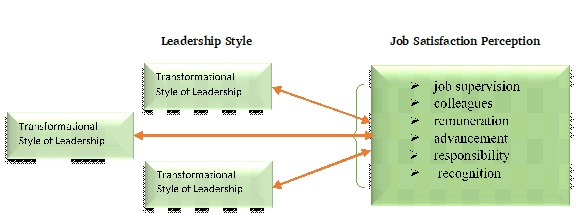
This research is quantitative in nature where the researcher has adopted post positivists approach which provides the most appropriate philosophical base for the study. In a quantitative research, variables are analyzed to obtain results. Numeric data is analyzed with the help of statistical techniques to get answers to the questions raised. This study is also a correlational study because it does not focus upon the causality of the variables.
The study participants are secondary school teachers selected from the higher secondary schools of Karachi. This study has targeted the secondary school population as the main area of research. According to Sindh Education Statistics Report (2015-16), Karachi is divided into 6 districts and total teaching staff hired in public sector schools is 11,731. The total sample size is 600 participants which is more than 5% of the total teaching staff. For this research the researcher used disproportionate stratified sampling design and researcher used the close-ended questionnaire to collect data from secondary school teachers from the selected public schools of Karachi. The instrument validity and reliability is checked through Cronbach's alpha and it is (0.798) more than 0.70; it means that the data is valid and reliable in nature.
Spearman-order rank and Pearson correlation was used to complete the required statistical-based analysis to answer the research questions. The styles of leadership like laissez-faire, transactional, and transformational are the independent variables. The perception of teachers in relation to job satisfaction is the dependent variable.
Table 1. Responses on Likert Scale for Leadership Style
| Likert Scaling | Management Leadership Style | |||
| Transactional | Transformational | Laissez-Faire | ||
| Strongly Disagree | Frequency | |||
| %age | ||||
| Disagree | Frequency | 82 | 73 | |
| %age | 13.67% | 12.17% | ||
| Neutral | Frequency | 186 | 97 | 120 |
| %age | 31% | 16.17% | 20% | |
| Agree | Frequency | 278 | 325 | 420 |
| %age | 46.33% | 54.17% | 70% | |
| Strongly Agree | Frequency | 54 | 105 | 60 |
| %age | 9% | 17.50% | 10% | |
It has been observed from the above data that teachers’ perceived transactional leadership positively and highlighted in their opinion when asked regarding the principals’ way of rewarding their staff for their work; the principals informing the staff about the set standards, the respective principals’ content to let others continue working in the same ways always, the principals’ attitude towards helping others to develop themselves and the faith of teachers in their respective principals.
The transformational leadership is regarded positively than transactional leadership style from the above data as perceived by the teachers when inquired whether the principals help their staff to have a sense of meaning in the work they do, whether the principals give personal attention to their staff who seem rejected, whether principals get others to rethink unquestioned ideas that that were never thought of before, whether principals provide their staff with newer ways of looking at complicated things.
Leadership style of Laissez-faire is regarded the most positive by the secondary school teachers. When inquired if the principals ask no more of their staff than what is essential and whatever staff want to do is OK with them. 80% agreed with this idea, however, no one disagreed.
Inferential Analysis
H1= There is at least one statistically significant relationship amid teachers’ perception of their principals’ transactional leadership style and teachers’ satisfaction with job supervision, colleagues, remuneration, advancement, responsibility and recognition.
Table 2. Pearson Correlation
| Job. Supervision | Colleagues | Remuneration | Advancement | Responsibility | Recognition | Transactional. Leadership | ||
| Job. Supervision | Pearson Correlation | 1 | .104* | .338** | .178** | .440** | .125** | .246** |
| Sig. (2-tailed) | .011 | .000 | .000 | .000 | .002 | .000 | ||
| N | 600 | 600 | 600 | 600 | 600 | 600 | 600 | |
| **. Correlation.is.significant.atthe 0.01 level. (2-tailed.). | ||||||||
| *. Correlation.is.significant.at.the 0.05 level. (2-tailed.). | ||||||||
Table 3. Spearman Correlation
| Job Supervision | Colleagues | Remuneration | Advancement | Responsibility | Recognition | Transactional Leadership | |||
| Spearman's rho | Job Supervision | Correlation Coefficient | 1.000 | .042 | .308** | .190** | .412** | .069 | .217** |
| Sig. (2-tailed) | . | .308 | .000 | .000 | .000 | .093 | .000 | ||
| N | 600 | 600 | 600 | 600 | 600 | 600 | 600 | ||
| **. Correlation.is.significant.atthe 0.01 level. (2-tailed.). | |||||||||
| *. Correlation.is.significant.at.the 0.05 level. (2-tailed.). | |||||||||
Analysis
It has been observed from the above tables that, Hypothesis 1 is proved as more than one of the variables is statistically significant with the moderate variable. It is to be seen from the above tables that job supervision, remuneration, advancement and responsibility are statistically significant with the transactional leadership style as their correlation value of both Pearson and Spearman is less than 0.05. However, colleagues and recognition is not linked with transactional leadership.
Although, job supervision, remuneration, and responsibility strength of relationship is weak in nature with the transactional leadership style. However, advancement characteristics are found to be having moderate strength of relationship with the transactional leadership style.
Hypothesis 2
There is at least one statistically significant relationship amid perception of the teachers’ of their principals’ transformational leadership style and those teachers’ satisfaction with job supervision, colleagues, remuneration, advancement, responsibility and recognition.
Table 4. Pearson Correlation
| Correlations | ||||||||
| Job Supervision | Colleagues | Remuneration | Advancement | Responsibility | Recognition | Transformationa Leadership | ||
| Job Supervision | Pearson Correlation | 1 | .104* | .338** | .178** | .440** | .125** | .301** |
| Sig. (2-tailed) | .011 | .000 | .000 | .000 | .002 | .000 | ||
| N | 600 | 600 | 600 | 600 | 600 | 600 | 600 | |
| **. Correlation.is.significant.atthe 0.01 level. (2-tailed.). | ||||||||
| *. Correlation.is.significant.at.the 0.05 level. (2-tailed.). | ||||||||
Table 5. Spearman Correlation
| Correlations | |||||||||
| Job Supervision | Colleagues | Remuneration | Advancement | Responsibility | Recognition | Transformational Leadership | |||
| Spearman's rho | Job Supervision | Correlation Coefficient | 1.000 | .042 | .308** | .190** | .412** | .069 | .249** |
| Sig. (2-tailed) | . | .308 | .000 | .000 | .000 | .093 | .000 | ||
| N | 600 | 600 | 600 | 600 | 600 | 600 | 600 | ||
| **. Correlation.is.significant.atthe 0.01 level. (2-tailed.). | |||||||||
| *. Correlation.is.significant.at.the 0.05 level. (2-tailed.). | |||||||||
Analysis
It has been observed from the above tables that, Hypothesis 2 has also been proved as more than one of the variables is statistically significant with the moderate variable. It is evident from the above tables that job supervision, remuneration, advancement and responsibility are statistically significant with the Transformational leadership style as their correlation value of both Pearson and Spearman is less than 0.05. However, recognition is negatively co-related with Transformational leadership. However, colleagues’ characteristics are statistically co-related with the Transformational leadership style only in Pearson correlation test. However, recognition is statistically negatively co-related in both tests.
Although, while taking it as a whole, job supervision, remuneration and advancement are revealed to be weaker in strength of relationship with the transformational leadership style. However, responsibility characteristics are found to be having moderate strength of relationship with the Transformational leadership style.
Hypothesis 3
There is at least one statistically significant relationship between teachers of Secondary school’s perception of their principals’ Laissez-faire leadership style and those teachers’ satisfaction with job supervision, colleagues, remuneration, advancement, responsibility and recognition.
Table 6. Pearson Correlation
| Job Supervision | Colleagues | Remuneration | Advancement | Responsibility | Recognition | Laissez-faire Leadership | ||
| Job Supervision | Pearson Correlation | 1 | .104* | .338** | .178** | .440** | .125** | -.149** |
| Sig. (2-tailed) | .011 | .000 | .000 | .000 | .002 | .000 | ||
| N | 600 | 600 | 600 | 600 | 600 | 600 | 600 | |
| *. Correlation.is significant. At.the 0.05 level. (2-tailed.) | ||||||||
| **. Correlation.is significant. At.the 0.01 level. (2-tailed). | ||||||||
Table 7. Spearman Correlation
| Job Supervision | Colleagues | Remuneration | Advancement | Responsibility | Recognition | Laissez.Faire Leadership | |||
| Spearman's rho | Job Supervision | Correlation Coefficient | 1.000 | .042 | .308** | .190** | .412** | .069 | -.133** |
| Sig. (2-tailed) | . | .308 | .000 | .000 | .000 | .093 | .001 | ||
| N | 600 | 600 | 600 | 600 | 600 | 600 | 600 | ||
| **. Correlation.is.significant.atthe 0.01 level. (2-tailed.). | |||||||||
| *. Correlation.is.significant.at.the 0.05 level. (2-tailed.). | |||||||||
Analysis
It has been observed from the above tables that, Hypothesis 3 has also been proved as more than one of the variables is statistically significant with the moderate variable. It is clear from the above tables that job supervision and responsibility are statistically significant with the Laissez-faire leadership style as their correlation value of both Pearson and Spearman is less than 0.05. However, the colleagues and remuneration are statistically co-related with the Laissez-faire leadership style in Pearson correlation test.
Although, job supervision, colleagues, remuneration and responsibility are negatively co-related in both tests and their strength of relationship is found to be weaker in nature with the Laissez-faire leadership style. However, advancement and recognition both are not statistically co-related with the Laissez-faire leadership style but, the Hypothesis 5 has been proved as two from the six characteristics are related with the Laissez-faire leadership style.
Conclusion and Discussion
Through the researches it is evident that principals’ behavior greatly influences teachers work performance which impacts students’ academic progress. Teachers and principals need to work in collaboration to create a conducive environment for the students learning. School environment reflects its administration, the type of environment developed by the administrator predicts the teachers’ job satisfaction level. Positive school environment leads to students’ achievement, teachers work efficiency and job contentment. On the other hand, low morale can reduce efficiency and cause dissatisfaction to the teachers.
The research suggested that principals and teachers should be honest and sincere with each other and they should be able to resolve the issues with sympathy and mutual understanding. The study found significant impact of principals’ leadership style on teacher’s job satisfaction be it transformational, transactional or laissez faire style. The results of the current study are convincing because a correlation is found between the leadership style and the job satisfaction and the study pointed out that teachers who participated in this research, believed that their job satisfaction was influenced by their preferred leadership behavior.
The finding of this study could impact leadership behavior that principals employ. While this research suggests implications of better leadership behavior that could influence their job satisfaction, overall school atmosphere and teachers’ turnover. Researchers relate the teachers’ job satisfaction with their interaction and personal experience with their school leaders who is their supervisor or principal. This study also highlighted that secondary principal behavior affected teachers’ job satisfaction which influenced students’ performances positively. The quality of education can only be improved with students’ achievement and by developing a conducive learning environment, which keeps the staff satisfied and the overall efficiency of school can be enhanced.
This study examined the relationship between the secondary school teachers’ opinion and views about their leaders’ style of management and assessed its impact on teachers’ job contentment. According to the descriptive analysis of the collected data, it was found that principals use both transactional and transformational leadership styles, this research outcome support the previous work done by (Fukushige & Spicer, 2007; Hariri, 2011).
According to the observation of Table 1, teachers’ perceived transactional leadership positively and highlighted in their opinion while answering regarding the principal way of rewarding their staff for their work, ensuring the maintained standards giving the staff freedom, the respective principals’ content to let others continue working in the same ways always, about the principals attitude for the staff professional growth the and the faith of teachers in their respective principals. We also more positive hints were obtained for transformational leadership than transactional leadership style as perceived by the teachers. When inquired whether principals help their staff to find meaning in their work, whether principal provide individual attention to their staff lacking confidence and felt rejected, whether principals allow innovative ideas which were never thought before and whether teachers are allowed to adopt new ways for problem solving issues. The same table suggested Laissez-faire leadership is regarded the most positive from the Secondary school teachers while inquiring about the principals whether the staff does what they want to do, and whether principal get involved in matters other than essential issues. Principals have the major role to play as leaders of their organization; they perform the task of delegating work leading teachers to achieve the students’ performance objectives. Principal influence the overall school activities and environment but the most prominent impact is seen on the staff of the school in which teachers are most affected.
References
- Ahadi, S., & Suandi, T. (2014). Structural empowerment and organizational commitment: The mediating role of psychological empowerment in Malaysian Research Universities. Journal of Asian Development Studies, 3(1), 44-65.
- Amos, J. (2014). On the path to equity: Teacher attrition costs United States up to $2.2 Billion Dollars Annually. Alliance for Excellent Education. Retrieved from
- Barbuto Jr, J. E. (2005). Motivation and transactional, charismatic, and transformational leadership: A test of antecedents. Journal of Leadership & Organizational Studies, 11(4), 26-40.
- Bass, B. M. (1985). Leadership and performance beyond expectations. New York: The Free Press
- Bogler, R. (2001). The influence of leadership style on teacher job satisfaction. Educational Administration Quarterly, 37(5), 662-683.
- Cantril, H. (1965). The pattern of human concerns. New Brunswick, NJ: Rutgers University Press.
- Cerit, Y. (2009). The effects of servant leadership behaviors of school principals on teachers' job satisfaction. Educational Management Administration & Leadership, 37(5), 600-623.
- Cha, S. H., & Cohen-Vogel, L. (2011). Why they quit: A focused look at teachers who leave for other occupations. School Effectiveness and School Improvement, 22(4), 371-392.
- Choy, S. P. (1992). Schools and Staffing in the United States: A Statistical Profile, 1987-88. Schools and Staffing Survey (SASS) and Teacher Followup Survey. Washington, DC: US Government Printing Office.
- Dinham, S., & Scott, C. (2000). Moving into the third, outer domain of teacher satisfaction. Journal of Educational Administration, 38(4), 379-396.
- Egley, R. J., & Jones, B. D. (2005). Principals' Inviting Leadership Behaviors in a Time of Test-Based Accountability. Scholar-Practitioner Quarterly, 3(1), 13-24.
- Fukushige, A., & Spicer, D. P. (2007). Leadership preferences in Japan: An exploratory study. Leadership & Organization Development Journal, 28(6), 508-530.
- George, J. M., & Jones, G. R. (2008). Organizational Behavior. New Delhi: Pearson Publication.
- Hallinger, P., & Heck, R. H. (1998). Exploring the principal's contribution to school effectiveness: 1980â€1995. School Effectiveness and School Improvement, 9(2), 157-191.
- Hariri, H. (2011). Leadership styles, decision-making styles, and teacher job satisfaction: an Indonesian school context. Douglas, Australia: James Cook University.
- Hariri, H., Monypenny, R., & Prideaux, M. (2012). Principalship in an Indonesian school context: can principal decision-making styles significantly predict teacher job satisfaction? School Leadership & Management, 32(5), 453-471.
- Harvey, G. E. (2018). Teachers' Perceptions of the Principal's Servant Leadership and Their Job Satisfaction. Phoenix, AZ: Grand Canyon University.
- Heyliger, W. (2014). Academic administrator leadership styles and the impact on faculty job satisfaction. Journal of Leadership Education, 13(13), 34-49.
- Hoppock, R. (1935). Job Satisfaction. New York: Harper Brothers.
- Hui, H., Jenatabadi, S. H., Ismail, B., Azina, N., Radzi, W. M., & Jasimah, C. W. (2013). Principal's leadership style and teacher job satisfaction: A case study in China. Interdisciplinary Journal of Contemporary Research in Business, 5(4), 175-184.
- Kaliski, B. S. (2007). Encyclopedia of Business and Finance. Detroit: Thompson Gale.
- Lester, P. E. (1987). Development and factor analysis of the teacher job satisfaction questionnaire (TJSQ). Educational and Psychological Measurement, 47(1), 223-233.
- Locke, E. A. (1976). The nature and causes of job satisfaction. Handbook of Industrial and Organizational Psychology. Chicago: Randmc Narlly.
- Lytle, N. (2013). Teacher turnover: A look into teacher job satisfaction. Journal of Cross-Disciplinary Perspectives in Education, 6(1), 34-45.
- Ndoye, A., Imig, S. R., & Parker, M. A. (2010). Empowerment, leadership, and teachers' intentions to stay in or leave the profession or their schools in North Carolina charter schools. Journal of School Choice, 4(2), 174-190.
- Ostroff, C. (1992). The relationship between satisfaction, attitudes, and performance: An organizational level analysis. Journal of Applied Psychology, 77(6), 963-974.
- Perie, M., & Baker, D. P. (1997). Job Satisfaction among America's Teachers: Effects of Workplace Conditions, Background Characteristics, and Teacher Compensation. Wahington, DC: NCER.
- Pettis, M. L. (2017). Relationship of Employee's Perception of Administrator's Leadership Style and Their Perceived Empowerment. Phoenix, AZ: Grand Canyon University.
- Sauer, S. J. (2011). Taking the reins: The effects of new leader status and leadership style on team performance. Journal of Applied Psychology, 96(3), 574.
- Scott, C., Stone, B., & Dinham, S. (2001).
- Simon, N. S., & Johnson, S. M. (2015). Teacher turnover in high-poverty schools: What we know and can do. Teachers College Record, 117(3), 1-36.
- Usdan, M., McCloud, B., & Podmostko, M. (2000). Leadership for Student Learning: Reinventing the Principalship. Washington, DC: Institute of Educational Leadership.
- Van den Berg, R. (2002). Teachers' meanings regarding educational practice. Review of Educational Research, 72(4), 577-625.
- Zinni, M. (2011). The relationship between a teacher mentor induction program and new teachers' perceptions of their professional self-concept. DeKalb: Northern Illinois University.
Cite this article
-
APA : Zaman, Z., Alwi, S. K. K., & Shaiq, M. (2019). Relationship of Leadership Style of School Principal with Teachers Job Satisfaction: As Perceived by Secondary School Teachers. Global Social Sciences Review, IV(I), 344-353. https://doi.org/10.31703/gssr.2019(IV-I).45
-
CHICAGO : Zaman, Zobia, S. Khurram Khan Alwi, and Mohammad Shaiq. 2019. "Relationship of Leadership Style of School Principal with Teachers Job Satisfaction: As Perceived by Secondary School Teachers." Global Social Sciences Review, IV (I): 344-353 doi: 10.31703/gssr.2019(IV-I).45
-
HARVARD : ZAMAN, Z., ALWI, S. K. K. & SHAIQ, M. 2019. Relationship of Leadership Style of School Principal with Teachers Job Satisfaction: As Perceived by Secondary School Teachers. Global Social Sciences Review, IV, 344-353.
-
MHRA : Zaman, Zobia, S. Khurram Khan Alwi, and Mohammad Shaiq. 2019. "Relationship of Leadership Style of School Principal with Teachers Job Satisfaction: As Perceived by Secondary School Teachers." Global Social Sciences Review, IV: 344-353
-
MLA : Zaman, Zobia, S. Khurram Khan Alwi, and Mohammad Shaiq. "Relationship of Leadership Style of School Principal with Teachers Job Satisfaction: As Perceived by Secondary School Teachers." Global Social Sciences Review, IV.I (2019): 344-353 Print.
-
OXFORD : Zaman, Zobia, Alwi, S. Khurram Khan, and Shaiq, Mohammad (2019), "Relationship of Leadership Style of School Principal with Teachers Job Satisfaction: As Perceived by Secondary School Teachers", Global Social Sciences Review, IV (I), 344-353
-
TURABIAN : Zaman, Zobia, S. Khurram Khan Alwi, and Mohammad Shaiq. "Relationship of Leadership Style of School Principal with Teachers Job Satisfaction: As Perceived by Secondary School Teachers." Global Social Sciences Review IV, no. I (2019): 344-353. https://doi.org/10.31703/gssr.2019(IV-I).45