
Abstract
Drawing on empowerment literature and intrinsic motivation, this study examines the relationship of empowering leadership and employee outcomes (service performance and organizational citizenship behavior; OCB), along with mediating role of employee engagement. Based upon data of 970 officer level employees working in banking industry of Pakistan, hierarchical regression results demonstrated that empowering leadership behavior is positively related to employee service performance and OCB. Further, the results also reveal employee engagement partially mediated the relationships between empowering leadership and employee behavioral outcomes.
Keywords
Empowering Leadership, Employee Engagement, Service Performance, OCB, Banking Sector of Pakistan
Introduction
Since decades, leaders' behavior has been considered one of the key contributor of organizational effectiveness through influence on employees' behavior at the workplaces. Traditional leadership theories and models have their roots in bureaucratic framework with a top-bottom control. However, new concepts in organizational sciences like teams, flatter organizational structures with more participation expected from employees require the leaders to empower their subordinates rather than directing them (Arnold, Arad, Rhoades & Drasgow, 2000). Furthermore, Avolio, Zhu, Koh and Bhatia, (2004) provided many evidences of positive association between empowerment and employees outcomes.
In this regard, empowering leadership has been considered as a type of behavior that leader demonstrates (Arnold et al., 2000) by providing essential support to followers in the form of mentorship, motivation and encouragement, emotional support and information sharing. Resultantly, employees have a sense of meaningfulness and efficacy to carry out the job activities in self-managed way. Studies on empowering leadership and employees outcomes relationship, mainly, focus on employees' general job related outcomes like task performance, job performance and so on (Arnold et al., 2000; Ahearne et al., 2005) ignoring specific behaviors and discretionary behaviors. Moreover, researchers have reported inconsistent results in the case of leadership and employee outcomes linkage (Boles, McKee, & McMurrian, 1997; Hao, He & Long 2018; Netemeyer, Seibert, Wang & Courtright, 2011). This scientific investigation will add to literature by considering service performance behavior and OCB as employee outcomes, less focused, while investigating the relationship of leaders' empowerment behavior and employee outcomes. Both aforementioned employee outcomes are considered vital for service quality (e.g. Riaz & Mahmood, 2017; Subramony & Pugh, 2015) and organizational effectiveness (Podsakoff et al., 2000) respectively ultimately lead towards competitive advantage.
Further, researchers focus the intermediary processes, which explain the linkage between leader's empowering behavior and employee outcomes (Kim, Beehr & Prewett, 2018). Researchers have made several attempts to explain intermediary mechanisms by using different theoretical perspectives such as psychological empowerment (Zhang & Bartol, 2010; Raub & Robert, 2010; Amundsen & Martinsen, 2015) and self-efficacy (Ahearne et al., 2005; Li, He, Yam, & Long, 2015). Adding to this effort, based upon social exchange and intrinsic motivation theory, this study proposes and empirically testing employee engagement taking it as mediator for the relationship among the employees' perceptions of their leader's empowering behavior and subsequent employee related outcomes. In this way, this study will add to literature by providing another explanation regarding the mediating processes linking empowering behavior of the leaders and their followers' workplace related outcomes.
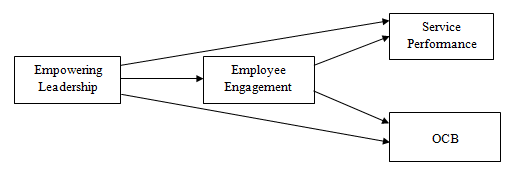
Therefore, this study is conducted with the aims of investigating (i) the linkage between empowering behavior of the leaders and employee outcomes (service performance and OCB) and (ii) employee engagement considered as mediator among leader' empowering behavior and employees' related job outcomes. This study will, thus contribute, by studying the linkage between empowering behavior of leader, employee engagement and employee outcomes (service performance and OCB).
Literature Review
The empowering leadership as one of the influential style of leadership based upon motivating employees through empowering them, which is likely to be pertinent to job-related behaviors of employees as stated by Arnold et al., (2000) and Ahearne, et al., (2005). Various researchers have reported favorable relationship of employees' perceptions of their leaders' empowering behavior with different employee related outcomes such as task performance (Ahearne et al., 2005) and creativity (Zhang & Bartol, 2010), turnover intentions and affective commitment (Chen et al., 2011). The empowering leadership primarily emphases on the meaningfulness and significance of task, showing confidence in subordinates by giving them autonomy in order to get maximum outcomes (Ahearne et al., 2005). The existing research study proposes that managers' empowering behavior has favorable impact on employee outcomes (service performance and OCB). Service performance is employees' behavior towards customers while serving those (Liao et al., 2009). Customer contact employees are considered as "face" of the organization because their behavior while serving employees causes long lasting impact on customers (Bettencourt et al. 2001). Such behavior results in superior service quality and translated into favorable customer outcomes like customer satisfaction and loyalty (Riaz & Mahmood, 2017; Subramony & Pugh, 2015).
This study claims, when employees' feel that their supervisor empowers them by exhibiting empowering leadership behavior, they reciprocate in form of superior service performance and engaging themselves in discretionary behaviors more frequently (Bettencourt & Brown, 1997). Therefore, leaders' empowering behavior enhances employees' perceptions of efficacy, motivation, trust and leader's confidence in them to engage in behaviors beneficial for organization especially superior service performance and discretionary behaviors at work (Auh, Menguc, & Jung, 2014). Based upon empowerment literature, it may be argued that when a leader is engaged and inclined to empowering subordinates, he/ she tries to add more autonomy of decision making through creating meanings to subordinates' jobs. Upon receipt of such enriching experiences, they will be involved more in the behaviors associated with servicing customers. Extant literature on empowering leadership and employee outcomes indicated that researchers made attempts to investigate this relationship. For instance, Sharma and Kirkman, (2015) investigated the relationship of empowering behavior of leaders with followers' job performance and reported that these constructs were related positively. Likewise, Zhang and Bartol (2010) in their research study reported that leaders' empowering behavior and creativity of the subordinates were positively related to each other. Moreover, recently, Wang, Demerouti, and Le-Blanc, (2017) empirically found a positive and significant association between managers' engagement in empowering behavior and their subsequent task performance. Thus, based upon this discussion, this study proposes the following relationship for empirical analysis:
H1: Empowering leadership and employee service performance are positively related to each other.
Further, based upon empowerment theory, this study also proposes that employees' perceptions of empowering behavior of their leaders increase their involvement in discretionary behaviors which are considered as cause of competitive advantage for organizations. This present research study maintains that the engagement of managers' into empowering behavior creates organizational environment in which employees demonstrate prosocial behavior more frequently. The term "organizational citizenship behavior (OCB)" was firstly introduced and explained in literature by Organ in 1980 which was refined and strengthened with the passage of time. As discussed by Organ (2006) in his research study, organizational citizenship behavior delimits as "individual behavior that is discretionary, and is not directly or explicitly recognized by the formal reward system, and, in the aggregate, promotes the efficient and effective functioning of the organization." Moreover, Ma, Qu and Wilson (2016) stated that the discretionary behaviors increased organizational effectiveness and efficiency by promoting employees discretionary behaviors at work which ultimately led towards favorable customer-related outcomes.
Although researchers have investigated the linkage between the empowering behavior of the managers and their employees' job performance (Arnold et al., 2000; Ahearne et al., 2005; Zhang & Bartol, 2010), limited scientific investigations have been focused on studying the influence of empowering behavior of the managers on discretionary behaviors of their follower employees (Park 2016). Podsakoff et al. (2000) also argued that social exchange could be used to understand the relationship between leaders' support and empowerment and employees OCB. Recently, Park (2016) concluded that empowering leadership had positive association with the OCB among the employees of social welfare organization operating in Korea. Based upon the discussion, this study hypothesizes that employees' perceptions of leader's empowering behavior positively influence their subsequent citizenship behavior. Thus, following hypothesis has been developed for empirical investigation:
H2: Empowering leadership and organizational citizenship behavior (OCB) are positively related to each other.
Further, this study also claims that employee engagement is the intermediary mechanism which can explain empowering behavior of the leaders and employee outcomes linkage (service performance and OCB). This study explains and carried out on the conceptualization of employee engagement by Khan (1990, 1992) as being the most comprehensive, and agreed to by the researchers in the area of organizational studies (Rich et al. 2010; Christian et al., 2011). According to Khan (1990), employee engagement exhibits "the simultaneous employment and expression of a person's 'preferred self' in task behaviors that promote connections to work and to others, personal presence (physical, cognitive, and emotional), and active, full performances".
Leaders' behavior has a critical role in enhancing employees' engagement (Zhu et al., 2009; Tuckey et al., 2012; Mohammed et al., 2013). Therefore, it could be argued that leaders' empowering behavior increases the engagement of the workforce by taking the ownership of their jobs and resultantly exerting more energy while fulfilling their job responsibilities. Such empowering behavior of leaders motivates the followers to understand meaningfulness of their work and raise their high energy level. As a result, employee engagement emerges due to high motivation and energies along with strong identification of followers' affiliation with their work that they perform at workplace (Schaufeli & Bakker, 2004). In addition to this, Khan (1990) argued that employees remain more engaged in their workplaces when they clearly know and identify their work boundaries distinctively. Similarly, feelings of engagement increase when leader shows empowering behavior by recognizing followers' self-worth and work roles through information sharing (Ford and Fottler, 1995). Similarly, Tuckey et al., (2012) reported that empowering behavior of the leader in fire brigade organization increased the engagement level of their employees. Similarly, Bakar (2013) also concluded that empowerment leadership affected the engagement level of their subordinates through showing concerns towards employees' work and personal needs. Moreover, Saks and Gruman (2014) argued that empowerment behavior of leader's effects employee engagement towards work, group/ teams and organization through the psychological conditions and job demands and resources. Finally, recently, Park, et al., (2017) also concluded that empowerment leadership behavior of managers enhanced the engagement level of the followers along with their psychological well-being.
Further, Kahn (1992) argued that employees' engagement leads to favorable employee outcomes (task performance, satisfaction, commitment and so on) which, subsequently, influences organizational outcomes (productivity, growth, profitability and efficiency). There could be many explanations for the existing relationship between employees' engagement and favorable employee outcomes. The simplest is the feeling of engagement as a result of positive state of mind and work related experience (Schaufeli & Bakker, 2004; Sonnentag, 2003) which leads to better health and increased performance (Sonnentag, 2003). Schaufeli and Bakker (2004) argued that employees who were more engaged at workplace exhibited greater commitment with their employers and their involvement in discretionary behaviors more frequently. Next, according to social exchange, when the employer and employees, both, follow the social exchange, it results in more trustworthy and loyal relations (Cropanzano & Mitchell, 2005). Consequently, the employees, more engaged in their workplaces, exhibit more favorable behaviors towards the customers and also involved more frequently in discretionary behaviors. Thus, based upon above arguments and discussion, following hypotheses are developed for empirical testing:
H3: Employee engagement acts as mediating factor between the association of empowering leadership and service performance.
H4: Employee engagement also acts as mediating factor between the relationship of empowering leadership and organizational citizenship behavior (OCB).
Methodology
Population, Sample and Procedure
For this research, data were collected from 970 (74.6%) officer grade employees working in commercial banks operating in Pakistan. Main cities of all the four provinces (Karachi, Hyderabad, Multan, Faisalabad, Lahore, Rawalpindi, Islamabad, Quetta, Peshawar and Abbottabad) were selected which constituted almost 70% of the total banking sector operating in Pakistan. Data was gathered through self-administered questionnaires for this study. In terms of gender, 737 (75.98%) of the employees were male and remaining 233 (24.02%) were female. Out of 970 employees, 82 (8.45%) belonged to the age group of up to 24 years, 513 (52.87) belonged to 25-34 years category, 322 were between 35-44 years of age group and the remaining 53 (5.46%) were the employees who belonged to 45 years and above. Further, in terms of salary range, 337 (34.74%) earned upto 30,000 PKR, 274 (28.24%) had salary ranging from 30,001 - 50,000 PKR, 82 (8.45%) belonged to salary range of 50,001 to 70,000 PKR, 75 (7.73%) were those who were earning between 100,001 - 150,000 PKR and remaining 12 (1.23%) earned above 150,000 PKR. Next, with reference to education, 229 (23.60%) employees had a bachelor's degree (14 years of education) or below, 698 (71.95%) had 16 years of education and remaining 43 (4.43%) had 18 years of education and above. Out of 970 employees, 834 (85.97%) employees were permanent employees, 95 (9.79%) were contractual employees and remaining 41 (4.33%) had third party employment. Finally, in terms of employment tenure, 183 (18.87%) employees had a total of up to two years of experience, 384 (39.59%) were those who had 03 - 07 years of tenure with their current employer, 304 (31.34%) belonged to 8 - 13 years of experience category and remaining 99 (10.21%) employees were those who had spent14 years or above with their current employer.
Measurement Instruments
This study adopted measurement scales used for the previous published studies to address the validity issues of measuring scale for this study. 5 point Likert scale being the renowned method ranging from 5 denotes as "completely agree" to 1 denotes as "completely disagree" was used to record the responses on the variables of study. The appended section describes about detail of each measurement scale used in this study.
Empowering Leadership
Leader's empowerment behavior was gauged using 12-items scale adopted by research study done by Ahearne, et al. (2005). Items of scale include "My manager helps me to understand how my job fits into the bigger picture". The reliability result of this scale for current study was 78.
Employee Engagement
To measure the employee engagement level of respondents who participated in the current research study, 18-items scale developed and empirically tested by Rich et al., (2010) was adopted to get responses from the banking sector employees accordingly. Sample item for this construct includes "I work with intensity on my job". The reliability of this adopted scale for current research study was .93.
Service Performance
To gauge service performance behavior of the employees, a 7-item scale was taken from Liao and Chuang (2004). For this variable, sample item was like: "I am friendly and helpful to customers". The reliability result of this scale for current study was .88.
Organizational Citizenship Behavior (OCB)
A 24-items scale developed by Podsakoff et al. (1990) was used to gauge the citizenship behavior of the employees having sample statement like: "I help others who have heavy workloads". The reliability of aforesaid scale observed 0.83.
Control Variables
This study used age, gender and job tenure of the employees as control variables as suggested in previous studies (e.g. Kim, Beehr & Prewett, 2018). The effects of these variables were controlled in analysis to eliminate any biasness in the results caused by these variables.
Data Analysis and Results
In this research study, descriptive statistics applied to present the values of mean and standard deviation of the variables. Cronbach's Alpha was used to ensure reliability of the key constructs used in this study along with correlation among study variables. In the end, hierarchical regression applied to test the proposed relationships among the variables of the study.
Descriptive Statistics, Reliability and Correlation Analysis
Table 1 represents the results of descriptive statistics, reliability analysis and the correlations among the constructs of the study. It has observed that mean age of the participating banking sector employees was 32.50 years, whereas, their average job tenure of service with current employer was 3.75 years. All the reliability results were well above the cutoff value i.e. 0.70 (Nunnally, 1978) representing that there is no issue of reliability in this study. In the last, all the correlation analysis values among the key variables of the study were found to be significant at one percent significance level.
Table 1. Descriptive Statistics, Reliability Alpha and Correlation Results
| S.No | Variables | Mean | SD | Alpha | 1 | 2 | 3 | 4 | 5 | 6 |
| 1 | Gender | - | - | - | ||||||
| 2 | Age | 32.50 | 6.60 | - | - | |||||
| 3 | Tenure | 3.75 | 3.24 | - | .16** | .47** | ||||
| 4 | EmpLead | 3.89 | .46 | .78 | .11** | .15** | .13** | |||
| 5 | EmpEng | 4.30 | .51 | .93 | -.02 | .11** | .07* | .35** | ||
| 6 | ServPerfo | 4.32 | .53 | .88 | .01 | .12** | .07* | .37** | .54** | 6. ServPerfo |
| 7 | OCB | 4.09 | .45 | .86 | .01 | .09** | .04 | .38** | .62** | .61** |
Notes. Age and tenure in years;
* p <0.05. ** p <0.01.
Hypotheses Testing
The current research study hypothesizes that leader's empowering behavior is positively related to service performance (H1) and OCB (H2) of the employees. In addition to this, this study also proposes that employee engagement acts as mediating mechanism for the relationship between empowering leadership and service performance (H3). In the last, this study also postulates that the relationship between empowerment behavior of the leaders and OCB is mediated by employee engagement (H4).
Model 1 for service performance in Table 2 represents that empowering leadership has significant positive relationship (β = .41, p < .01) with service performance of banking employees which substantiates the first hypothesis of the study. The results reported in Table 2 indicate that one unit increase in empowering behavior of the manager would increase .41 units increase in service performance behaviors of the employees. Next, the results reported in Model 1 for OCB given in Table 2, indicate that empowering behavior of leaders has significant positive relationship (β = .37, p < .01) with the organizational citizenship behavior of the employees. These findings demonstrate that one unit increase in empowering behavior of leader would increase 0.37 units of OCB.
Table 2. Hierarchical Regression Results
Variables | Service Performance | Organizational Citizenship Behavior | ||||||
Model 1 | Model 2 | Model 3 | Model 4 | Model 1 | Model 2 | Model 3 | Model 4 | |
| Age | -.06 | -.10** | .01 | -.02 | -.05 | -.10** | .02 | .01 |
| Gender | .06* | .06* | .04 | .03 | .04 | .06* | .01 | .01 |
| Tenure | -.01 | .00 | .01 | -.01 | -.02 | .00 | -.01 | -.02 |
| EmpLead | .41** | .39** | .23** | .37** | .39** | .18** | ||
| EmpEng | .56** | .49** | .55** | .49** | ||||
| Adj R2 | .14 | .13 | .29 | .33 | .14 | .13 | .38 | .41 |
| Δ R2 | .13 | .12 | .28 | .31 | .13 | .12 | .37 | .40 |
| F Value | 39.3** | 27.3** | 100.4** | 93.8** | 40.2** | 27.3** | 150.5** | 134.9** |
Notes. Age and tenure in years;
* p <0.05. ** p <0.01.
Furthermore, the study proposes that employee engagement mediates the association of empowering leadership with service performance (H3) and OCB (H4). To test proposed mediating relationships of the study, we used the process prescribed by baron and kenny (1986). According to them, in first step, the predictor (empowering leadership) must be significantly related to the dependent variable (service performance and OCB). Secondly, independent variable (empowering leadership) should be related to mediator (employee engagement). Next in the third step, the mediator (employee engagement), should be significantly related to outcome variables (service performance and OCB). In last step, upon adding independent variable (empowering leadership) and mediator (employee engagement) simultaneously, in the regression equation, either effects of independent variable (empowering leadership) become insignificant indicating full mediation or there is decrease in effects of independent variable, but, however, remain significant known as partial mediation.
First, investigating mediation of employee engagement for empowering leadership and service performance linkage, the results of H1 of the study as indicated in Model 1 of Table 2 indicated that empowering leadership was significantly related to service performance of the employees (fulfilled the first condition of mediation analysis). Next, for step 2, results of Model 2 in Table 2 reflected that empowering leadership was positively related (β = .39, p < .01) to employee engagement, the mediator, of the employees. For fulfilling the 3rd condition of mediation analysis, the study also found that employee engagement was positively related (β = .56, p < .01) to service performance of the employees (Model 3, Table 2). In the last step (Model 4 in Table 2), when both the empowering leadership and employee engagement both simultaneously entered into regression, the effects of empowering leadership reduced (from β = .41 to β = .23) but remained significant indicating partial mediation. Collectively, these findings empirically supported H3 of the study and indicated that employee engagement acted as mediating mechanism to explain the relationship pf empowerment behavior of manager and employee service performance.
Lastly, for investigating mediation of employee engagement regarding empowering leadership and OCB relationship, the results of H2 already indicated that empowering leadership was significantly related to OCB of the employees (fulfilled the first condition of mediation analysis). Next, for step 2, results of Model 2 in Table 2 reflected that empowering leadership was positively related (β = .39, p < .01) to employee engagement, the mediator, of the employees. For fulfilling the 3rd condition of mediation analysis, the study also found that employee engagement was positively related (β = .55, p < .01) to OCB (Model 3, Table 2). In the last step (Model 4 in Table 2), when both the empowering leadership and employee engagement were simultaneously entered into regression, the effects of empowering leadership reduced (from β = .39 to β = .18) but remained significant indicating partial mediation. Collectively, these findings provided empirical support to the H4 of the study and indicated that employee engagement mediated the relationship between empowerment behavior of leaders and OCB.
Discussion about Results
The aim of this study was to investigate empowering leadership behavior and employee outcomes (service performance and organizational citizenship behavior; OCB) relationship. Further, this study also proposes that employee engagement mediate the relationship between empowering leadership and employee outcomes. Findings of the study revealed that empowering leadership behavior positively influenced the service performance behavior of the employees working in the banking industry. Employees' service related behavior was considered vital for favorable customer outcomes through superior service quality (Riaz & Mahmood, 2017; Subramony & Pugh, 2015). These findings provided additional empirical support to the studies concluded that empowerment behavior of the leader influenced employees' task performance related behaviors in their workplaces (e.g. Arnold et al., 2000; Ahearne, et al., 2005; Wang et al., 2017). In addition to this, the study results also proposed that empowering leadership positively influenced the discretionary behavior of employees. Study results confirmed the fact that perceptions of empowering leadership behavior of managers also encourage employees to engage in the behaviors, which are beyond their job description, but caused much favorable impact on organizational effectiveness. Overall, these results indicate that managers' behavior of empowering subordinates influence them favorably by improving their behavior while servicing customers and also engaging in discretionary behaviors more frequently which is eventually, vital to achieve competitive advantage (e.g. Podsakoff et al., 2000).
Moreover, based upon the recommendations of the researchers to investigate the mediating mechanisms for ascertaining the linkage between empowering behavior of leaders and employee outcomes, this study also proposes employee engagement as a medium to explain the linkage between empowerment leadership of the manager and the employee outcomes (service performance and OCB). Findings of the study demonstrated that employee engagement partially mediated the linkages of empowering leadership with (i) service performance and (ii) OCB. These results of the study are consistent with the arguments of the researchers that employees remain more engaged as a result of leaders' empowering behavior which ultimately leads towards favorable employee outcomes (Park, et al., 2017), service performance and OCB in case of this study. However, the findings of the study are different from the afore-mentioned study in way that this study has considered specific service behavior of the employees and OCB.
The findings of the study have been added to literature about empowering leadership behavior and its effects on employee outcomes in many ways. For instance, the study proposed and empirically tested the linkage between empowering behavior of managers and employee outcomes (service performance and OCB) along with the employee engagement as mediating mechanism to explain these direct relationships. Based upon data collected from 970 officer ranked employees working in the banking industry of Pakistan, the study concluded that empowering behavior of the managers positively influence service performance and OCB of employees. Further, the findings also concluded that employee engagement was a mean through which the effects of empowering leadership behavior were being transmitted to employee outcomes.
Implications of the study
The findings of the study involve several implications in the literature about the relationship of empowering behavior of the leader and the employee outcomes. First, the study considered service performance behavior and OCB of the employees while investigating empowerment leadership and employee outcome relationship. These employee outcomes are vitally important for competitive advantage for service organizations but less explored in the case of empowering leadership and employee outcomes relationship. In this way, this study also generated empirical evidence of positive relationship between leaders' empowering behavior and employee outcomes, whereas, previous researches explored mixed findings (Netemeyer et al., 1997; Seibert et al., 2011; Hao, et al., 2018). This study also contributed to the debate regarding the mediating mechanisms between empowering leadership and employee outcomes (Kim, et al., 2018) by proposing and empirically testing the mediating role of employee engagement for the said relationship. Collectively, this study also contributed to the literature by proposing and empirically testing the relationship of empowering leadership, employee engagement, service performance and OCB.
Along with contributions for literature, this research also suggests many important suggestions for organizations and practitioners. First, managers, being leaders, could enhance the service performance and discretionary behaviors of the employees. Service performance behavior is considered critical for favorable customer-based outcomes through superior service delivery ((Riaz & Mahmood, 2017; Subramony & Pugh, 2015), whereas OCBs play important role for organizational effectiveness and competitive advantage (Podsakoff et al., 2000). Next, this study pointed out that leaders should focus on employee engagement through their empowering behavior to influence their subsequent behaviors (service performance and OCB). In other words, empowering behavior of the leaders intrinsically motivates through developing a sense of meaningfulness and empowerment through empowerment leadership to enhance the engagement level of the employees which leads to favorable behaviors of employees while serving customers, and more frequent discretionary behaviors. Last not the least, organizations should make efforts to inculcate the empowering behavior of the managers while leading employees through training and development and rewards.
Conclusion
This research was envisaged and undertaken with the objective of investigating the (i) association of empowering leadership with employee outcomes (service performance and OCB) and (ii) mediating role of employee engagement for the linkage between empowering leadership behavior and employee outcomes. Empirical findings of the study confirmed all direct and indirect relationships of the study. Findings of the study contributed to the literature of empowering leadership and its effects on employees by empirically testing the linkage of empowering leadership, employee engagement and employee outcomes. Specifically, the results indicated that empowering leadership behavior was directly related to employee outcome, and employee engagement mediated the direct association between managers' empowering behavior and employee outcomes.
Limitations and Future Prospects for Research
Although this research embodies many benefits and implications for literature, and practitioners, like all other scientific investigations, this study also has some limitations, which could be considered, in the future studies for advancement of the research. First and most common limitation in the area of organizational studies that, in the current study, cross sectional design has been used which alerts the causal relationship among the study variables. Second, this study has empirically tested one mediating variable (i.e. employee engagement) to explain the relationship of empowering leadership and employee outcomes. Based upon different theoretical lens and perspectives, like empowerment and motivation paths to understand the effects of empowering leadership on employees, future researchers could explore more mediating processes to explain this relationship. Lastly, this study considered banking sector of Pakistan and, therefore, more future research efforts are needed in different cultural and industrial settings to validate and extend the findings of present study in different cultures and other industries.
References
- Ahearne, M., Mathieu, J., & Rapp, A. (2005). To empower or not to empower your sales force? An empirical examination of the influence of leadership empowerment behavior on customer satisfaction and performance. Journal of Applied Psychology, 90(5), 945-955.
- Amundsen, S., & Martinsen, O. L. (2015). Linking empowering leadership to job satisfaction, work effort, and creativity: The role of self-leadership and psychological empowerment. Journal of Leadership & Organizational Studies, 22, 304-323.
- Arnold, J. A., Arad, S., Rhoades, J. A., & Drasgow, F. (2000). The empowering leadership questionnaire: The construction and validation of a new scale for measuring leader behaviors. Journal of Organizational Behavior, 22, 249-269.
- Auh, S., Menguc, B., & Jung, Y. S. (2014). Unpacking the relationship between empowering leadership and service-oriented citizenship behaviors: A multilevel approach. Journal of the Academy of Marketing Science, 42(5), 558-579.
- Avolio, B. J., Zhu, W., Koh, W., & Bhatia, P. (2004). Transformational leadership and organizational commitment: Mediating role of psychological empowerment and moderating role of structural distance. Journal of Organizational Behavior, 25(8), 951-968.
- Bakar, R.A. (2013). Understanding factors influencing employee engagement: A study of the financial sector in Malaysia. Unpublished doctoral dissertation, RMIT University, Melbourne.
- Baron, R. M., & Kenny, D. A. (1986). The moderator–mediator variable distinction in social psychological research: Conceptual, strategic, and statistical considerations. Journal of Personality and Social Psychology, 51(6), 1173.
- Bettencourt, L. A., & Brown, S. (1997). Contact employees: Relationships among workplace fairness, job satisfaction, and pro-social service behaviors. Journal of Retailing, 73(1), 39–61.
- Chen, G., Sharma, P. N., Edinger, S. K., Shapiro, D. L., & Farh, J. L. (2011). Motivating and demotivating forces in teams: Cross-level influences of empowering leadership and relationship conflict. Journal of Applied Psychology, 96(3), 541–557.
- Christian, M. S., Garza, A. S., & Slaughter, J. E. (2011). Work engagement: A quantitative review and test of its relations with task and contextual performance. Personnel Psychology, 64(1), 89–136.
- Cropanzano, R., & Mitchell, M. S. (2005). Social exchange theory: An interdisciplinary review. Journal of Management, 31(6), 874–900.
- Ford, R. C., & Fottler, M. D. (1995). Empowerment: A matter of degree. The Academy of Management Executive, 9(3), 21–29.
- Gyu Park, J., Sik Kim, J., Yoon, S. W., & Joo, B. K. (2017). The effects of empowering leadership on psychological well-being and job engagement: The mediating role of psychological capital. Leadership & Organization Development Journal, 38(3), 350-367.
- Hao, P., He, W., & Long, L. R. (2018). Why and when empowering leadership has different effects on employee work performance: The pivotal roles of passion for work and role breadth self-efficacy. Journal of Leadership & Organizational Studies, 25(1), 85-100.
- Kahn, W. A. (1990). Psychological conditions of personal engagement and disengagement at work. Academy of management journal, 33(4), 692-724.
- Kahn, W. A. (1992). To be fully there: Psychological presence at work. Human Relations, 45(4), 321-349.
- Kim, M., Beehr, T. A., & Prewett, M. S. (2018). Employee responses to empowering leadership: A meta-analysis. Journal of Leadership & Organizational Studies, 1548051817750538.
- Li, N., Chiaburu, D. S., & Kirkman, B. L. (2017). Cross-level influences of empowering leadership on citizenship behavior: Organizational support climate as a double-edged sword. Journal of Management, 43(4), 1076–1102.
- Li, S. L., He, W., Yam, K. C., & Long, L. R. (2015). When and why empowering leadership increases followers’ taking charge: A multilevel examination in China. Asia Pacific Journal of Management, 32, 645–670.
- Liao, H., Toya, K., Lepak, D. P., & Hong, Y. (2009). Do they see eye to eye? Management and employee perspectives of high-performance work systems and influence processes on service quality. Journal of Applied Psychology, 94(2), 371–391.
- Ma, E., Qu, H., & Wilson, M. (2016). The affective and dispositional consequences of organizational citizenship behavior: A cross-cultural study. Journal of Hospitality & Tourism Research, 40(4), 399–431.
- Yasin Ghadi, M., Fernando, M., & Caputi, P. (2013). Transformational leadership and work engagement: The mediating effect of meaning in work. Leadership & Organization Development Journal, 34(6), 532–550.
- Netemeyer, R. G., Boles, J. S., McKee, D. O., & McMurrian, R. (1997). An investigation into the antecedents of organizational citizenship behaviors in a personal selling context. The Journal of Marketing, 85-98.
- Nunnally, J. C. (1978), Psychometric Theory, New York: McGraw-Hill.
- Organ, D. W. (1988). Organizational citizenship behavior: The good soldier syndrome. Lexington, MA: Lexington Books.
- Organ, W. D. (2006). Treating employees fairly and OCB: Sorting the effect of job satisfaction, organizational commitment and procedural justice. Plenum Publishing Corporation: USA.
- Park, Y. H. (2016). The effects of empowering leadership on organizational citizenship behavior: Focusing on mediation effects of self-efficacy. Journal of the Korea Society of Computer and Information, 21(5), 185–191.
- Podsakoff, P. M., MacKenzie, S. B., Moorman, R. H., & Fetter, R. (1990). Transformational leader behaviors and their effects on followers' trust in leader, satisfaction, and organizational citizenship behaviors. The Leadership Quarterly, 1(2), 107–142.
- Podsakoff, P. M., MacKenzie, S. B., Paine, J. B., & Bachrach, D. G. (2000). Organizational citizenship behaviors: A critical review of the theoretical and empirical literature and suggestions for future research. Journal of Management, 26, 513–563.
- Raub, S., & Robert, C. (2010). Differential effects of empowering leadership on in-role and extra-role employee behaviors: Exploring the role of psychological empowerment. Human Relations, 63, 1743–1770.
- Rich, B. L., Lepine, J. A., & Crawford, E. R. (2010). Job engagement: Antecedents and effects on job performance. Academy of Management Journal, 53(3), 617–635.
- Schaufeli, W.B. and Bakker, A.B. (2004). UWES (Utrecht Work Engagement Scale): Test manual. Unpublished manuscript, Department of Psychology, Utrecht University, Utrecht.
- Schaufeli, W. B., & Bakker, A. B. (2004). Job demands, job resources, and their relationship with burnout and engagement: A multi‐sample study. Journal of Organizational Behavior, 25(3), 293-315.
- Seibert, S. E., Wang, G., & Courtright, S. H. (2011). Antecedents and consequences of psychological and team empowerment in organizations: A meta-analytic review. Journal of Applied Psychology, 96(5), 981–1003.
- Sharma, P. N., & Kirkman, B. L. (2015). Leveraging leaders: A literature review and future lines of inquiry for empowering leadership research. Group & Organization Management, 40(2), 193–237.
- Sonnentag, S. (2003). Recovery, work engagement, and proactive behavior: A new look at the interface between non-work and work. Journal of Applied Psychology, 88(3), 518-528.
- Subramony, M., & Pugh, S. D. (2015). Services management research review, integration, and future directions. Journal of Management, 41(1), 349–373.
- Tuckey, M. R., Bakker, A. B., & Dollard, M. F. (2012). Empowering leaders optimize working conditions for engagement: A multilevel study. Journal of Occupational Health psychology, 17(1), 15-27.
- Wang, H., Demerouti, E., & Le Blanc, P. (2017, November). A job crafting perspective on empowering leadership and job performance. In Academy of Management Proceedings. Academy of Management Briarcliff Manor, NY 10510.
- Zhang, X., & Bartol, K. M. (2010). Linking empowering leadership and employee creativity: The influence of psychological empowerment, intrinsic motivation, and creative process engagement. Academy of Management Journal, 53(1), 107-128.
- Zhu, W., Avolio, B. J., & Walumbwa, F. O. (2009). Moderating role of follower characteristics with transformational leadership and follower work engagement. Group & Organization Management, 34(5), 590-619.
Cite this article
-
APA : Ghani, U., Masood, M. T., & Rehman, Z. U. (2018). Empowered Leadership and Employee Outcomes: Mediating Role of Employee Engagement. Global Social Sciences Review, III(II), 301-318. https://doi.org/10.31703/gssr.2018(III-II).17
-
CHICAGO : Ghani, Usman, Muhammad Tahir Masood, and Zia Ur Rehman. 2018. "Empowered Leadership and Employee Outcomes: Mediating Role of Employee Engagement." Global Social Sciences Review, III (II): 301-318 doi: 10.31703/gssr.2018(III-II).17
-
HARVARD : GHANI, U., MASOOD, M. T. & REHMAN, Z. U. 2018. Empowered Leadership and Employee Outcomes: Mediating Role of Employee Engagement. Global Social Sciences Review, III, 301-318.
-
MHRA : Ghani, Usman, Muhammad Tahir Masood, and Zia Ur Rehman. 2018. "Empowered Leadership and Employee Outcomes: Mediating Role of Employee Engagement." Global Social Sciences Review, III: 301-318
-
MLA : Ghani, Usman, Muhammad Tahir Masood, and Zia Ur Rehman. "Empowered Leadership and Employee Outcomes: Mediating Role of Employee Engagement." Global Social Sciences Review, III.II (2018): 301-318 Print.
-
OXFORD : Ghani, Usman, Masood, Muhammad Tahir, and Rehman, Zia Ur (2018), "Empowered Leadership and Employee Outcomes: Mediating Role of Employee Engagement", Global Social Sciences Review, III (II), 301-318
-
TURABIAN : Ghani, Usman, Muhammad Tahir Masood, and Zia Ur Rehman. "Empowered Leadership and Employee Outcomes: Mediating Role of Employee Engagement." Global Social Sciences Review III, no. II (2018): 301-318. https://doi.org/10.31703/gssr.2018(III-II).17