
Abstract
The present investigation was conducted aimed to investigate the relationship of proactive personality and careerism. The said relationship was not tested in isolation: rather it has been tested with the inclusion of career self-efficacy as a mediator and two moderators (openness to experience, extroversion). It was basically an attempt to build/ analyze the relationship of proactive personality with careerism which was not fully captured in the previous literature. In addition, the current study conducted a comparative analysis for male and female to identify the proactive behaviors in handling their careers. The population for the current study was selected from different private FMCG related firms. The analysis revealed that proactive personality has a significant relationship with careerism. Female respondents report lower proactive behavior than male. Overall the results supported three hypotheses and the one related to moderation was rejected.
Keywords
Proactive Personality; Career Self -Efficacy; Extroverts, Openness to Experience; Gender and Careerism.
Introduction
The concept of careerism relates to individual employees who are continuously changing their jobs/ organizations for achieving their career-related goals . However, researchers such as Rousseau, (1990) defined careerism as a useful tool for an individual in getting the desired employment relationship. Such individuals (high careerist) perceive their employer as an instrumental stepping-stone and they opt mostly for a transactional relationship with their employers. Such a relationship is based on the transaction so they have a short-term focus (Bandura, 2006). Disparity high and low careerists, and low careerists have a focus on a more relational approach. The individuals with low careerism tendencies have the faith that they have to be loyal with their organization for a longer period of time and the organization is solely responsible for setting their career path. The thoughts can differ from department to department and organization to organization. The study of Pitt et al., (2002) identified the sales department as a backbone of any organization, where salespeople are mostly more proactive towards their careers with respect to others. So, it is necessary for the organization to identify these potential proactive employees and give them opportunities to accelerate in their careers within the organization rather than leaving the organization for a better career. This concept is seen in the employees working in the organizations coming under the Fast Moving Consumer Goods industry of Pakistan like Angro Foods, Dostea, nestle and Communicator Globe especially in the sales department.
In the recent era, the concept is growing significantly that employee initiatives about their career and proactivity are critical drivers for the effectiveness or non-effectiveness of any organizations. Moreover, the organizations are unable to motivate and retain their talented employees, and also due to job boredom they procrastinate which affects the productivity of the organization. It has been observed largely that employees working in sales and marketing departments of an organizations are more effective for the organization and they are more career-oriented so the switching behavior also exists: thus the organizations need to identify the factors and relationships which are helpful for retaining such employees . Owing to the fast-growing competition and easy availability of workforce, the organizations are focusing more on the growth of the business rather than on the career development of employees.
The rationale for selecting the sales and marketing department of the FMCG industry is owed to the high attrition rate and easy employability of such employees in other organizations. Furthermore, proactive behavior is more witnessed in the sales and marketing department as these individuals have the ability to change the current circumstances which impact their situation, both personally and professionally (Bateman & Crant, 1993). The present study is also taking the actual data of employees switching from one organization to another for betterment and achievement of career-related goals. After conducting interviews with the General Manager (Sales) of Communicate Globe Pakistan we came to know that 150 Business Development Officers (BDOs) left the company and joined another company (Engro Foods) at a higher salary and higher grade as Territory Manager (T.M) during the year of 2014-2015.
Literature Review
Proactive Personality and Careerism
Proactive personality is the concept which is a complex and multiple caused construct (Crant, 2000) with various positive and negative consequences at the organizational as well as a personal level. It is basically a belief of individuals in their own abilities which can help to deal with the uncertain environment prevailing in the scenario (Bateman & Crant, 1993) according to their own success. The concept of proactivity is opposing the passive tendencies of an individual, and rather it has focused on active tendencies. An employee with proactive behavior analyzes the situation and environment and acts, initiates and implements the change for betterment. So, it is an important and considerable behavior of an individual with the capacity to change and survive in a competitive environment. Some previous research associated with the proactive personality defined some career outcomes i.e. promotion and satisfaction in a career (Seibert et al., 2001) with the successful job search. Grant (2000) defined that the proactive personality has positive consequences related to individual job performance, satisfaction and success in career. Moreover, this behavior or personality can work as a guiding mechanism to maintain the relationship and challenge the environment which can cause positive outcomes for an individual who is showing the proactive behavior/ personality. It can provide guidance to an individual to opt for a career and manage their careers by their own rather wait for an organization's initiatives (Chiaburu et al., 2006). Allen, Weeks, & Moffitt (2005) provided a connection for defining the significant relationship between proactivity and careerism. Researchers such as Seibert et al. (2001) also concluded the research by presenting results which are supporting the proposed relationship.
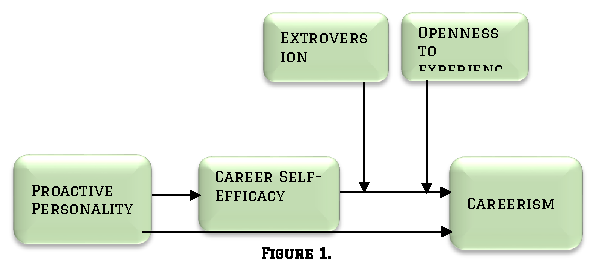
H1: Proactive personality is significantly related to careerism.
Based on some differences in traits or patterns researchers identified that males and females are having different personalities. For example, one of the researchers identified that females generally exhibit agreeable personalities as compared to males (Costa et al., 2001). Another research reported that not only western cultures but eastern cultures also have gender differences within personalities. The females are identified as less proactive than males specifically in career-related outcomes. Researchers also explained that males and femaleshave different personalities based on some traits. Due to some emotional bonding and some other traits, females' behavior is found less proactive and more inclined to reactivity. Based on the above studies and further conceptualization we formulated the first sub-hypothesis as below.
H1a: There is a significant difference in male and female proactive personalities.
In gender comparison, it was found that females would tend to utilize the strategies related to career management differently than males (Gould & Penley, 1984). Moreover, studies found that female involvement in careerism is complex as compared to men (Gould & Penley, 1984). Women generally hesitate for continuous switching from one organization to another. So, women are having lower tendencies to show careerist attitudes as compared to men. Especially in the country like Pakistan where society restricts women from jobs, and owing to gender stereotyping related to professional jobs, the ratio of females in certain jobs is low. So they try to retain their position in the organization rather than continuously switching for higher positions. Based on this argument we developed the second sub-hypothesis as below:
H1b: There is a significant difference between careerism in males and females.
Career Self- Efficacy
Hackett & Betz (1981) developed career self-efficacy theory where the researcher is providing a link of self- efficacy and behavior of an individual related to the career. The idea of having belief in one's abilities for performing a required behavior in giving situation is core component of Bandura's social learning theory which was later on known as social cognitive theory (Bandura, 2006).
The proactive individual plan smart goals to achieve their career targets. Career self -efficacy gives confidence to individuals about their career-related capabilities. Proactive people shape their environment rather than responding to it. Moreover, the career self- efficacy research found that such individuals possess the ability to find new opportunities for career grooming. It can predict many beginning career behaviors such as continuous job searching (Niles & Sowa, 1992) which relates to careerism. The above discussion provides justification of selecting career self -efficacy as a mediator in the relationship of proactive personality and careerism. It has also been used as a mediator by previous researchers (Niles & Sowa, 1992; Lent et al., 2002). Researcher also supports the mediating role of self-efficacy in individual behavior outcomes of proactive personality. Some other previous studies found some other variables i.e. perceived social support, barriers and career choice being significantly affected through self-efficacy (Lent et.al. 2002).
H2: Career Self- Efficacy mediates the relationship of Proactive Personality and Careerism.
Personality Traits as a Moderator
An individual's personality plays an important role in stabilizing one's mental world and management of external situations. Personality is commonly known as a structured system through which individuals organize themselves in a way to respond to a particular situation. In the late '80s personality was researched as a construct for quite some time. In the 1980s personality was understood in terms of five dimensions. These dimensions had some components like fun-loving, affectionate, sociability, talkative, friendly and the experience of joy and pleasure (Costa & McCrae, 1992). Openness as a personality trait has been interpreted in different ways such as intelligence and openness (Costa & McCrae, 1985). Later on Costa & Mccrae (1992) labeled openness as openness to experience. The individuals with openness to experience are imaginative, intellectually curious, depict flexible behavior, and are sensitive to art and having a complex emotional life. Such individuals are involved in searching for novelty and the individuals with openness to experience come up as strong predictors of careerism.
H3: Openness to experience moderates the relationship of Career Self -Efficacy and Careerism.
Extraversion with its facets appears to have a significant and positive relationship with career success. The individuals with this personality trait are fun-loving, friendly, talkative and sociable (Chiaburu et. al., 2013). Extrovert individuals tend to show more concerns for career success and such individuals are more careerist then others because they have the ability of human contact and can inspire others. Researchers (Seibert & Kraimer, 2002) have stated that people having an extravert personality score higher on career success. The researchers further explained that extraverts continuously exhibit self-confidence and seek out a career for gaining authority. They are generally involved and are more careerist than others because of their socialization ability. As they have good relations within the organization as well as outside the organization so they seek the opportunities related to their career and easily exploit these opportunities. Based on the above literature the proposed hypothesis can be stated as under:
H4: Extraversion moderates the relationship of Career Self -Efficacy and Careerism such that it strengthens this relation.
Research Methodology
Research Design
This present study is quantitative in nature and the data was collected in two different points of time. In the first phase, we collected the data of independent variable (Proactive Personality) with moderating variables of Openness to experience and extroversion. After a few weeks, we collected the data for careerism and career self- efficacy. The purpose of using this approach is to minimize the biasness and interrelatedness of variables. Moreover, a pilot study was conducted on a sample of 50 respondents to check the reliability of the instrument in our local context and all items reported reliability more than 0.8 which gave us confidence that the adopted instrument can be used in our eastern settings.
Population, Sample Size, Analysis Tools and Data Collection Techniques
The sample was taken from the private organizations operating in Islamabad and Rawalpindi e.g. communicator globe. The unit of analysis is individuals who left their parent organization to acquire higher positions in other organization. The sample size of the study was determined at one hundred and fifty (150).
Since the study's objective can be fulfilled through a selective unit of analysis that is why among all other sampling techniques the current study shortlisted a "Judgmental sampling technique" which has been identified as a relevant sampling technique useful for such types of studies. The said sampling technique permits the researchers to judge the population and conducts the data collection accordingly.
Measures
The questionnaire for Proactive Personality is taken from the study of Crant, J. M. (1995). This scale consists of 10 items with overall reliability of 0.80. A five item scale is adopted from Robinson, S. L., & Rousseau, D. M. (1994) ("careerism scale") to measure careerism. The reliability of this overall scale is 0.71. For measuring the career self -efficacy we adopted 05 items "self- efficacy expectations "scale of Anderson, S. L., & Betz, N. E. (2001), the reliability of this scale is 0.84. For measuring personality traits, we took the items from Goldberg, (1993) Big Five Inventory (BFI) scale and the reliability of this scale is calculated as 0.842.
Results
Demographic Analysis
Table 1 of demographic analysis displays the background information of participants participated in the current study.
| Table 1. Demographic Characteristics against respondents (N=150) | ||
Frequency | Percent | |
| Gender | ||
| Female | 75 | 50 |
| Male | 75 | 50 |
| Age | ||
| 20-30 (Years) | 143 | 95.3 |
| 31-40 (Years) | 7 | 4.7 |
| Tenure with Current Organization | ||
| Less than 5 Years | 141 | 94 |
| Greater than 5 Years | 2 | 1.3 |
| Less than 10 Years | 7 | 4.7 |
| Education | ||
| Intermediate | 4 | 2.7 |
| Bachelor | 9 | 6 |
| Master | 137 | 91.3 |
| No of the organization served | ||
| 01 Organization | 17 | 11.3 |
| 02 Organization | 72 | 48 |
| 03 Organization | 35 | 23.3 |
| 04 Organization | 26 | 17.3 |
Normality of the Data
Table 2 depicts that the standard deviation of all items is less than the mean values. The kurtosis and Skewness values lie within the specified intervals which are +1 to -1 for Skewness and +3 to -3for kurtosis. Moreover, it is displaying the reliability values which are in the range of thresholds defined by the researchers.
Table 2. Descriptive Statistics to Check the Normality (N=150)
| Items | Mean | S D | Skewness | Kurtosis | Cronbach's Alpha |
| Proactive Personality | 3.46 | 0.73 | -0.32 | -0.22 | 0.903 |
| Careerism | 3.66 | 0.78 | -0.99 | 1.20 | 0.887 |
| Career Self Efficacy | 3.30 | 0.54 | -1.37 | 1.94 | 0.872 |
| Openness to Experience | 3.55 | 0.59 | 0.56 | -0.26 | 0.937 |
| Extroversion | 3.77 | 0.52 | 0.15 | 0.04 | 0.842 |
Multicollinearity Analysis
Table 3 of correlation analysis is showing the relationship between different variables. Researchers defined that if the correlation between the independent variables is between 0.40 and 0.70 it is acceptable to run the regression. The normality, reliability and Multicollinearity analysis of the data also allowed us to run regression analysis.
| Table 3. Correlations Analysis (N=150) | |||||
| Variables | 1 | 2 | 3 | 4 | 5 |
| 1. Proactive Personality | 1 | ||||
| 2. Career Self Efficacy | .412** | 1 | |||
| 3. Extroversion | .403** | .283** | 1 | ||
| 4. Openness to Experience | .698** | .359** | .505** | 1 | |
| 5. Careerism | .577** | .529** | .615** | .758** | 1 |
Compare Means of Male and Females
In order to test hypothesis H1a and H1b gender-wise comparative analysis was done by comparing the mean values as can be seen in table 5 using the method of Skaalvik & Skaalvik (2011)
Gender | N | Mean | Std. Deviation | |
| Proactive Personality | Male | 75 | 3.9780 | .44957 |
Female | 75 | 2.9387 | .57982 | |
| Careerism | Male | 75 | 3.9147 | .57720 |
Female | 75 | 3.4133 | .88246 |
H1a: There is a significant difference in males and females proactive personalities.
Mean Values are showing that there is a difference in the proactive personality of Male and Females, so the above-stated hypothesis is accepted.
H1b: There is a significant difference between careerism in males and females
Table 4 values showing that there is a minor difference in the intention of careerism in Male (3.91) and Female (Mean= 3.41). So, the above-stated hypothesis (H1b) is rejected.
H1: Proactive personality is significantly related to careerism is accepted as the values are (β= .462) at a significant level of 0.001. Same as the above table 5 is also showing that career self-efficacy is having the mediating role between proactive personality and careerism which is accepted.
| DV | IV on M | M on DV | Total | IV on DV | Bootstrap results | ||||||
| β | t. | Β | t. | Β | t. | Β | t. | LL 95% CI | UL 95% CI | ||
| Careerism | .302*** | 4.483 | .510*** | 4.138 | .617*** | 7.954 | .462*** | 5.787 | .068 | .276 | |
* p<0.05, ** p<0.01, *** p<0.001, No. of bootstrap resample = 5000, *IV =Proactive personality, M = Career Self Efficacy
β = -.583, P<= 0.01. Table also showing that there is no zero containing between the values (-.952, -.208), so moderating related variable is also accepted but the other moderator is rejected based on the values.
Dependent Variable: Careerism | Bootstrap results | |||
β. | t. | LL 95% CI | UL 95% CI | |
| Effect of CSE on Careerism | .476*** | 4.516 | .268 | .685 |
| Effect of Extroversion on Careerism | .729*** | 7.369 | .534 | .925 |
| Effect of CSE x Extroverts on Careerism | -.236 | -.868 | -.776 | .302 |
| Effect of CSE on Careerism | .179* | 2.005 | .002 | .357 |
| Effect of Openness on Careerism | .873*** | 13.938 | .749 | .997 |
| Effect of CSE x Openness on Careerism | -.583** | -3.048 | -.952 | -.208 |
* p<0.05, ** p<0.01, *** p<0.001, No. of bootstrap resample = 5000, CSE= Career Self Efficacy
Discussion
The study was conducted in the FMCGs related organizations found significant and positive results of proactive personality and careerism (H1). A meta-analysis in the recent past also suggested career success as an outcome of proactive personality (Fuller & Marler, 2009). As discussed earlier, the individuals working in the sales and marketing department of organizations generally have proactive personality and such individuals have the abilities to influence the environment or can change the environment. The current study results and analysis suggest that individuals with proactive personality have more involvement in careerism. FMCG related organizations have room and employment opportunities for the experienced sales force. Such organizations encourage the employees to join the organization and for this, the management of such organizations offers more benefits and higher positions, which proactive individuals take as an opportunity and join the organizations.
On the other hand, the results show that women report less proactive behavior than men (H1a). The reason being that Pakistani society is known as a male dominating society where females are less proactive because their family norms are not so much flexible to give them freehand rather most of their work is done through male family members (Shahid. J, 2012). The current study shows gender differences prevailing in the society in support of previous research. This concept of gender difference can also be defined with the help of sex-role theory. This theory explains that gender differences exist in the roles of male and females as they interact with their environment. Owing to similar reasons, females report a low tendency toward careerism compared to males in Pakistan. Basically, most of the career concepts are implicitly related to male career orientations rather than female (Shahid, 2012) and these are agency base career concepts. Generally, it is observed that females report more organizational commitment than males which restrict them to involve in careerism as compared to males (Allen & Mayer, 1993).
Career self-efficacy relation with careerism is also studied with the inclusion of personality trait (openness to experience) in the current study and the results suggested that it is moderating the relationship of career self-efficacy and careerism. The individuals with openness are described in the literature as having qualities such as "more open to new and non-traditional ideas and are curious about the world around them". Openness cannot be studied in isolation: rather, we can use its facets like actions, fantasy, ideas, feelings, values, and aesthetics. Individuals with characteristics of openness to experience are generally associated with preference for novelty (Coelho & Augusto, 2010) and continuous searching for new ways to advance their career. The results reinforced the above studies by establishing its moderation in the relationship of career self-efficacy and careerism (H3). The reason behind it is that the open individuals searching for novelty and owing to curiosity about the world continuously switch and exploit the opportunities to get advancement in career.
The relationship of career self-efficacy and careerism is also studied with another personality trait, extroversion as moderator, and results show an insignificant role of this personality trait. Empirical evidence suggested that among all other personality types, extroverts individuals considered as an important and significant moderator between career-related variables. The individuals with extrovert's qualities are more sociable, confident and optimistic with the tendencies to grasp the opportunities because they identified as more focused for career advancement in the current organization than being careerist (Costa & McCrae, 1992). Such characteristics/ qualities can generate more positive outcomes for individuals in every field of life. They can proactively take the initiatives for the betterment of their lives. They can also be considered as the most successful individuals in opting a career and gain career progress. They can deal with the situation more effectively and efficiently. So, they adjust themselves in the current organization rather than leaving the organization for a better career (H4).
Future Research Directions
Future researchers can see the relationship of all big five personality traits with careerism. Moreover, the moderating effects of culture can also be studied in this model. We did a comparative analysis of both genders to see the proactive behaviors of males and females in handling their careers. The future research can incorporate other demographics such as age, experience etc. to see the comparison.
Conclusion
The results suggested that careerism related activities can affect the person focusing on proactivity. The management of the organizations especially related to FMCGs needs to focus on the employees and retain such employees by offering them competitive market-based salaries and provide them with an environment where they seek positive feelings rather take negative vibes from the organizational environment because the proactive personality of an individual helps them to read the environment. If the organizations offer them a positive environment then the employee will remain in the organization rather leave or quit for a better environment.
Ethical Standards Compliance
Authors declared no conflict of interest. Written approval was obtained from the organizations before collecting the data and the study has not contained any elements which can be performed with animals by authors.
References
- Allen, N. J., & Meyer, J. P. (1993). Organizational commitment: evidence of career stage effects? Journal of business research, 26(1), 49-61.
- Akhtar, S., & Malik, M. F. (2016). Effect of Boredom and Flexible Work Practices on the Relationship of WFC with Procrastination and Affective Commitment: Mediation of Non-Work-Related Presenteeism. Global Journal of Flexible Systems, 1-14.
- Anderson, S. L., & Betz, N. E. (2001). Sources of social self-efficacy expectations: Their measurement and relation to career development. Journal of Vocational Behavior, 58(1), 98-117.
- Bandura, A. (2001). Social cognitive theory: An agentic perspective. Annual review of psychology, 52(1), 1-26.
- Bateman, T. S., & Crant, J. M. (1993). The proactive component of organizational behavior: A measure and correlates. Journal of organizational behavior, 14(2), 103-118.
- Chiaburu, D. S., Baker, V. L., & Pitariu, A. H. (2006). Beyond being proactive: what (else) matters for career self-management behaviors?. Career Development International, 11(7), 619-632.
- Costa, P. T., & McCrae, R. R. (1992). Four ways five factors are basic. Personality and individual differences, 13(6), 653-665.
- Crant, J. M. (1995). The Proactive Personality Scale and objective job performance among real estate agents. Journal of applied psychology, 80(4), 532.
- Fuller, B., & Marler, L. E. (2009). Change is driven by nature: A meta-analytic review of the proactive personality literature. Journal of Vocational Behavior,75(3), 329-345.
- Garson, G. D. (2009). Reliability analysis. Retrieved December 28, 2009.
- Gould, S., & Penley, L. E. (1984). Career strategies and salary progression: A study of their relationships in a municipal bureaucracy. Organizational Behavior and Human Performance, 34(2), 244-265.
- Hackett, G., & Betz, N. E. (1981). A self-efficacy approach to the career development of women. Journal of vocational behavior, 18(3), 326-339.
- Kim, T. Y., Hon, H. Y., & Lee, R. D. (2010). Proactive Personality and Employee Creativity: The Effects of Job Creativity Requirement and Supervisor Support for Creativity. Creativity research journal, 37-45.
- Lent, R. W., Brown, S. D., & Hackett, G. (2002). Social cognitive career theory. Career choice and development, 4, 255-311.
- Niles, S. G., & Sowa, C. J. (1992). Mapping the Nomological Network of Career Self‐Efficacy. The Career Development Quarterly, 41(1), 13-21.
- Pitt, M. A., Myung, I. J., & Zhang, S. (2002). Toward a method of selecting among computational models of cognition. Psychological Review, 109(3), 472.
- Robinson, S. L., & Rousseau, D. M. (1994). Violating the psychological contract: Not the exception but the norm. Journal of organizational behavior,15(3), 245-259.
- Rousseau, D. M. (1990). New hire perceptions of their own and their employer's obligations: A study of psychological contracts. Journal of organizational behavior, 11(5), 389-400.
- Sigrid, M. H., & Kathryn, v. T. (2012). An examination of psychological. Career Development International, 475-494.
- Shahid, J. (2012). Position of Pakistani Women in the 21st Century: A Long Way to Go. The Journal of Political Science, 30, 69.
- Sullivan, K. R., & Mahalik, J. R. (2000). Increasing Career Self‐Efficacy for Women: Evaluating a Group Intervention. Journal of Counseling & Development, 78(1), 54-62.
Cite this article
-
APA : Akhtar, S., Malik, M. F., & Afridi, M. A. (2019). Antecedents of Careerism: A Mediated- Moderated Model. Global Social Sciences Review, IV(III), 48-55. https://doi.org/10.31703/gssr.2019(IV-III).07
-
CHICAGO : Akhtar, Shazia, Muhammad Faisal Malik, and Muhammad Asim Afridi. 2019. "Antecedents of Careerism: A Mediated- Moderated Model." Global Social Sciences Review, IV (III): 48-55 doi: 10.31703/gssr.2019(IV-III).07
-
HARVARD : AKHTAR, S., MALIK, M. F. & AFRIDI, M. A. 2019. Antecedents of Careerism: A Mediated- Moderated Model. Global Social Sciences Review, IV, 48-55.
-
MHRA : Akhtar, Shazia, Muhammad Faisal Malik, and Muhammad Asim Afridi. 2019. "Antecedents of Careerism: A Mediated- Moderated Model." Global Social Sciences Review, IV: 48-55
-
MLA : Akhtar, Shazia, Muhammad Faisal Malik, and Muhammad Asim Afridi. "Antecedents of Careerism: A Mediated- Moderated Model." Global Social Sciences Review, IV.III (2019): 48-55 Print.
-
OXFORD : Akhtar, Shazia, Malik, Muhammad Faisal, and Afridi, Muhammad Asim (2019), "Antecedents of Careerism: A Mediated- Moderated Model", Global Social Sciences Review, IV (III), 48-55
-
TURABIAN : Akhtar, Shazia, Muhammad Faisal Malik, and Muhammad Asim Afridi. "Antecedents of Careerism: A Mediated- Moderated Model." Global Social Sciences Review IV, no. III (2019): 48-55. https://doi.org/10.31703/gssr.2019(IV-III).07