
Abstract
Karachi, a megapolis city in specific, has seen a significant increase in urban growth and motorization over the last fifty years. The lack of effective public transportation is a consequence of incredibly reduced operational costs that are reasonable to many of Karachi's habitats, resulting in excessive car use. The study aims to figure out what psychological factors influence motorists' decisions to use sustainable alternative modes of choice. People's movements are strongly linked to their social demographic characteristics, such as age, gender, marital status, profession, education levels, and family activities. For research, data has been collected through a self-administered questionnaire. Partial Least Square Structural Equation Modelling (PLS-SEM) was used. Private Car users of Karachi's CBD were Focused. The descriptive analysis was adopted through SPSS. The "SEM" model was applied through the "PLS" Path Least Square Model. Resultantly, Intention is the crucial factor for the completion of the research.
Key Words
PLS-SEM; Public Transportation; Mode Choice; Karachi; Sustainable Alternative Mode Choice
Introduction
The crucial aspects of people's daily routine without moving their activities cannot be performed without Transportation (Soomro et al., 2021). In the next few decades, the current global car population of one billion will almost double (Gordon & Sperling, 2009). Although becoming a chosen mode of transportation for a variety of reasons, the exponential increase in the number of automobiles has created serious problems. The potential impacts of heavy traffic are road accidents, emissions, and congestion(Qureshi et al., 2022). Because of increased urban sprawl and motorization, the scale of trouble will rise much faster than the city's population(Memon et al., 2020a). Both journeys in terms of space and time are now more distributed, and our knowledge of environmental problems has also changed(Kalwar et al., 2022; Shaikh et al., 2020; Talpur et al., 2016; Talpur et al., 2014). Elderly people are more concerned about pollution, while analysts speak about outlying gridlock, and edge cities are also connected to issues such as greenhouse gas emissions and social inequality (Ghaffar et al., 2021; Sahito et al., 2020; Shah et al., 2021a, 2021b). In most cities today, unaffordable problems, mostly in urban mobility networks, are being faced (Bulkeley & Tuts, 2013; Irfan Ahmed et al., 2021; Ki-moon, 2013; Memon, Kalwar, Sahito, & Napiah, 2021; Memon, Kalwar, Sahito, Talpur, et al., 2021; Memon, Napiah, et al., 2016a; Memon, Napiah, Talpur, et al., 2016). Generally, several transportation problems arise when transportation networks fail to meet the needs of urban mobility (Brohi, Memon, et al., 2021; Kalwar et al., 2019; MEMON, 2018a; Memon et al., 2022;
Transit, 2015). People's movements are strongly linked to their social demographic characteristics, such as age, gender, marital status, profession, education levels, and family activities. Job, school, shopping, outdoor sports, etc., all are part of the activities (Bowman et al., 2014). The massive expansion of urban areas has resulted in significant challenges such as increased use of the region, an increasing rate of vehicle dominance, and less efficient motorization (Pojani & Stead, 2015). Expansions in different cities have shown that population is the most important indicator for travel, with travel demand rising in lockstep with population growth (Alkhathlan & Javid, 2013; JAVID et al.). It's been noted that the future planning of Karachi's public transportation system should take into account the city's residents' cultural and social perceptions, as well as the need for protection and separate family carriages (Brohi, Kalwar, et al., 2021a; Gill et al., 2020; Kalwar et al., 2020; Memon et al., 2014; Memon et al., June 2014).
The importance of psychological variables in the modal split model is the subject of this initiative. These characteristics were measured using psychometric methods that were appropriate for discrete option models using a latent variables approach and path analysis (Galdames et al., 2011; MEMON, 2018b).
Problem Background
In classical choice models, selecting a mode of transportation is viewed as an operation involving straight observable variables such as the traveller's physical characteristics such as gender, age, and earnings, as well as aspects of the mode of travel choices such as trip length, trip cost, and so on. Current decision-making model efforts have highlighted the significance of precisely managing psychology-related factors that influence decision-making. (Antonini et al., 2004; Memon, 2010b; Memon et al., June 2014; Memon, Napiah, et al., 2016b; Memon, Napiah, Talpur, et al., 2016). Including psychology-related considerations leads to a more socially rational depiction of the options process and hence increased explanatory capacity (Antonini et al., 2004). According to studies, psychology-related aspects of choosing a mode of transportation are both rational and natural behaviour.
(MEMON, 2018b).
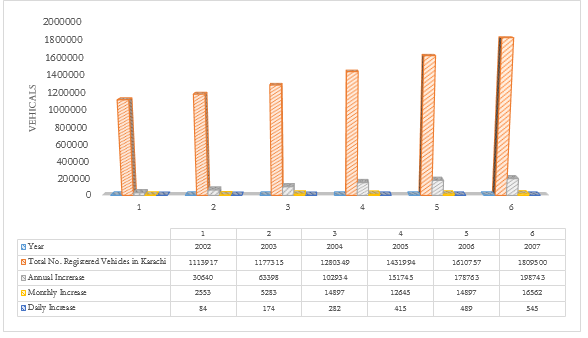
The metropolitan city of Karachi, in specific, has seen a significant increase in urban growth and motorization over the last fifty years. The absence of adequate public transit in Karachi is due to the very low automobile running expenses that many Karachi residents can afford, resulting in excessive car use. This has been followed by a heavy dependence on private automobiles, resulting in serious car crashes, traffic congestion, and economic, social, and environmental consequences. The registered number of vehicles carrying rickshaws, according to excise and taxation, was 105,684, 6,506 buses, minibuses were 15,807, 104,097 vans/pickups, 47,165 taxis and motorcycles were 1,296,481 (Brohi, Kalwar, et al., 2021b; Irfan Ahmed et al., 2021; MEMON, 2018b; Memon, Kalwar, Sahito, Talpur, et al., 2021; Shah et al., 2021b; Shaharyar et al., 2021)
Research Objectives
As stated above, in the context of transportation issues and sustainable alternative mode choices in the city of Karachi, the research poses the question: "What processes and approaches need to be dealt with to guarantee public transport uptake in Karachi?
1. Analysis of the measures that influence the modal choice pattern of private car users.
2. To develop a choice modal to definitive psychosomatic factors.
Literature Review
The four steps of the urban transportation planning system model are trip generation, Trip distribution, Mode-choice, and Route assignment.
Mode choice analysis is measured as the third step in the four-step transportation-forecasting model.
A continuing increase in road traffic congestion leading to driver frustration is disturbing many urban areas' Longer travel times, lower efficiency, more serious accident and car insurance rates, higher fuel consumption, higher cost of transport, and decreased air quality.
The Intention is a key factor affecting
behaviour, according to the Planned Behavior theory(Ajzen & Fishbein, 2005). Tpb assumes that deliberate behaviour captures and mediates all motivational factors that influence a person's behaviour. Behavioural values, subjective norms, perceived moral obligation and perceived behavioural regulation all influence the intent of behaviour. Top models have been adopted by numerous studies of travel mode choice Behavior (Hunecke et al., 2007)
Research Methodology
The research design for this study begins with a probing investigation that reviews the literature to assess the research gap and describe the research questions. The research plan is regarded as a logical method as well as a master plan of the research effort that sheds light on research in order to give a solution to the research question(s) (Memon et al., 2020b; Stenson et al., 2003). It presents the researchers with knowledge for the data collection and analyzes in their research and also ensures them that the provided data applies to their effort and deals with the research requirements. This research is established on assembling quantitative facts regarding the upcoming recognition of the anticipated. Karachi inhabitants enforce public infrastructure and policies.
? CBD of Karachi I. I. Chandigarh Road
? Private Car users were focused.
? 100 Sample size questionnaires were collected.
? A self-administered questionnaire Survey was conducted among private transport users.
? Data was entered in “SPSS”.
? Descriptive analysis was done through “SPSS”.
? “SEM” Structural Equation model Through “PLS” Path Least Square Model.
SEM is a fairly generic statistical modelling tool that is commonly utilized in behavioral sciences. This is a combination of factor analysis and regression or path analysis. The importance of SEM is a lot on a hypothetical construct that is corresponded to the latent factors. The relations between the theoretical constructs are shown between the variables by path or regression coefficients. The structural equation model provides a structure for the covariance between the variables observed and offers modeling of the structure of covariance by another name. However, the model can be further expanded to include experimental means of variables or other things in the model, which allows the modeling of covariance structure a mere precise name. These models are mostly known by many researchers as 'Lisrelmodels' which is often less specific. (LISREL) is abbreviated as Linear Structural Relations is the name of one of Jöreskog's first and most well-known SEM algorithms. Structural equation models must now be nonlinear, and SEM's possibilities extend much beyond the actual Lisrel programme.Like Browne (1993), he presented the
possibility of fitting nonlinear curves.
Result and Discussion
Assessment of the Structural model with their steps is described in Fig. 2. Step 1 demonstrates collinearity. If any construct has a value greater than five, the construct is collinear, and the query must be rechecked or rewritten. The Variance Inflation Factor (VIF) must be less than five. Step 2, all p Values less than 0.05 are acceptable.
Fig.3 SEM is a univariate statistical analysis used to investigate structural relationships. Exogenous and endogenous variables are used in this model. In this model, the total variation of endogenic factors on exogenic factors was 42%.
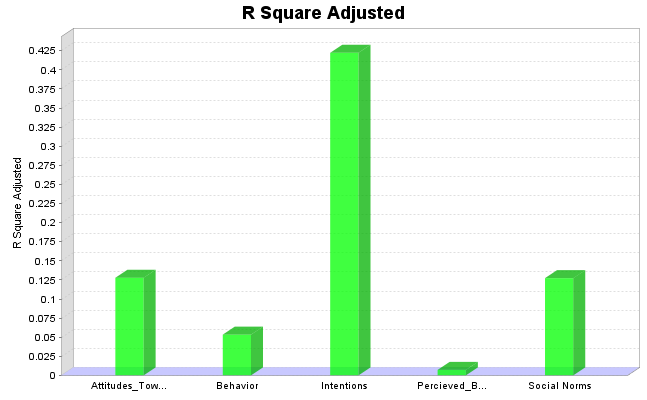
In step 3 in step 3, we see access to the value of R2 the average variance extracted was established. Discriminant validity established. Endogenous variables had a cumulative variance of 42% on exogenous variables. Nonetheless, we should consider the factor and variable that account for 100% variance in the independent variable.
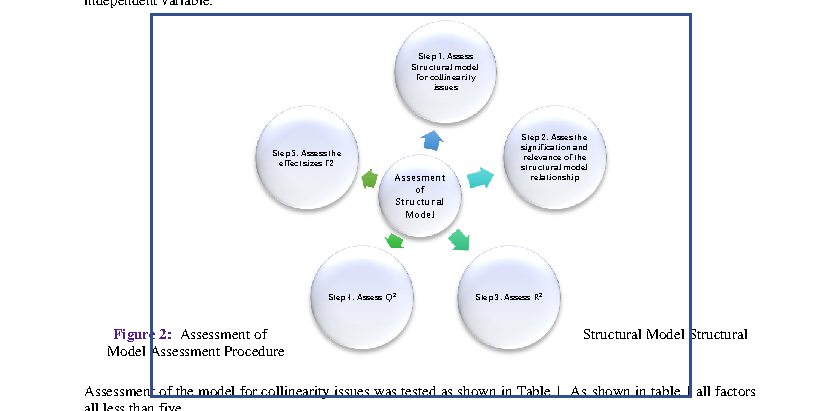
Assessment of the model for collinearity issues was tested as shown in Table 1. As shown in table 1 all factors all less than five.
Table 1. Variance Inflation Factor (VIF)
| Variable’s | VIF |
|---|---|
| ATTITUDE3 | 1.801 |
| ATTITUDE 4 | 2.202 |
| ATTITUDE 5 | 1.758 |
| ATTITUDE 7 | 1.652 |
| ENVIROMENT5 | 1.000 |
| IntToPublTrans1 | 1.092 |
| IntToPublTrans2 | 1.092 |
| IntentionpWalking | 1.000 |
| PercivedNBP2 | 1.396 |
| PercivedNBP3 | 1.258 |
| PercivedNBP1 | 1.210 |
| PercivedWalkingE10 | 2.565 |
| PercivedWalkingE6 | 2.979 |
| PercivedWalkingE7 | 2.760 |
| PercivedWalkingE8 | 3.134 |
| PercivedWalkingE9 | 3.471 |
| Subjectnorm1 | 1.180 |
| Subjectnorm 2 | 1.235 |
| Subjectnorm 3 | 1.099 |
| Trip-Charctere1 | 1.123 |
| Trip-Character 2 | 1.123 |
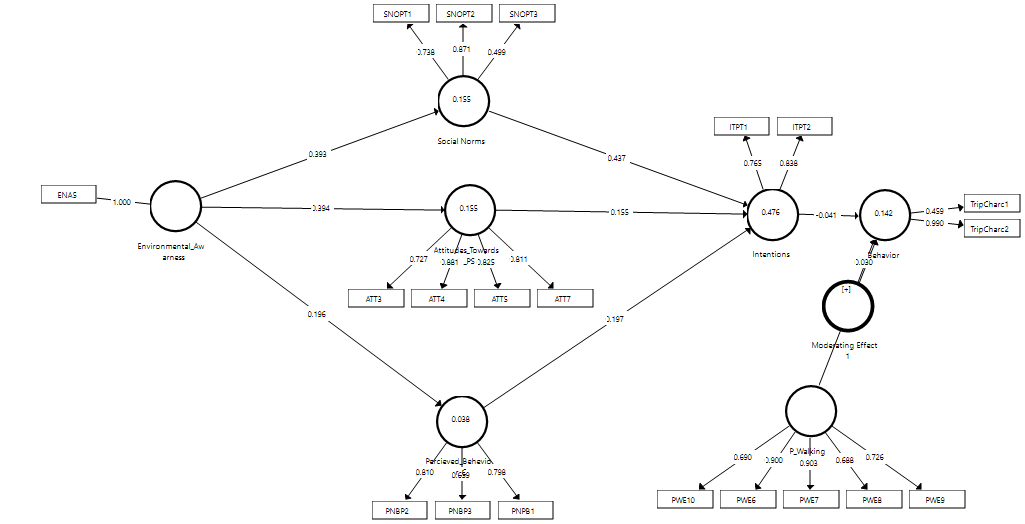
Assessment of Model for Path Coefficient is shown in Table II. Size of Path-coefficients shows the strength of relationship and importance among constructs
? Attitudes_Towards_PS has a weak relationship with Intentions and is not significant)
? Environmental_Awarness has a strong relationship with Attitudes_Towards_PS and it is significant
? Environmental_Awarness has a weak relationship with Percieved_Behevior_C not significant
? Environmental_Awarness has a weak relationship with Behavior not-significants.
? Moderating Effect 1 has a weak relationship with Behavior not-significants.
? P_Walking -> has a weak relationship with Behavior not-significants.
? Percieved_Behevior_C has a weak relationship with Intentions not-significants
Social Norms have a weak relationship with intentions and are not significant
Table 2. Path Coefficient
| INITIAL TEST (O) | TEST MEAN (M) | Standard Deviation | T-DATA (|O/STDEV|) | P VALUES | |
| ATTI TO PS > INTEN | 0.15 | 0.14 | 0.26 | 0.58 | 0.55 |
| ENV AWAR > ATTI TO PS | 0.39 | 0.39 | 0.18 | 2.10 | 0.03 |
| ENV AWAR > PERCIV BEVR | 0.19 | 0.25 | 0.23 | 0.83 | 0.40 |
| ENV AWAR > SOCI NRM | 0.39 | 0.37 | 0.23 | 1.67 | 0.09 |
| INTEN > BEVR | 0.04 | 0.12 | 0.23 | 0.17 | 0.86 |
| MODERT EFCT-1 > BEVR | 0.03 | 0.04 | 0.25 | 0.11 | 0.90 |
| PERCIV WALK ENV > BEVR | 0.36 | 0.26 | 0.45 | 0.79 | 0.42 |
| PERCIV-BEVR-CON > INTENTION | 0.19 | 0.20 | 0.20 | 0.96 | 0.33 |
| SOCI NRM > INTENTIONS | 0.43 | 0.47 | 0.25 | 1.71 | 0.08 |
Assessing Predictive Relevance (Q2) is presented in Table III. In which it is presented that Intention to use private transport is greater than 0 so (0.206) it is Established.
Table 3. Blindfolding Results in Predictive Relevance.
| Sso | Sse | Q² (=1-Sse/Sso) | |
|---|---|---|---|
| ATTI TO PS | 132 | 126.28 | 0.05 |
| BEHAVIOR | 66 | 72.35 | 0.08 |
| ENV AWAR | 33 | 33 | |
| INTENTS | 66 | 52.39 | 0.20 |
| MODERT EFCT-1 > | 33 | 33 | |
| PERCIV WALK ENV | 165 | 165 | |
| PERCIV BEVR | 99 | 98.08 | 0.00 |
| SOCI NRM | 99 | 96.93 | 0.01 |
Bootstrapping Results are Hypothesis Testing
Table 4. Bootstrapping: Hypothetical Testing
| Initial Test (O) | Test Mean (M) | Standard Deviation | T Statistics (|O/STDEV|) | P Values | |
|---|---|---|---|---|---|
| ATTI TO PS > INTEN | 0.156 | 0.150 | 0.260 | 0.590 | 0.560 |
| ENV AWAR > ATTI TO PS | 0.394 | 0.399 | 0.188 | 2.101 | 0.036 |
| ENV AWAR > PERCIV BEVR | 0.196 | 0.255 | 0.235 | 0.832 | 0.406 |
| ENV AWAR > SOCI NRM | 0.393 | 0.375 | 0.235 | 1.674 | 0.094 |
| INTEN > BEVR | -0.041 | -0.124 | 0.236 | 0.173 | 0.862 |
| MODERT EFCT-1 > BEVR | 0.030 | -0.041 | 0.255 | 0.117 | 0.907 |
| PERCIV WALK ENV > BEVR | -0.363 | -0.262 | 0.455 | 0.797 | 0.425 |
| PERCIV-BEVR-CON > INTENTION | 0.197 | 0.206 | 0.205 | 0.961 | 0.337 |
| SOCI NRM > INTENTIONS | 0.437 | 0.473 | 0.254 | 1.718 | 0.086 |
Table 5. Effect Size of F2
| Construct | f² / Effect |
|---|---|
| ATTI TO PS | 0.019 Less Effect |
| ENV AWAR | 0.180 Modest |
| INTENTS | 0.002 Less Effect |
| MODERT EFCT-1 > | 0.002 Less Effect |
| PERCIV WALK ENV | 0.130 Modest |
| PERCIV-BEVR-CON | 0.041 Less Effect |
| SOCIAL Norms | 0.176 Modest |
The goodness of the Fit indexThe goodness of Fit (GoF) G0F=?average R2 x average communalityG0F=?(0.183 x) 0.702 =0.35Analysis of GoF is finest considered 0, 0.35 proposes good GoF. As per results, if it is 0.7 >then it indicates poor GoF.The Correlation Coefficient of Latent Variables is shown in Table VI.
Table 6. Correlation Coefficient of Latent Variables
| Attitudes Towards PS | Behaviour | Environmental_ Awareness | Intentions | Moderating Effect 1 | P Walking | Perceived Behavior C | Social Norms | |
|---|---|---|---|---|---|---|---|---|
| ATTITUDES TOWARDS PS | 1.00 | |||||||
| BEHAVIOR | -0.01 | 1.00 | ||||||
| ENVIRONMENT AWARENESS | 0.39 | 0.14 | 1.00 | |||||
| INTENTIONS | 0.50 | 0.16 | 0.44 | 1.00 | ||||
| MODERATING EFFECT 1 | -0.24 | 0.02 | 0.32 | 0.56 | 1.00 | |||
| P_WALKING | 0.18 | -0.37 | 0.23 | 0.27 | 0.08 | 1.00 | ||
| PERCEIVED BEHAVIOR C | 0.62 | 0.01 | 0.19 | 0.51 | 0.26 | 0.27 | 1.00 | |
| SOCIAL NORMS | 0.71 | 0.06 | 0.39 | 0.64 | 0.49 | 0.13 | 0.51 | 1.0 |
Findings
Table 5 shows a strong correlation between the latent exogenous constructs and the latent endogenous construct.
Table 7. Correlation Coefficient of Latent Variables
| Initial Test (O) | Test Mean (M) | Standard Deviation | T Statistics | P-value | Relation | Significance | Test | |
|---|---|---|---|---|---|---|---|---|
| Attitudes Towards PS Behaviour | 0.150 | 0.150 | 0.260 | 0.590 | 0.560 | Positive | Not Significant | Rejected |
| Environmental Awareness Attitudes towards PS | 0.394 | 0.399 | 0.188 | 2.101 | 0.036 | Positive | Significant | Accepted |
| Environmental Awareness Perceived Behavior | 0.196 | 0.255 | 0.235 | 0.832 | 0.406 | Positive | Not Significant | Rejected |
| Environmental Awareness Social Norms | 0.393 | 0.375 | 0.235 | 1.674 | 0.094 | Positive | Not Significant | Rejected |
| Intentions Behavior | -0.041 | -0.124 | 0.236 | 0.173 | 0.862 | Negative | Not Significant | Rejected |
| Moderating Effect | 0.04 | -0.040 | 0.255 | 0.118 | 0.910 | Positive | Not Significant | Rejected |
| Walking | -0.360 | -0.260 | 0.460 | 0.780 | 0.430 | Negative | Not Significant | Rejected |
| Perceived Behavior Intentions | 0.197 | 0.206 | 0.205 | 0.961 | 0.337 | Positive | Not Significant | Rejected |
| Social Norms | 0.440 | 0.480 | 0.250 | 1.719 | 0.090 | Positive | Not Significant | Rejected |
Conclusion
This study was performed on factors influencing private transport users to shift towards public transport. The result shows that Environmental_Awarness has a strong relationship with an attitude toward public transportation (Attitudes_Towards _PS) and its significance.
The interpersonal model was assessed through composite reliability in which average variance was applied. Discriminant validity is satisfactory according to the Fornel – Lacher cetteiorn.
The average variance extracted was established. Discriminant validity established. Endogenous variables had a cumulative variance of 42% on exogenous variables.
The Structural Model was evaluated using the F2 effect size, which revealed that all independent variables have a very small effect size, except for the Intention to use private transportation. Except for Environmental-Awareness, none of the independent variables had a significant size or importance. The R2 impact of all independent variables on the dependent variable was extremely high at 42 per cent.
The Q2 value was higher than 0 (0.206), indicating a predictive value.
The goodness of fit index was 0.35, which shows that empirical data fits the model satisfactorily. Except for Environmental-Awareness, all hypotheses are dismissed using the bootstrapping method. The part of the Intention is very important for the accomplishment of the research. Such as the Intention to use private transport is satisfactory.
According to the study's results, Intention is the most important factor.
References
- Alkhathlan, K., & Javid, M. (2013). Energy consumption, carbon emissions and economic growth in Saudi Arabia: An aggregate and disaggregate analysis. Energy Policy, 62, 1525–1532.
- Antonini, G., Bierlaire, M., & Weber, M. (2004). Simulation of pedestrian behaviour using a discrete choice model calibrated on actual motion data. Swiss Transport Research Conference,
- Bowman, J. L., Bradley, M., Castiglione, J., & Yoder, S. L. (2014). Making advanced travel forecasting models affordable through model transferability.
- Brohi, S., Kalwar, S., Memon, I. A., & Ghaffar, A. (2021a). Using the theory of planned behavior to identify the behavioral Intention to use public transportation service: the case study of Karachi circular railway. Int. J. Emerg. Technol, 12(6),
- Brohi, S., Kalwar, S., Memon, I. A., & Ghaffar, A. (2021b). Using the Theory of Planned Behavior to Identify the Behavioral Intention to use Public Transportation Service: The Case Study of Karachi Circular Railway. International Journal on Emerging Technologies, 12(1),
- Brohi, S., Memon, I. A., Kalwar, S., & Sahito, N. (2021). Predicting The Use Of Public Transportation Service: The Case Study Of Karachi Circular Railway. PalArch's Journal of Archaeology of Egypt / Egyptology, 18(03), 13.
- Bulkeley, H., & Tuts, R. (2013). Understanding urban vulnerability, adaptation and resilience in the context of climate change. Local environment, 18(6), 646-662.
- Cohen, J., Cohen, P., West, S. G., & Aiken, L. S. (2013). Applied multiple regression/correlation analysis for the behavioral sciences. Routledge.
- Galdames, C., Tudela, A., & Carrasco, J. A. (2011). Exploring the Role of Psychological Factors inMode Choice Models by a Latent Variables Approach. Transportation Research Record: Journal of the Transportation Research Board, 2230(1), 68–74.
- Ghaffar, A., Kalwar, S., Memon, I. A., Brohi, S., & Sahito, N. (2021). Evaluating Accessibility Of Public Parks Through Gis: A Case Study Of Tando Allahyar City. PalArch's Journal of Archaeology of Egypt/Egyptology, 18(2), 758-771.
- Gill, R., Kalwar, S., & Memon, I. A. (2020). Yeh’s Satisfaction Index Modelling of Tenants in Rental Appartments (A Case Study of Latifabad Hyderabad). Sukkur IBA Journal of Computing and Mathematical Sciences, 4(2), 1-10.
- Hunecke, M., Haustein, S., Grischkat, S., & Böhler, S. (2007). Psychological, sociodemographic, and infrastructural factors as determinants of ecological impact caused by mobility behavior . Journal of Environmental Psychology, 27(4), 277-292.
- Ahmed, I. M., Saima, K., Noman, S., & Madzlan, B. N. (2021, 02/15). Factors That Influence Travelers’ Willingness To Use Or Not Park- And-Ride Service In Putrajaya And Karachi Cbd. PalArch's Journal of Archaeology of Egypt / Egyptology, 18(2), 720-734.
- Kalwar, S., Memon, I. A., & Qureshi, S. (2020). Significance of National Spatial Planning for Economic Development of Secondary Cities in India: Critical Analysis of JNNURM Programme. Sukkur IBA Journal of Computing and Mathematical Sciences, 4(2), 49-60.
- Kalwar, S., Sahito, N., Memon, I. A., Hwang, J., Mangi, M. Y., & Lashari, Z. A. (2019). National Planning Strategies for Agro-based Industrial Development in Secondary Cities of Sindh Province, Pakistan. Sustainability, 11(24),
- Kalwar, S., Samoo, S. K., Memon, I. A., & Sahito, N. (2022, Janurary 2022). A Comparative Analysis Of Urbanization Trends Of Hyderabad And Sukkur. Academy of Strategic Management Journal, 21(2),
- Memon, I. A. (2018a). Mode Choice Modelling to Shift Car Travelers Towards Park and Ride Service in the CBD of Putrajaya and Karachi Universiti Teknologi PETRONAS.
- Memon, I. A. (2018b). Mode Choice Modelling to Shift Car Travelers Towards Park and Ride Service in the CBD of Putrajaya and Karachi Universiti Teknologi PETRONAS].
- Memon, I. A., Kalwar, S., Sahito, N., & Napiah, M. B. (2021). Factors That Influence Travelers’willingness To Use Or Not Park- And-Ride Service In Putrajaya And Karachi Cbd. PalArch's Journal of Archaeology of Egypt/Egyptology, 18(2), 720-734.
- Memon, I. A., Kalwar, S., Sahito, N., Qureshi, S., & Memon, N. (2020a). Average Index Modelling of Campus Safety and Walkability: The Case Study of University of Sindh. Sukkur IBA Journal of Computing and Mathematical Sciences, 4(1), 37-44.
- Memon, I. A., Kalwar, S., Sahito, N., Qureshi, S., & Memon, N. (2020b, 2020-07-29). Average Index Modelling of Campus Safety and Walkability: The Case Study of University of Sindh. Sukkur IBA Journal of Computing and Mathematical Sciences(1), 37-44.
- Memon, I. A., Kalwar, S., Sahito, N., Talpur, M. A. H., Chandio, I. A., Napiah, M., & Tayyeb, H. (2021). Mode choice modeling to shift car travelers towards park and ride service in the city centre of Karachi. Sustainability, 13(10),
- Memon, I. A., Napiah, M., Hussain, M. A., & Hakro, M. R. (2016b). Influence of factors to shift private transport users to Park-and-Ride service in Putrajaya. In N. A. W. A. Zawawi (Ed.), In Engineering Challenges for Sustainable Future: Proceedings of the 3rd International Conference on Civil, Offshore and Environmental Engineering (ICCOEE 2016, Malaysia, 15-17 Aug 2016) (1st Edition ed., pp. 566). CRC Press.
- Memon, I. A., Napiah, M., Talpur, M. A. H., & Hakro, M. R. (2016). Mode choice modelling method to shift car travelers towards Park and Ride service. ARPN Journal of Engineering and Applied Sciences, 11(6), 3677-3683.
- Pojani, D., & Stead, D. (2015). Sustainable urban transport in the developing world: beyond megacities. Sustainability, 7(6), 7784-7805.
- Qureshi, S., Memon, I. A., & Talpur, M. A. H. (2022, 2022-01-01). Association between Objectively Measured Neighbourhood Built Environment and Walkability. Mehran University Research Journal of Engineering and Technology, 41(1), 157-168.
- Sahito, N., Kalwar, S., Memon, I. A., Mangi, M. Y., & Hussain, A. (2020). Examining rapid land-use variation using multicriteria decision analysis (mcda) method. International Journal, 76, (7-1).
- Shah, M. H., Memon, I. A., Talpur, A. H., Sethar, W. A., & Das, G. (2021a, 22 March 2021). Factors Influencing Private Transport Users to Shift Towards Public Transport In Karachi. Engineering Science And Technology International Research Journal (ESTIRJ), 5(1),
- Shah, M. H., Memon, I. A., Talpur, A. H., Sethar, W. A., & Das, G. (2021b, 22 March ). Factors Influencing Private Transport Users to Shift Towards Public Transport In Karachi. ESTIRJ-Engineering Science and Technology International Research Journal, 5(1),
- Shaharyar, B., Irfan Ahmed, M., Saima, K., & Noman, S. (2021, 04/09). [;//. PalArch's Journal of Archaeology of Egypt / Egyptology, 18(3), 4736-4748.
- Shaikh, K., Memon, A., Memon, I. A., Laghari, Z. A., & Memon, A. M. (2020). Awareness regarding Coronavirus pandemic among the population of Sindh, Pakistan: A cross- sectional study. Sukkur IBA Journal of Computing and Mathematical Sciences, 4(1), 28-36.
- Soomro, F., Kalwar, S., Memon, I. A., & Kalwar, A. B. (2021). Accessibility Factor for Boulevard Shopping Mall, Hyderabad City, Pakistan. International Research Journal of Innovations in Engineering and Technology, 5(10),
- Stenson, P. D., Ball, E. V., Mort, M., Phillips, A. D., Shiel, J. A., Thomas, N. S., Abeysinghe, S., Krawczak, M., & Cooper, D. N. (2003). Human gene mutation database (HGMD®): 2003 update. Human mutation, 21(6), 577- 581.
- Talpur, M. A. H., Chandio, I. A., Memon, I. A., Napiah, M., & Jafri, K. H. (2016). A brief review on the role of regional transport accessibility in the development process of distant sub-regions. Indian Journal of Science and Technology, 9(13), 1-9.
- Talpur, M. A. H., Chandio, I. A., Memon, I. A., & Qureshi, T. A. (2014). Computer-based database system: rapid response for rural planning agencies to devise transport policies. Indian Journal of Science and Technology, 7(10), 1603-1612.
Cite this article
-
APA : Shah, M. H., Marvi, H., & Soomro, M. (2022). Factors Encouraging Single Occupant Vehicle Users to Adopt Sustainable Alternative Mode Choice. Global Social Sciences Review, VII(I), 388 - 400. https://doi.org/10.31703/gssr.2022(VII-I).36
-
CHICAGO : Shah, Muzamil Hussain, Hina Marvi, and Mehnaz Soomro. 2022. "Factors Encouraging Single Occupant Vehicle Users to Adopt Sustainable Alternative Mode Choice." Global Social Sciences Review, VII (I): 388 - 400 doi: 10.31703/gssr.2022(VII-I).36
-
HARVARD : SHAH, M. H., MARVI, H. & SOOMRO, M. 2022. Factors Encouraging Single Occupant Vehicle Users to Adopt Sustainable Alternative Mode Choice. Global Social Sciences Review, VII, 388 - 400.
-
MHRA : Shah, Muzamil Hussain, Hina Marvi, and Mehnaz Soomro. 2022. "Factors Encouraging Single Occupant Vehicle Users to Adopt Sustainable Alternative Mode Choice." Global Social Sciences Review, VII: 388 - 400
-
MLA : Shah, Muzamil Hussain, Hina Marvi, and Mehnaz Soomro. "Factors Encouraging Single Occupant Vehicle Users to Adopt Sustainable Alternative Mode Choice." Global Social Sciences Review, VII.I (2022): 388 - 400 Print.
-
OXFORD : Shah, Muzamil Hussain, Marvi, Hina, and Soomro, Mehnaz (2022), "Factors Encouraging Single Occupant Vehicle Users to Adopt Sustainable Alternative Mode Choice", Global Social Sciences Review, VII (I), 388 - 400
-
TURABIAN : Shah, Muzamil Hussain, Hina Marvi, and Mehnaz Soomro. "Factors Encouraging Single Occupant Vehicle Users to Adopt Sustainable Alternative Mode Choice." Global Social Sciences Review VII, no. I (2022): 388 - 400. https://doi.org/10.31703/gssr.2022(VII-I).36