
Abstract
The European Union passed a resolution in 2002 which required all listed companies and firms to prepare consolidated and simple accounts according to Financial Reporting Standards starting from January 2005. This was intended to improve performance and will have an influence on the information environment for listed firms. This study provides empirical and theoretical literature regarding the adoption of IFRS, accounting conservatism and firm performance. This paper provides different theories that discuss the impact of IFRS and accounting conservatism on a firm’s performance that includes positive accounting theory, modernization theory, contingency theory, and world-system theory.
Key Words
IFRS, Accounting Conservatism, Firm Performance, IASB, UAE
Introduction
In the past decades, a number of countries throughout the world have adopted the upgraded reporting standard namely IFRS “International Financial Reporting Standards” as a foundation for current reporting for a clearer and better understanding of the company’s practice. IFRS is defined as “a set of accounting principles that is rapidly gaining acceptance on a worldwide, as they play a vital role in raising the accounting quality because of its tight requirement of transparency”. More than 258 countries worldwide have adopted IFRS (IASB, 2013).
There are many reasons behind the increase in countries that have adopted these standards. Among others, they have included the power and pervasive nature of the ever-increasing globalization trend that has made countries take a change from traditional GAAP principles to the upgraded “International Financial Reporting Standards” (IFRS). Adoption of a unique set of standards known as IFRS have been introduced by firms facing various business, industrial and social factors such as political factors and economic issues prevailing in the world. Cooper et al. (2003) conclude that traditional accounting promotes the dogma that “economic growth promises a better world, and plays a crucial role” in the process of globalization and economic growth (Neu and Ocampo, 2007).
Background of the Study
The adoption of these standards has a significant effect on corporate financial performance, which has been an issue of high interest for practitioners, academics, professionals, and regulators for a long time. IFRS has been established to provide "a single set of high quality, global accounting standards that require transparent and comparable information in general purpose financial statements" (IFRS Handbook, 2003). The main goal of IFRS is to deliver a transparent, high quality, user-friendly and easily understandable accounting standards that can help the stakeholders in the financial and stock markets that alternatively helps in making economic decisions. Prior studies such as Bebington (2004) suggested that the implementation of IFRS augments earnings quality through the reduction of information asymmetry, provision of company’s financial statements and reports to help stakeholders and investors in making better investment decisions, and plummeting capital cost. From a worldwide perspective, the adoption of IFRS helps the multinational companies to save huge expenses of preparing various sets of accounts for public authorities as required
(Chand, 2005). On the other hand, to improve reporting standards Accounting Principle Board (APB) introduced accounting conservatism in 1970 which is considered as an ultimate concept in accounting. The APB “Accounting Principles Board” in Statement No. 4 (APB, 1970) summarizes the convention of conservatism as follows:
“Frequently, assets and liabilities are measured in the context of significant uncertainties. Historically, managers, investors, and accountants have generally preferred that possible errors in measurement be in the direction of understatement rather than overstatement of net income and net assets.”
FASB Concepts Statement defined it as "a prudent reaction to uncertainty to try to ensure that uncertainty and risks inherent in business situations are adequately considered." In other words, it is “the accountant's tendency to require a higher degree of verification to recognize good news as gains than to recognize bad news as losses" (Basu, 1997). Conservatism assures that a business has to deal with the unpredictable and uncertain situation on a daily basis and to deal with the situation with extra care.
Problems and Issues
Various studies have reported the significant impact of conservatism on the financial information and information statement and also protects new investors from exaggerated financial performance. Hence, studies argued in favor of adopting the IFRS standard for the purpose of achieving quality in the accounting information and to diminish the information asymmetry. The quality and transparency of conservatism should be augmented after IFRS adoption in the company’s practice (Lara & Mora, 2004).
IFRS is adopted due to its quality accounting standards that help to avoid fake information. In most of the countries, its implementation is compulsory; therefore, IFRS helps the firm to better communicate with the entire world. Accounting practices are mainly concerned with the concept of “Fair Value” which is defined by accounting theory. Accounting theory suggests that the “fair value of an asset should be its fundamental value, equivalent to the present value of future cash flow calculated using all available information.” Fundamental values were used in many cases during 2008 and were cause for the collapse of Lehman Brothers. Second, in the case of assets without market price, these are assigned values based on a mathematical projection of future earnings under IFRS.
A low education level, lack of knowledge and information, no enhancement of skills and lack of awareness of the current accounting slandered are the main barriers in the adoption of IFRS, and meeting the standard criteria was an issue for the year (2005). A number of the issue were reported that include, training of staff, knowledge and skills in the implementation of IFRS, which was the reason for depending greatly on auditors for different services. Jermakowicz and Tomaszewski (2006) confirmed the issue accompanying with the implementation of IFRS in the listed firms in UAE and acknowledged the required level of education and training/development structure as a key task for firms. A very small number of the employee were able to handle the IFRS-reporting.
The Principle of Conservatism
The principle of AC is the oldest concept of accounting (Sterling, 1976) since the 15th century. It refers to the exposition on accounting bookkeeping, “as limiting the overstatement of net assets and income, it has constrained actions that could harm one’s reputation in a multi-period world of exchanges” (Dickhaut et al., 2010). However, it can be defined theoretically as, “conservatism is the accounting practice that anticipates economic losses before being realized and recognizes economic gains only when realized” (Beaver & Ryan, 2005). When a situation arises related to a real uncertainty in choosing amongst different reporting methods, the one that has the least desirable effect on owners' equity should be chosen. Accounting conservatism is deemed to be a prerequisite to having a high authorization to recognize profits against losses (Beaver and Ryan 2005). At its introduction stage, the concept was censured for “considering earnings in current financial cycles and overstating them in future cycles” (Watts, 2003a). Mora & Walker (2015) reported that “the importance of the conservatism (prudence) concept in financial reporting stems from its role in mitigating adverse selection and moral hazard (Lai et al. 2013a).
Classifications of Conservatism
Recent studies have segregated conservatism into two classes based on the current economic news and situation. The first one termed as Unconditional Conservatism envelopes the adoption of accounting standards that reduce the earnings and profit independent from any contemporaneous economic news (Ball and Shivakumar, 2006). Whereas, the second classification is known as the “Conditional Conservatism” is the implementation of standards that identify bad news in earnings timely as compared to good news (Ball and Shivakumar, 2005, Beaver and Ryan, 2005).
Figure 1
The Types of conservation
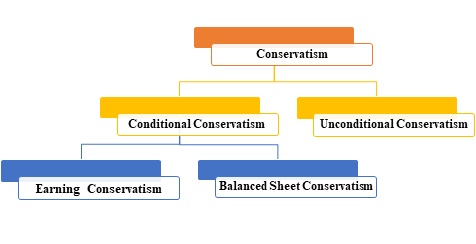
Figure 1
The Types of conservation
The above figure reports the different types of conservatism. Conservatism is mainly divided into two sub-headings. Conditional conservatism is also subdivided into two categories as mentioned in figure 1. Prior to the studies of Ball (2004), this classification was not so explicitly available, and these said concepts were vaguely discussed as two perceptions of accounting conservatism. To measure it a large number of studies employed the market to book ratio (Easton and Pae, 2004; Pope and Walker, 2003, Ismail and Elbolok, 2011). However, Ball and Shivakumar (2005a) argue that MTB cannot be used to measure conditional but can only gauge unconditional conservatism since it does not envelope the timeliness of loss recognition.
International Financial Reporting Standards (IFRS)”
The IASB (2012) replaced the lASC “International Accounting Standards Committee” in 2001, the international entity that takes the function of reducing and eliminate such differences as well as harmonized procedures, regulations and accounting standards (Lehman, 2005). IASB assume that when financial statements are prepared, then the common needs of most users are met since economic decisions are made by the majority of them (Pascual et al., 2002).
BeforeIFRS there were many standards prior to the current international standards. Many enterprises around the world prepare and present financial statements for external users and, whilst such financial statements may seem similar, they do differ (Liu, 2011; Albu et al., 2011). Probable reasons for differences are the variety of social (Al-Ajmi and Saudagaran, 2011), economic and legal contexts within different countries (Arvidsson, 2011), and the setting of national requirements to provide information and fulfill the need of its users (Beneish and Yohn, 2008).
Globalization, as well as trade and investment liberalization and the need of flows of investments between countries, the strong linkages between financial markets due to the development in technology and communications, necessitate the need of easy comparisons between different firms to encourage investment and to ease the use of information included and presented by different firms in different countries and for different uses of these statements. The main users of these reports are current and potential investors, lenders, auditors, customers, employees, government institutions and agencies (Moneva, et. al., 2007). These users need information and not all information in the financial statements are useful and used by all the users but must meet their needs (Taplin et al., 2002).
Challenges Problems and Obstacles Facing the IFRS
The implementation of the IFRS standards is mainly associated with many challenges for countries which are willing to adopt IFRS. The main problems raised in the implementation of IFRS are related to “W” questions such as “whether to and why, when and how” to convert from traditional accounting practices to the IFRS standard and its adoption. Implementation and adoption of IFRS standards are not only for the sake of cost and benefit, but they provide a global standard for the reporting procedures. If IFRS is adopted then other countries linked with western countries might need to adopt IFRS, because the different versions may not support the accounting practices in the procedures (Daske, Hail & Leuz, 2008). Sunder (2010) recommended 6 basic features for the decision such as “involvement in prosperity and wealth of society, the inclusion of relevant information from all parts of the economy, stability over time, adaptability to changes in the economic environment, robustness against manipulations, and resistance to capture by narrow interest groups.”
The perception of IFRS is considered critical by the users of financial statements. McEnroe & Sullivan (2011) specified that investors considered themselves secure and are satisfied with the current accounting procedures because of this. Small businessmen and SME were not prepared and happy to switch to IFRS; the reason was that it was less well known and they were unable to see the advantages of IFRS adoption in the future but considered it critical (Winney et al., 2010).
Accounting Conservatism and Firm’s Profitability
A considerable amount of literature is present that assesses the role of conservatism in regard to the firm’s profitability. Pirayesh, Mansouri, and Armanmehr (2013) studied the impact of conservatism on the firm’s return on investment in Tehran. They established a significant positive relationship between return on investment and conservatism, both conditional and unconditional. Furthermore, Pirayesh et al. (2013) are of the view that the application of conservatism needs to be carried out with full understanding as it can “accelerate the process of recognizing the elements which can decrease the firm’s profitability and decelerate recognizing the elements which can increase the firm’s profitability.”
Conservatism has been viewed as having two countervailing impacts on the proficiency of accounting decisions. Firstly, it shrinks the prospect of a bad firm procuring a high signal, therefore, making it less probable to borrow and reduce bankruptcy, thus improving financing efficiency. Secondly, conservatism can also decrease the outlook of a good firm, leading to misclassification and decreasing its probability of obtaining a high signal (Nan and Wen, 2011).
Another study from Turkey aimed to further establish the relationship among accounting conservatism level, debt contracts, and profitability impacting the earnings management of listed companies in Tehran Stock Exchange. 140 companies were tested for the said hypothesis, results of which revealed a positive and significant measure. ROE was employed as a profitability index and leverage ratio was employed to study debt contracts. Therefore, firms with more conservative numbers, in turn, have more earnings management. Their findings were consistent with previous studies that also examined the relationship (for e.g. see, Nahandi et al., 2012 and Kermani et al. 2013).
This relationship was further investigated by Lara et al. (2009). A US sample of 70,803 firms- from 1975-2006 was observed to assess the relationship between conditional conservatism. The model developed by Biddle et al., (2008) was employed to analyze the said association. Findings reveal that accounting conservatism enhances investment efficiency in corporations in fronting liquidity constraints, reducing under-investment, and also for cash-rich and low leveraged firms, reducing over-investment. Moreover, conditionally conservative firms are inclined to invest less and outstrip other corporations with regards to future investment operations.
UAE and the Adoption of IFRS
In order to maintain financial health for the dominant states, policies that enhance their financial health, Arnold and Sikka (2001) suggested the guidance of “intentional politics and policies”. Furthermore, listed firms need to adapt to the international standards and practices that are globally accepted such as IFRS. Abundant Steps, therefore, have been made to create harmony amongst the presentation and reporting of financial information around the globe to heighten transparency (AICPA, 2013). AICPA stated that “Approximately 120 nations and reporting jurisdictions permit or require IFRS for domestic listed companies, although approximately 90 countries have fully conformed to IFRS as promulgated by the IASB and include a statement acknowledging such conformity in audit reports”. IFRS compliance has been studied by a number of researchers.
In recent years, the economic growth of the UAE increased twofold and has taken the country to be in the list of those that have high potential and attractive capital; this is subject to the changing economic policies and standards of the country. Oil and natural gas, with which UAE is self-sufficient, have been employed to generate revenues that led to massive development and industrialization of the country.
Theoretical Framework
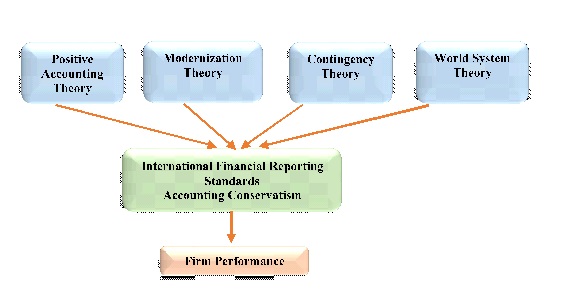
This paper examines the relationship using modernization theory, contingency theory, world-system theory and positive accounting theory as suggested by previous studies (Kimeli, 2017) as their theoretical lenses. In this light, a unitary perspective is inadequate.
Figure 2
Multiple Theoretical Approach
Positive Accounting Theory
Companies accounting practices are being affected by different factor and interest of the actors. This theory is associated with the contracts that the company enters into a debt contracts or executive compensation contract. These contracts are normally based on different variables that include net income ratio or debt to equity ratio. Accounting practices have an impact on the variables, and thus management is answerable to avoid the issues related to these variables and firm contract, and management must be mainly concerned with the policies that are associated with the accounting practices. Undeniably, management may choose and enhance these policies to maximize the firm’s interests relative to these contracts (Scott, 2003).
In accounting research, this theory defined the choices made by the managers that have an impact on the reporting of profits and financing in a firm. The theory originated that the information has not a great value for the manager’s self-interest. Despite considering them undesirable, accounting information and conservatism continue in the financial statements. Firm relatio0nship are mostly managed by the accounting choices. Managers are mostly accountable for the accounting choices through decision making “about when and how to apply specific accounting choices, therefore, influencing the performance of a firm. The theory explains and predicts accounting practices as opposed to just describing the practice. This theory is critical in the determination of the effects of accounting choice on the quality of accounting.”
Theory of Modernization
This theory also being considered as the “Uniform Evolutionary theory of development” which is the work of “Larson and Kenny (1996) and Wilber and Jameson, (1979). Larson and Kenny (1996) believe that Justman and Teubal’s (1991) structuralize perspective is consistent with modernization theory. They consider that structuralisms view structural changes in the economy as necessary conditions for growth in general. Therefore, structural changes often involve skill-specific infrastructures, which may encompass accounting systems (Larson and Kenny, 1996).”
Larson and Kenny (1995) reported that “consistent with the proposed benefits of harmonization is the prediction that stock market development and economic growth should both be greater when IASs are adopted without modification in developing countries.” Nevertheless, Clements et al. (2013) argued that some studies reported that the standard and use of the extent of IFRS has variations from one particular country to the other developed and developing economy. If, the standard of the accounting practices are grounded on IFRS such as in “Tunisia and Iran”, that at the other side they are permitted such as in “Morocco and Israel” or even maybe compulsory for some kinds of firms such as “Costa Rica and Saudi Arabia”.
Contingency Theory
Contingency theory has been used for more than 50 years in international business, while it mainly originated from the field of psychology. This theory is more familiar with the importance of the impact and influences of the environmental factor that affects economic development. Each and every country has a specific set of environment and factors associated with it. Schweikart (1985) argued that the “contingency theory assumes that such environmental conditions are salient and interact with the development and requirements of the country’s specific accounting system”. Contingency theory supports the implementation of IFRS in order to improve the accounting practice but with modification due to the reason that, in an economy the business, industrial and accounting environments are different. To adopt these standards, the country must have the resources that help them in up-gradation such as human resource.
Certainly, Perera and Baydoun (2007) argued that accounting system such as IFRS is mostly allowed by the naturalistic strategy with the condition that to meet the environmental needs the changes should be made to the traditional accounting procedures as well. Therefore, modified IFRS adoption can be considered as positively associated with a better SMD.
World System Theory
Studies conducted by Larson and Kenny (1996) reported that “WST and the dependency theory mainly came in the political economy of development and based on notions of social conflict and transfer of wealth”. WST argued that developing economies must work to create a more appropriate system that helps the firm to improve its performance. They reported that “World-system theory and dependency theory have roots in both Marxist and fascist ideologies”. In this case, to solve the problems associated with poor economic development has a big difference from those promoted by modernization theorists. In a difference with modernization theory about communication and imitation, WST suggested that developing economies should independently establish and industrialize by uniting their own people for the task.
Different Theories Approach IFRS Adoption
| Theory | Modernization Theory | Contingency Theory | World System Theory |
| Accounting standard-setting strategy | Harmonization | Naturalistic | Particularism |
| The implication for the adoption of IFRS | Supports IFRS adoption without modification | Supports IFRS adoption, but only if modified for the local environment | Supports IFRS rejection |
| Prediction of the effects of IFRS adoption on emerging stock market development | Adoption of IFRS without modifications should lead to high-stock market development | Adoption of IFRS with modifications should lead to higher stock market development | Adoption of IFRS with modifications should lead to higher stock market development |
Conclusion
This study objective was to investigate the Impact of IFRS Adoption and Accounting Conservatism on Firm Performance. This result is the inconsistency of many studies done in the region as well as those done in the developing and developed countries. The study concludes that the compliance to the IFRS is very high in the companies listed in both UAE financial markets; however, there are many other accounting standards UAE companies follow and adopt in producing the financial reports such as the Islamic standards mainly for the obligation of the firms to pay the Zakat. This study concluded that IFRS adoption by the firms in a specific economy is difficult but to meet the standard criteria and to meet international standards a firm must convert its accounting procedure from traditional accounting practice such as GAAP to IFRS to better communicate and deliver to the outer world to improve the communication process with other multinational companies and improve firm performance. It is concluded that the IFRS and practice accounting conservatism influence performance. However, the response of performance to IFRS and practice accounting conservatism is differs according to the sector.
References
- Al-Ajmi, J., & Saudagaran, S. (2011). Perceptions of auditors and financial-statement users regarding auditor independence in Bahrain. Managerial Auditing Journal, 26(2), 130-160.
- Albu, N., Nicolae Albu, C., Bunea, Ş., Artemisa Calu, D., & Mădălina Girbina, M. (2011). A story about IAS/IFRS implementation in Romania. Journal of Accounting in Emerging Economies, 1(1), 76-100.
- Ball, R., & Shivakumar, L. (2006). The role of accruals in asymmetrically timely gain and loss recognition. Journal of accounting research, 44(2), 207-242.
- Basu, S. (1997). The conservatism principle and the asymmetric timeliness of earnings. Journal of Accounting and Economics, 24(1), 3-37.
- Bebbington, J., & Song, E. (2004). The Adoption of IFRS in the EU and New Zealand: A Preliminary Report. National Centre for Research on Europe Paper.
- Beaver, W. H., & Ryan, S. G. (2005). Conditional and unconditional conservatism: Concepts and modeling. Review of accounting studies, 10(2-3), 269-309.
- Chand, P., (2005) Impetus to the Success of Harmonization: The Case of South Pacific Island Nations', Critical Perspectives on Accounting, 16 (3): 209-26.
- Daske, H., Hail, L., Leuz, C., & Verdi, R. (2008). Mandatory IFRS reporting around the world: Early evidence on the economic consequences. Journal of accounting research, 46(5), 1085-1142
- Dickhaut, J., Basu, S., McCabe, K., & Waymire, G. (2010). Neuroaccounting: Consilience between the biologically evolved brain and culturally evolved accounting principles. Accounting Horizons, 24(2), 221-255.
- Easton, P., & Pae, J. (2004). Accounting conservatism and the relation between returns and accounting data. Review of Accounting Studies, 9(4), 495-521.
- Embring, H. and Wall, J. (2012). The effect of the IFRS adoption on conservatism in Swedish accounting. Accounting Conservatism in Sweden, Master Thesis, Uppsala University.
- International Accounting Standards Board (IASB). 1998. International Financial Reporting Standard No. 38. Intangible Assets. London, UK: IASB
- Jermakowicz, E. K., & Gornik-Tomaszewski, S. (2006). Implementing IFRS from the perspective of EU publicly traded companies. Journal of international accounting, auditing and taxation, 15(2), 170-196.
- Kimeli, P., Nyasimi, M., & Radeny, M. (2017). Strengthening Farmer Adaptive Capacity Through Farms of the Future Approach in Nyando, Western Kenya. In Climate Change Adaptation in Africa (pp. 629-645). Springer, Cham.
- Lai, L. W., & Idris, A. (2013). Disruption of oil palm trunks and fronds by microwave-alkali pretreatment. BioResources, 8(2), 2792-2804.
- Lara, J. M. G., Osma, B. G., & Penalva, F. (2009). Accounting conservatism and corporate governance. Review of accounting studies, 14(1), 161-201.
- Larson, R. K., & Kenny, S. Y. (1996). Accounting standard-setting strategies and theories of economic development: implications for the adoption of international accounting standards. Advances in International Accounting, 9, 1-20.
- Liu, C., Yao, L. J., Hu, N., & Liu, L. (2011). The impact of IFRS on accounting quality in a regulated market: An empirical study of China. Journal of Accounting, Auditing &
- McEnroe, J. E., & Sullivan, M. (2011). Individual investors' attitudes toward the acceptance of International Financial Reporting Standards in the United States. Journal of International Accounting, Auditing and Taxation, 20(1), 20-31.
- Mora, A., & Walker, M. (2015). The implications of research on accounting conservatism for accounting standardsetting. Accounting and Business Research, 45(5), 620-650.
- Moneva, J. M., Rivera-Lirio, J. M., & Muñoz-Torres, M. J. (2007). The corporate stakeholder commitment and social and financial performance. Industrial management & data systems, 107(1), 84-102.
- Neu, D., & Ocampo, E. (2007). Doing missionary work: The World Bank and the diffusion of financial practices. Critical Perspectives on Accounting, 18(3), 363-389.
- Nikolai, L. A., Bazley, J. D., & Jones, J. P. (2009). Intermediate Accounting (Book Only). Cengage Learning.
- Perera, H., & Baydoun, N. (2007). Convergence with international financial reporting standards: the case of Indonesia. Advances in International Accounting, 20, 201-224.
- Pope, P. F., & Walker, M. (2003). Ex-ante and ex-post accounting conservatism, asset recognition and asymmetric earnings timeliness. Lancaster University and The University of Manchester.
- Pirayesh, H., Khanjanzadeh, H., & Salari, A. (2013). Effect of using walnut/almond shells on the physical, mechanical properties and formaldehyde emission of particleboard. Composites Part B: Engineering, 45(1), 858-863.
- Schweikart, J. A. (1985). Contingency theory as a framework for research in international accounting. International Journal of Accounting Education and Research, 21(1), 89-98.
- Scott, W. R. (2003). Financial accounting theory. Prentice-Hall.
- Sterling, T. D., & Weinkam, J. J. (1976). Smoking characteristics by type of employment. Journal of occupational medicine. Official Publication of the Industrial Medical Association, 18(11), 743-754.
- Taplin, S. H., Ichikawa, L. E., Kerlikowske, K., Ernster, V. L., Rosenberg, R. D., Yankaskas, B. C., & Barlow, W. E. (2002). Concordance of breast imaging reporting and data system assessments and management recommendations in screening mammography. Radiology, 222(2), 529-535.
- Watts, R. L. (2003). Conservatism in accounting part I: Explanations and implications. Accounting Horizons, 17(3), 207-221.
- Winney, K., Marshall, D., Bender, B., & Swiger, J. (2010). Accounting globalization: roadblocks to IFRS adoption in the United States. Global Review of Accounting and Finance, 1(1), 167-178.
- Zhang, J. (2008). The contracting benefits of accounting conservatism to lenders and borrowers. Journal of Accounting and Economics, 45(1), 27-54
Cite this article
-
APA : Haider, M., Aamir, M., & Khan, M. T. (2019). International Financial Reporting Standards, Accounting Conservatism, and Firm Performance: Evidence from UAE. Global Social Sciences Review, IV(III), 206-213. https://doi.org/10.31703/gssr.2019(IV-III).26
-
CHICAGO : Haider, Maqsood, Muhammad Aamir, and Muhammad Tahir Khan. 2019. "International Financial Reporting Standards, Accounting Conservatism, and Firm Performance: Evidence from UAE." Global Social Sciences Review, IV (III): 206-213 doi: 10.31703/gssr.2019(IV-III).26
-
HARVARD : HAIDER, M., AAMIR, M. & KHAN, M. T. 2019. International Financial Reporting Standards, Accounting Conservatism, and Firm Performance: Evidence from UAE. Global Social Sciences Review, IV, 206-213.
-
MHRA : Haider, Maqsood, Muhammad Aamir, and Muhammad Tahir Khan. 2019. "International Financial Reporting Standards, Accounting Conservatism, and Firm Performance: Evidence from UAE." Global Social Sciences Review, IV: 206-213
-
MLA : Haider, Maqsood, Muhammad Aamir, and Muhammad Tahir Khan. "International Financial Reporting Standards, Accounting Conservatism, and Firm Performance: Evidence from UAE." Global Social Sciences Review, IV.III (2019): 206-213 Print.
-
OXFORD : Haider, Maqsood, Aamir, Muhammad, and Khan, Muhammad Tahir (2019), "International Financial Reporting Standards, Accounting Conservatism, and Firm Performance: Evidence from UAE", Global Social Sciences Review, IV (III), 206-213
-
TURABIAN : Haider, Maqsood, Muhammad Aamir, and Muhammad Tahir Khan. "International Financial Reporting Standards, Accounting Conservatism, and Firm Performance: Evidence from UAE." Global Social Sciences Review IV, no. III (2019): 206-213. https://doi.org/10.31703/gssr.2019(IV-III).26