
Abstract
Afghanistan has been wrapped in insurgency since the Russian withdrawal in 1979, followed by civil war. The emergence of Taliban to power with their self-styled type of imposition of Islamic law compelled the great powers to interfere in the internal affairs of Afghanistan. September 2001 was a turning point in the history of Afghanistan as the NATO forces made their entry under the garb of security. The establishment of a democratic government in the country could not help in uprooting terrorism and insurgency from the country. Since the period of Russian Withdrawal, the country witnessed different eras of Taliban and the democratic governments coupled with the NATO mission. It is a fact that during the long stay of the presence of coalition forces in Afghanistan, insurgency could not be completely uprooted since new threats from different groups of insurgents have overpowered the country. Some of the provinces are hit hard by insurgency and terrorism. Efforts to hold peace talks were always dashed to the ground when the ISAF started its military operations against the terrorists.
Keywords
Insurgency, Taliban, Afghanistan, Threats
Introduction:
Afghanistan has been facing insurgency since the withdrawal of the Russian forces in 1989 when the country was overpowered by civil war. But looking at the country in the current scenario, Taliban made it draw the attention of the world when they captured power in the country in 1994. Not only the international community but also the regional powers turned against the policies of Taliban and sided with coalition partners in the post 9/11 episode. Threat assessment in the country can be prognosticated by having a look at the past and present security situation on the basis which, judgment about the future can be formed only (Schroden, Norman and Meyerle 2014).
The period (1989-1992) when the Soviet Forces decided to leave Afghanistan as a result of which militancy and insurgency established their steps in the country. These groups that were known as Mujahideen at that time, tried to assert their authority by various attempts. It was the beginning of a new era in the history of Afghanistan when it was destined to face the situation of a civil war in the aftermath of the withdrawal of the Russian forces. Since then the Afghan people have suffered a lot in terms of human losses and infrastructure.
The period (1994-2000) when the Taliban rose as a new force in the country by taking the arms of the government while dethroning the then ruler and succeeded in getting control over much of the country. During this period, the Al-Qaida, emerged in the country by forming strong bases there while the strict adherence to the self-styled Islamic laws and their imposition by the Taliban and the Al-Qaida compelled the international community and the regional powers to do away such type of system as the Al-Qaeda had also been held responsible for the major incidence of 9/11.
The period (2006-2009) when the Taliban started to resume their activities of expanding their influence over the sphere of the government and worked to recapture larger areas in the South and East of Afghanistan by taking recourse to heinous attacks and offensives in the country. This raised a question mark on the competency of the security forces of NATO since they had been there for the last eight years. This period shows to be a great blow to the law enforcement agencies of the country and the security apparatus of NATO as they have been equipped with the tactics of modern warfare and technologies.
The current security scenario in Afghanistan owes its link to the post 9/11 incident when the Twin Cities of the United States were hit by the insurgents, the claim of which was accepted by the Al-Qaeda and its allied networks. This period commences from 2001 and extends to 2005 in which the Taliban aligned itself with the thinking of Jihad in the Middle East, by using whatever financial facilities were available to them (Nielsen & Syed, 2015, p 31). The main source of income and revenue for them was the opium production and related business even though its cultivation and resultant business had been declared illegal by the Taliban (Nielsen and Syed 2015,pp 32-33). The Taliban were and the allied networks of Al-Qaeda were looked down upon by the United States and coalition forces when they tried their level best to exercise all means of exploiting Mullah Omer who had transformed the Taliban from a self-styled strict Islamic doctrinaire to the Machiavellian doctrinaire where end justifies the means. But the way this system was applied by the Taliban for dealing with crimes and wrong-doings, proved to be the interest of the western world. This makeover gained great impetus when heavy blows were inflicted upon the wrong-doers and those involved in crimes of different nature.
From 2002 to 2005, Iraq became the focus of attention for the United States and coalition forces and less attention was focused on Afghanistan. On account of greater attention to Iraq, Hamid Karzai, was enthroned in Afghanistan with limited powers by barring him to enter into any treaty or negotiation with the Taliban or any other network without their prior permission. Moreover, he was also threatened that all types of help and cooperation will be stopped in case he didn't comply (Nielsen & Syed, 2015,pp 32-33). While placing Hamid Karzai on the throne, Taliban were totally ignored from sharing any governmental power or authority. This further aroused the hatred of Taliban as they still enjoyed the support of their benefactors in the eastern and western provinces of the country. This support got momentum in the remote parts of Afghanistan but it still lacked the actual back up of the local Taliban. It is also a fact that support for Taliban procured was procured through terrorization, extortion, buying-off and other illegal activities (Nielsen & Syed, 2015 p32). Their scattered nature in the far flung areas of the country and sanctuaries in the tribal and border region made it for the government and its representatives to hold peace parleys with them. Their scattered nature had an inherent problem which could not hold them together under the umbrella of single leadership for long as they faced splitting into various groups.
Since the U.S remained pre-occupied with Iraq from 2002 to 2005, it paved the way for Taliban for their resurgence and ponder over retaking their lost momentum in the remote provinces that was supposed to be far beyond the control of the Afghan government. This provided them with the opportunity to intimate and influence the local stakeholders and power brokers n the eastern and western provinces of the country (Giustozzi, 2007, pp19-21). The situation worsened to such an extent that its gravity demanded from the Afghan President to hold negotiation with the moderate Taliban made fim face harsh criticism from the United States. Thus, the government of Hamid Karzai was unable to have its consolidated authority over Afghanistan in spite of the fact that he had ruled for more than three years. The prevailing security situation in the country compelled him to take the initiative of holding peace talks with the Taliban that had shouldered the liability for the 9/11 incident as a consequence of which military action was taken against them by the ISAF (Giustozzi 2007, pp19-21).
Taliban from 2005-2014
As a result of the various military operations in Afghanistan by the ISAF, the activities of Taliban remained restricted and limited till 2008 but the state of affairs altered dramatically in 2009 when Taliban made targeted attacks, exploded suicide bombing and even conducted large scale ambushes (Guistozzi & Reuter, 2011). They remained at the peak of their activities from 2009 to early 2010, particularly in the Zhari, a primarily Pashtun district in the province of Kandahar. The rural areas mostly remained under their control where they were hardly challenged by the government and law enforcement agencies. During this period the Taliban used to wander openly in the suburban areas, maintained some hundreds of full pledged fighters and administered justice in various courts. Their governors were able to have interaction with the local population while listening to their problems and getting them redressed. They became overconfident by showing their exposure and identity in the general public (Guistozzi 2011-2012, p 18). The Taliban had made some abortive attempts in 2005 to hold control of some parts of the country but they were repulsed by the ISAF forces on each occasion. Their attempts succeeded in 2009 where certain areas came under the control of Taliban and where they exercised power and authority. Attempts by Taliban for capturing areas enabled them to gain control over some of the areas of Baghlan, Kunduz, Takhar and Jozjan (Guistozzi & Reuter, 2011,p 1).
The Taliban that had hitherto been termed as a Pashtun Movement by the Afghan authorities and Western block kept their door open for the non-Pashtun people in 2009 and were able to enlist some Tajiks and Uzbeks while making bases in their areas. Resultantly, some Uzbeks, Turkmen and Tajiks found their way in the security agencies of the country. As a consequence of this marriage, a diverse group of militants comprising multiple ethnicities made their début in 2010 in the Northern part and took recourses to militancy and terrorism. Thus, Aryab, Jowzjan, Sar-e-Pol and Takhar, fell to the sphere of influence of Taliban where their approach towards life had a tint of religion and ideology rather than ethnic touch (Guistozzi & Reuter, 2011 p 2).
Having penetrated into the Northern parts, Taliban formed shadow management in the areas seized and controlled by them while emphasizing on the system of judicious judgments, taxation, health and education. Mobile Courts were set up with speedy justice based on non-partisan and summary trial system. The Justice system was administrated by a mobile court consisting of a Mullah and two assistants using a motor bike. The decisions given by them had a great venerating value in the eyes of the common masses and were full of appreciation for them since it worked in the areas falling in the jurisdiction of the Taliban. Due to summary trail, people from other areas used to take their cases to them (Guistozzi & Reuter, 2011 p 3). It is worth mentioning that cases were decided on merit having no concept of bargaining but it still lacked the sophisticated art of modern pleading where culprits or accused are represented by the counsel. Their concept of education was based on strict self-styled Islamic interpretation of law as Girls Schools were closed down in the province of Kunduz and the students were debarred from taking part in curricular activities despite the protest of local population.
The approach of Taliban towards the NGOs is two pronged; in the Northern part of the country some NGOs were urged by them to get themselves enlisted with their authorities while in some cases they were attacked and targeted. The only thing that matters is the source of revenue generation, for example, the NGO funded by the USAID, was greatly criticized by them. Where ever, they soft corner and leniency for the NGOs, it is because of the pressure from the local population since they are a source of bread for them (Guistozzi & Reuter, 2011).
Taliban are not the only anti-government group fighting against the government and the ISAF, but several other groups also fight against the security agencies of the country. One commonalty among Taliban and other insurgents is that they are associated with Taliban according to ideological and religious approach towards the government and related issues. For example, the Islamic Movement of Uzbekistan (IMU) uses the Northeastern part of Afghanistan as battle ground in order to infiltrate into Central Asia (Guistozzi & Reuter, 2011,p3). Contrary to this group is the Hizb-e-Islami Group led by Gulbadin Hekmatyar, which is at likelihood with Taliban. Taliban are supported in the Badakhshan province by the Hizb, but the result is not always the same as in the province of Baghlan, Taliban defeated the HIG in 2010. Although Taliban do not have full command over any prominent area of the country yet it has seized some areas in Helmand and the North BROWN, 2017, p 4). By the culmination of 2014, Taliban were said to have prominence in Ghazni, and Kabul where episode of explosives such as IEDs were used to be exploded and were believed to have formed safe havens in Wardak, Kapisa and Logar provinces (Lewis, McFate, Denburg, & Forest, 2015,p 16). They had such a footing that they had to collect taxex, administer educational institutes and exercise undeveloped court system (Lewis, McFate, Denburg, & Forest, 2015, p 16).
Post- Drawdown Scenario
December 2015 manifested almost a year to the drawdown of NATO forces from Afghanistan, where the strength of the residuary forces was to stay at Afghanistan for some years. The basic function and objective of the residuary forces would be to develop the capacity of institutions and maintain law and order in the country by assisting the security forces of Afghanistan. The residuary forces were also assigned the duty to be stationed at all the key posts for the purpose of security. (' DoD News Transcript' ' 20 June 2012.) The first year of transition marked a hallmark in the history of Afghanistan as the security forces of Afghanistan were confronted with stiff resistance from the militants. The security forces had to face resistance in those provinces which were previously declared secure but insurgency had now been found its strong foothold there. The security forces are determined to protect every inch of the motherland even at the cost of their lives and leave no stone unturned in safeguarding its geographical frontiers by making it a peace loving country. The example of Esa Khan Laghmani, is there to prove that the soldiers are ever ready to put the insurgents to death, since he killed an insurgent in the vicinity of Afghan Parliament.
The main function of the residuary forces in Afghanistan, at present, is to train, advise, and assist the security forces of Afghanistan. Its main objective is to make the country free of insurgents and remnants of Al-Qaeda and its associates. Barrack Obama reiterated on October 15, 2015 that 9.800 U. S forces have to reside in Afghanistan till the end of 2016. One point was made clear by this statement that they were not yet certain over the security capacity of Afghan government (The News ,January1, 2015). The sole objective with them was to ensure peace and stability in the country by making it free of both internal and external threats.
The government of Afghanistan has been successful in holding the country under its control to a great extent but still the presence of Taliban and insurgents cannot be gainsaid. By the end of 2016, the administration had control over Sixty three percent of Afghanistan's Four Hundred and Seven Districts . The authority of the government seems to lose its hegemony while Taliban are in the winning position since they serve their soldiers with cannons . Mullah Mansour's death by the U.S forces has lessened the prospects of peace parleys with the government. Law and order situation has worsened to such an extent cases of kidnap and abduction have become very common and ransom as small as $ 5,000 is demanded from the people .
Threat Environment
Insecurity prevailed in the country after August 2015 whereby the militants infiltrated into the provinces of Helmand and Kunduz. Security forces had even to face threats of insurgency and militancy in the province of Kandahar, which was previously declared as secure Kandahar (BROWN, 2017). Despite many abortive attempts by the militants for the capturing of the key areas, the law enforcement agencies were active in repulsing the attacks and maintaining law and order situation under their control. The competency of the security agencies can be gauged from the fact that the militants and Taliban were restricted to their customary strongholds in Helmand, Wardak, Logar and Kunduz.
Mullah Omer's death in July 2015 provided the opportunity to Mullah Akhtar Mansour to get control of the Taliban leadership. As a new commander, he strived hard to strengthen his position among the Taliban circle by bringing the discordant elements together inside the Taliban and work for the political settlement of the country. But they could not be kept united as their buoyancy during the second half of 2015 prognosticated that they wanted to carry on their struggle against the governments of both Afghanistan and Pakistan (Department of Defence, 2015). It is also a worth mentioning fact that elements of foreign networks prevail in Afghanistan, particularly the provinces of Nangarhar (Katzman 2017).
In the early part of 2015 Pakistan remained very much concerned about peace negotiations with the Taliban and the government of Afghanistan created a ray of hope in the amelioration of Pak-Afghan relations. But, the events like heinous attacks in Kabul in August and Badaber Airbase incident in September 2015 added fuel to the fire resulting in the deterioration of relations between the two neighboring countries (Department of Defence, 2015). Good relations are very necessary for the survival of the two countries since both the countries have a long porous border, which according to Muhammad Sadiq, ex-Pakistani Ambassador to Afghanistan, is crossed by fifty thousand to sixty thousand Pashtun people for various purposes on daily routine basis. In the aftermath of December 2014 incident on Army Public School Peshawar, the high of both the countries had shown their agreement of conducting joint military operations against the militants in both the countries. Nonetheless, the perpetrators of major terrorist attacks during 2014 and 2016 conducted in Pakistan such as Peshawar School, Badaber Airbase attack, Bacha Khan University Charsaddah, attack on NADRA office Mardan, are supposedly acknowledged to have shelter refuge in Afghanistan but no action has been taken against those perpetrators nor have been handed over to Pakistan.
Counter-Insurgency Mission
The U.S counterinsurgency program centers round the uprooting of the remnants of Al-Qaeda and its allies, safeguarding the U.S army and its security partners in Afghanistan and conduct military operations in the country by maintaining peace and stability in the country. As a result of the security strategies in the post-September 2001 incident, no major terrorist activity happened in any part of the world. Various security programs were started in different parts of the world. All the major powers including the United States, the United Kingdom, Pakistan and other regional powers had to embark upon security strategies in order to prevent any untoward act of militancy and insurgency.
It is important to note security has been improved to a great extent in Afghanistan by overcoming the Al-Qaeda and related networks but the existence of Islamic State of Iraq and the Levant (ISIL) in Khorasan province is a matter of serious concern for the security agencies of Afghanistan and the ISAF (Department of Defence, 2015). The strategy of counterterrorism adopted by the United States, at present, is very limited in nature and allows the security personnel to exercise jurisdiction in case of any serious nature security issues while their main focus is to provide assistance, training and advice to the Afghan security agencies under the nomenclature of Resolute Support Mission (RSM)
Resolute Support Mission
The drawdown of NATO forces from Afghanistan in December 2014 compelled the major powers to initiate new strategies of security for Afghanistan by ensuring their presence in the region. With this end, the Resolute Support Mission (RSM) was launched in Afghanistan on January 1st, 2015 to further the mission of ISAF in the country to train, advise, and assist the security personnel of Afghanistan. The main objective before this mission was to build the capacity of Afghanistan in the security sector. The RSM was actually a continuation of the Status of Forces Agreement (SOFA) agreed on between the Afghanistan and the United States on September 30, 2014 and ratified by the Parliament of Afghanistan on November 27, 2014 prior to its launching. The SOFA has a great importance in the security history of Afghanistan as it pertains to the terms and conditions of the NATO forces and its operation in the country. The strength of the RSM till November 2015 consisted of forces from forty different nations of the world; out of which the number of NATO member countries was twenty-five while the non-NATO member stood at fifteen. The former consisted of 11,385 NATO while the latter consisted of 1,725 and total strength amounts to 13,110 personnel. The U.S forces still forms the major portion of the RSM, followed by Georgia and Germany. The following graph represents the strength of the RSM as per their deployment in Afghanistan. It is also significant to note that the strength of the RSM does not remain fixed but keeps on change on daily basis. The graph below represents their strength as of November 2015, with round about 40-Nations of the word. The United States contributes almost half of the 39-Nations's forces strength which shows that it dominates the whole team of RSM.
Graph representing RSM, as of November 2015
Threat Assessment
Persistent threat pervades in Afghanistan particularly from the Taliban, insurgents and other fundamentalist factions such as the Haqqani network and to a lesser extent from the remnant of the Al-Qaeda. These networks are in the look out of reasserting their eminence and strong footing in the governmental sphere. But the law enforcement agencies of the country are quick enough in repulsing any attack by the insurgents and militants. Taliban showed their resurgence in September 2015 by capturing the province of Kunduz but the security system of Afghanistan was strong enough to repulse them and recapture it in the month of October 2015. This shows the competency and well-preparedness of the security personnel of Afghanistan since they have the capability of combating the enemies with both offensive and defensive measures.
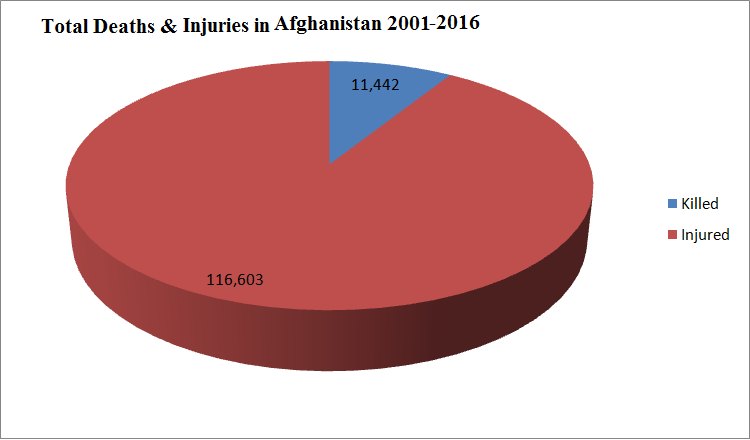
In spite of the long stay of the NATO forces in Afghanistan, security apparatus of the country has undergone many ups and downs, while the threat of insurgency still haunts the mind of the lay man. Since 2001 to mid-2016, a total of 111,000 people have been killed while 116,000 have been injured in Afghanistan. Of the dead people, more than 31000 are Afghan civilians (Crawford 2016). Products of opium and related items still serve as the main source of income and revenue generation for most of Taliban and other insurgent groups though this practice was done away with during the regime of Taliban. Currently the insurgents and related networks are mainly financed through the opium, practice of kidnapping and abduction and the resultant ransom (Department of Defence, 2015). Attacks by Taliban got intensified in the post death scenario of Mullah Omer, since Mullah Mansour wanted to strengthen his position as an undisputed ruler of Taliban (Lewis, McFate, Denburg, & Forest, 2015,p,1).
Human Death Casualties
As a result of the U.S intervention in Afghanistan huge number of people including both security personnel and civilians has been killed. An estimate shows the number of civilians as 31,000 but this may be even greater. The war in Afghanistan intensified in 2007 with a gradual increase each year. It saw a little decease in 2012 followed by an increase in 2013 and 2014 and 2015 but there was a slow decrease in 2015 but it again intensified in 2016 (Crawford, 2016,pp 3-6). The graph below represents the number of civilian death casualties in Afghanistan during the stipulated time.
Graph showing civilian casualties (2001 to 2016)
A report of the UN mission states that the sacrifices made by the civilian people as well as by the government functionaries shows a percentage of 41% in direct clashes. The gradual ups and downs in the death toll of both civilian and law enforcement agencies show the same ratio in the stipulated time (Crawford, 2017, pp 2-6.
Graph showing Deaths and Injuries in Afghanistan (2001-2016)
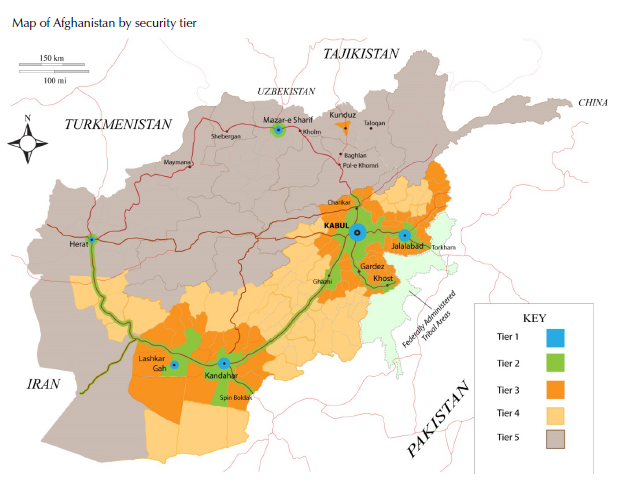
The threat of ISIS has also been seen in some parts of Afghanistan, particularly in Afghanistan's Wilayat- Khorasan where they have been fighting against Taliban and the government for asserting their authority (Lewis, McFate, Denburg, & Forest, 2015 p 1). The ISIS has also presence in Nangarhar where it faces stiff resistance from the security agencies of Afghanistan and the residuary forces of the ISAF (Fahim, November 5,2015). The Institute for Study of War, conducted a survey in Afghanistan for a period of Six months (July to December 2015), examining all the key areas of the country with the conclusion that the areas under study were disposed to threats from the insurgents. Moreover, the study was taken a fresh whereby it was concluded that 200 Districts out of 409 were receiving threats from insurgents (ISW, 2016). The result during the stipulated period may change from time to time, as situation deteriorated in Heart that was a little better. This shows the saturation and deployment of the Taliban and other insurgents in various parts of the country as per their own strategy. The status quo of Kunduz may also present a different picture since it was seized in September 2015 by Taliban but was recaptured by the government of Afghanistan in October 2015. So, the threat posed by the ISIS is two-pronged; one is aimed at the government of Afghanistan while the other is aimed at the Taliban. This shows the clash of interest between the Taliban and the ISIS. One thing is very clear that both the Taliban and the ISIS are directed against the government and security agencies of Afghanistan and the ISAF.
Unity among Taliban is also a far cry for them though they remained united under the charismatic leadership of Mullah Omer but his death in July 2015 created a huge gap among the circles of Taliban. The leadership of the new commander, Mullah Mansour was soon challenged resulting into two factions; one led by Mullah Mansour while the other was led by Mullah Rasool Akhund. One factor for the increasing saturation of the ISIS is the disunity among the various circles of Taliban. Now, it is very difficult to draw a clear demarcating line whether the attacks of insurgency in the country are caused by Taliban or the ISIS or the ISL. The situation in Zabul and Kunar may present such a picture where there are many safe havens for the Taliban and other Insurgent groups. The main objective of the insurants in these areas is either to use defensive line or strive to work for the consolidation of their position. Where they are a little bit strong, they exercise offensive measures against the provincial headquarters and other key Distircts while keeping themselves involved in the frontline position against the security agencies.
The Pak- Afghan border has proved to be another nourishing ground for the insurgents and the terrorists since it remains porous on many points. This border is another of great concern for the security agencies of the two neighboring countries of both Afghanistan and Pakistan. The insurgents and Taliban had made sanctuaries in the hidden areas, most of which were cleared by the various military operations by Pakistan. Being the staging ground for the various insurgent groups such as the Al-Qaeda, the Haqqani network, Lashkar-e Tayyiba (LeT), Tehrik-e-Taliban Pakistan (TTP), the Islamic State of Iraq and the Levant - Khorasan Province, and the Islamic Movement of Uzbekistan (IMU), has also been responsible for the worsening law and order situation in both Afghanistan and Pakistan. It is this border that has compelled the two neighboring countries on the blame game and counter blame game propaganda. But, clearing up the area of the insurgent activities and dismantling the sanctuaries therein still remains a great challenge for the security agencies of the two countries.
Map of Afghanistan
Conclusion
It is a fact that the episode of 9/11 was the most crucial point in the history of the world and particularly in the history of Afghanistan. It was this episode that got engaged the NATO and its allied forces in Afghanistan having far reaching ramifications. As of November 2015, the NATO led Resolute Support Mission comprised 11,385 while Non-NATO forces comprised 1,725, amounting the total security forces to 13, 110. Since 2001 to mid-2016, a total of 111,000 people have been killed while 116,000 have been injured in Afghanistan. During the period from 2001 to mid-2016, some of the provinces of Afghanistan that witnessed insurgency and attacks from Taliban include Zabul, Kunar, Kandahar, Kunduz, Paktia, Paktika and Khost. The activities of Taliban have been both offensive and defensive in nature. In the former case, they took recourse to offensive activities in the areas where their position was stronger while in the latter case they had to embark upon defensive strategies when operations were conducted by the law enforcement agencies of both Afghanistan and the ISAF. Nowithstanding this, the performance of the security forces of Afghanistan has laso been not weak as in some cases they repulsed the Taliban and insurgents despite their hard struggle. Esa Khan is one such example of the security forces who murdered a militant in the vicinity of Afghan Parliament.
References
- Ahmad, Azam. ""Powerful Afghan Police Chief Killed in Kabul,"." http://.nytimes.com/2015/03/20/world/asia/powerful-afghanpolice-chief-killed-in-kabul.html?_r=o, 03 15, 2015.
- Brown, Vanda Felbab. President Trump's Afghanistan policy:Hopes and pitfalls. Washington DC: Foreign Poicy at Brookings, 2017.
- Crawford, Neta C. "Update on the Human Costa of War for Afghanistan and Pakistan, 2001 to mid-2016." (Watson Institute, International and Public Affairs, Brown University) August 2016. Department of Defence, United States of America. Enhancing Security and Stability in Afghanistan. Department of Defence, Department of Defence, Report to Congress, 2015.
- Fahim, Zareek. "28 Daesh fighters killed in ongoing Achin offensive", Pajhwok
- Afghan News. November 5, 2015.
- Giustozzi, Antonio. Koran, Kalashnikov,and Laptop: The New Taliban Insurgency in Afghanistan,2002-2007. London: Hurst, 2007.
- Guistozzi, Antonio, and Christoph Reuter. The Insurgents of the Afghan North:
- The rise of the Taliban, the self-abandonment of the Afghan government
- and the effects of ISAF's 'capture-and-kill-campaign'. Thematic Report , Afghanistan Analysis Network, Afghanistan Analysis Network., 2011.
- Guistozzi, Dr. Antonio. Taliban Networks in Afghanistan. United States New
- Rhodes Island: CIWAG Case Study on Irregular Warefare and Armed Groups, United States Naval WarCollege Newport, Rhode Island www.aan.afghanistan.org, 2011-2012.
- Guistozzi, Antonio, and Christoph Reuter. The Insurgents of the Afghan North:
- The rise of the Taliban, the self-abandonment of the Afghan government and the effects of ISAF's 'capture-and-kill-campaign'. Thematic Report , Afghanistan Analysis Network, Afghanistan Analysis Network., 2011.
- Katzman, Kenneth, Afghanistan: Post-Taliban Governance, Security, and
- U.S.Policy. Congressional Research Service, 2015.
- Katzman, Kenneth, Afghanistan:Post Taliban Governance Security and U S
- Policy. 25. Washington D C: Congressional Research Service RL 30588, 8 August 2013.
- Katzman, Kenneth, and Clayton Thomas. Afghanistan: Post-Taliban
- Governance, Security, and U.S. Policy. Congressional Research Service, 7-5700, www.crs.gov RL30588, 2017, 20.
- Lewis, Jessica, McFate, Rob Denburg, and Caitlin Forest. "Afghanistan Threat
- Assessment: The Taliban and ISIS." Institute for thec Study of War, Backgrounder (Institute for thec Study of War, Backgrounder,www.understandingwar.org.), December 2015.
- Norland, Rod. ""Taliban End Takeover of Kunduz After." October 13, 2015.
- Press, Khaama. "Car bomb explosion rocks Sherpoor area of Kabul city".
- December 11, 2015. Report, Asia. The Insurgency in Afghanistan's Heartland. International Crisis Group,Asia Report No. 207, 27 June 2011, 2011.
- Schroden, Jonathan, Catherine Norman, and Jerry Meyerle. Independent
- Assessment of the Afghan National Security Forces. Washington D C, , 2014.
Cite this article
-
APA : Tariq, M., Afridi, M. K., & Minhas, A. S. (2018). An Analysis of Insurgency in Afghanistan (2001 - 2016). Global Social Sciences Review, III(II), 131-145. https://doi.org/10.31703/gssr.2018(III-II).09
-
CHICAGO : Tariq, Muhammad, Manzoor Khan Afridi, and Ahmed Saeed Minhas. 2018. "An Analysis of Insurgency in Afghanistan (2001 - 2016)." Global Social Sciences Review, III (II): 131-145 doi: 10.31703/gssr.2018(III-II).09
-
HARVARD : TARIQ, M., AFRIDI, M. K. & MINHAS, A. S. 2018. An Analysis of Insurgency in Afghanistan (2001 - 2016). Global Social Sciences Review, III, 131-145.
-
MHRA : Tariq, Muhammad, Manzoor Khan Afridi, and Ahmed Saeed Minhas. 2018. "An Analysis of Insurgency in Afghanistan (2001 - 2016)." Global Social Sciences Review, III: 131-145
-
MLA : Tariq, Muhammad, Manzoor Khan Afridi, and Ahmed Saeed Minhas. "An Analysis of Insurgency in Afghanistan (2001 - 2016)." Global Social Sciences Review, III.II (2018): 131-145 Print.
-
OXFORD : Tariq, Muhammad, Afridi, Manzoor Khan, and Minhas, Ahmed Saeed (2018), "An Analysis of Insurgency in Afghanistan (2001 - 2016)", Global Social Sciences Review, III (II), 131-145
-
TURABIAN : Tariq, Muhammad, Manzoor Khan Afridi, and Ahmed Saeed Minhas. "An Analysis of Insurgency in Afghanistan (2001 - 2016)." Global Social Sciences Review III, no. II (2018): 131-145. https://doi.org/10.31703/gssr.2018(III-II).09