
- Bamboo-reinforced beams have shown strong performance during initial testing phases, demonstrating its potential as a reliable reinforcement material.
- However, long-term challenges, such as moisture absorption and bond degradation, need to be addressed to ensure bamboo's consistent reliability.
- Through improved treatment methods, these issues can be effectively managed, significantly enhancing bamboo's durability and performance.
- Hybrid reinforcement strategies, which combine bamboo with other materials, offer promising results for improving structural integrity.
- This study underscores bamboo's potential as a cost-effective and eco-friendly reinforcement solution.
- The findings encourage the adoption of sustainable construction practices, promoting bamboo as a viable alternative to traditional reinforcement materials.
- Durability Enhancements: Investigate and test different enhanced treatment processes in order to increase bamboo's capability of resisting moisture and other conditions.
- Hybrid Reinforcement: Further research the utilization of bamboo steel hybrid reinforcement to obtain the best compromise between material cost, gauge, and durability.
- Species Selection: Research is needed to compare different bamboo species with a view to determining which one possesses the best mechanical and durability characteristics.
- Fire Resistance Studies: Conduct a series of tests to evaluate the increase of fire resistance of bamboo concrete and the solution for main safety issues.
- Standardization: Create protocols containing the methods for applying such a reinforcement material as bamboo.
- Sustainability Analysis: Carry out extensive life cycle assessments so as to determine the extent of environmental benefits that are expected from the use of bamboo in construction activities.
- Application Expansion: Assess the possibility of carrying bamboo reinforcement to other high-rise structures apart from low-rise constructed facilities.
- ASTM A615 - Specification for Deformed and Plain Carbon-Steel Bars for Concrete Reinforcement
- ASTM C192 - Practice for Making and Curing Concrete Test Specimens in the Laboratory
- ASTM C293 - Test Method for Flexural Strength of Concrete (Using Simple Beam with Center-Point Loading)
- ASTM D143 - Test Methods for Small Clear Specimens of Timber
- ASTM D3039 - Test Method for Tensile Properties of Polymer Matrix Composite Materials
- ISO 22157 - Bamboo: Determination of Physical and Mechanical Properties
- ASTM A370 - Test Methods and Definitions for Mechanical Testing of Steel Products
- ISO 6892 - Metallic Materials: Tensile Testing at Ambient Temperature
Abstract
The high costs and the increased negative effect on the environment when using steel-reinforced concrete prompted the studies on sustainability with bamboo recognized as green steel. Bamboo is a versatile, sustainable, and affordable material, which has great tensile strength. This research assesses the viability of bamboo as a reinforcement candidate in structural concrete based on its mechanical properties and compares it with steel. Tensile and flexural strengths of the reinforced concrete beams enclosed with bamboo or steel and plain concrete respectively were investigated on days 7, 14, and 28. RC beams strengthened with bamboo provided 95% of the control steel's performance in the 7 days but raised to 69% at 7 days later because of moisture lump and bond deterioration. Nevertheless, bamboo is even cheaper than steel and costs 58% less.
Introduction
Reinforced concrete is widely used in modern construction, as it is the only material that is able to bear both compressing and tension forces when reinforced with steel. However, based on the current trends of the rise in the price of steel, its environmental effects have prompted people to look for more efficient materials that will not only be costly but forceful. This has mortally led to an investigation into the use of bamboo as reinforcement in concrete structures. Bamboo is an herbaceous, perennial plant, which develops very fast and grows in tropical and subtropical zones. This makes it attractive especially due to its high tensile strength as a reinforcement material in low-rise structures and buildings with negligible factor importance. Besides, being environmentally friendly, bamboo is renewable, biodegradable, and cheap as compared to steel especially in areas of low-cost construction, especially in third-world countries. Some studies have established that bamboo possesses an absolute possibility of offering tensile and flexural strength comparable to that of steel in certain applications. Unfortunately, some challenges remain namely; This work also identifies the effect of moisture and biological degradation on bamboo's durability due to its natural characteristics that make it sensitive to those factors in the environment. These factors can degrade the bamboo's load-bearing capabilities, which makes pre-treatment and design interventions essential to improve both the durability and fabrication of bamboo as reinforcement for concrete structures. When compared to the bond between steel and concrete, the bond between bamboo and concrete is weak, and extra efforts are needed to enhance this bond and further performance improvement. This research seeks to provide a comprehensive assessment of the performance of bamboo as reinforcement materials in concrete. Through comparative analysis of results from bamboo-reinforced, steel-reinforced, and normal concrete beams, this research aims to contribute to the existing literature on the feasibility of bamboo as a sustainable, more economically cheaper material in construction. Special emphasis will therefore be placed on the estimates of tensile and flexural strengths of the bamboo reinforcement, economic feasibility analysis, and long-term sustainability of the bamboo rebar in relation to its relative performance.
Literature Review
Bamboo has received immense focus as a reinforcement material because of its remarkable mechanical characteristics and sustainability. It has also been stressed in many works as giving a perspective of being an excellent substitute for steel, and where steel is expensive or unavailable. Research by Kumar et al. (2021) proved how strong bamboo fiber is, sometimes, stronger than mild steel in some circumstances. They discovered that it is feasible to exploit bamboo to counter tensile forces if suitably treated and incorporated into reinforced concrete beams. Adhikari et al. (2021) further showed that bamboo-reinforced concrete slabs could provide a similar structural capacity and durability to that of steel-reinforced concrete slabs, particularly in low-stress situations. Rahman et al. (2019) The paper assessed the flexural capacity of the bamboo-reinforced concrete beams based on load distribution and crack control provided by bamboo. However, they pointed out that the strength-to-weight ratio in bamboo was slightly lower than that of steel and this could pose a problem in terms of deflection under equal loads thereby reducing its competence under stress-bearing applications.
There is however a main difficulty in utilizing bamboo as reinforcement - it is very sensitive to moisture and biological attacks. Singh et al. (2021) emphasized the fact that the bamboo surface has to be treated with alkali or silane-based coatings since it easily absorbs moisture, and this would also improve bonding between bamboo and concrete. Additionally, Duarte et al. (2022) emphasized the importance of using scientific procedures that would prevent the deterioration of the bamboo and produce a uniformly high-performance material. Duarte et al. (2022) also pointed out an addendum to concreting that bamboo reinforcement was environment friendly than steel in terms of emission of carbon dust, and was characterized by lesser embodied energy than the metal. Afolayan et al. (2020), then they also performed an economic feasibility study and found out that bamboo reinforcement could potentially cut a lot of costs in construction and that cost savings could amount to lots of money when compared to other conventional materials, particularly in the developing world where bamboo is native and cheap. Silva et al. (2022) carried out research focused on the use of both bamboo and steel reinforcement bars. They also noted that in their study, they realized that hybrid beams tend to take advantage of the advantages inherent in both materials in the sense that they would better the beam performance by a notch in terms of flexibility, strength, and cost. These sorts of mixed models seem to offer a sustainable way forward to address bamboo shortcomings while keeping its economic and ecological value propositions.
Conclusion of Literature Review
This research showed great promise in bamboo as an effective, cheaper, and environmentally friendly substitute for steel bars in concrete structures. It is fast growing, cheaper than steel or aluminum, and reusable these are key factors that make bamboo an ideal option, especially for low-cost environmentally friendly buildings and structures. However, some problems are still experienced, for example, the polybag is moderately sensitive to moisture, bio-degradable, and has a poor fire rating. These challenges must be overcome to optimize bamboo as a reinforcement material The above challenges must be overcome in order to optimize the use of bamboo as a reinforcement material. Hybrid reinforcement techniques involving bamboo and steel, and other previously explored novel treatment methodologies promise to significantly enhance the bamboo performance and sustainability. These approaches are intended to improve the adhesion of the concrete and overcome what is detrimental to bamboo such as moisture content that reduces its durability over time. Further, more promotion of these treatments and rewards to maintain orientation over bamboo and see sustainable integration into official construction. Further research of such phenomena as well as constant work on the creation and improvement of these rather standardized guidelines remain imperative. For bamboo to be used more effectively in the construction industry, improvements can be made in the techniques of treatment as well as in the search for better methods of reinforcing the fiber. This progress will make a new step forward to the coming of the new era of environmentally friendly buildings and constructions all over the region.
Materials and Methodology
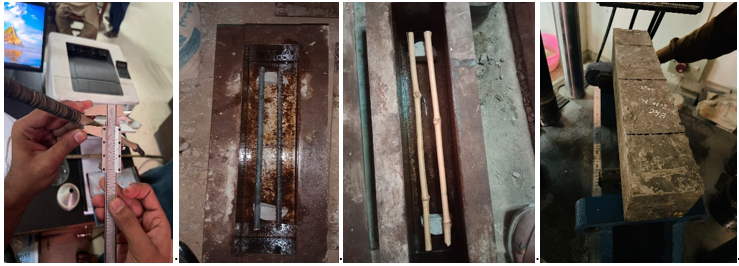
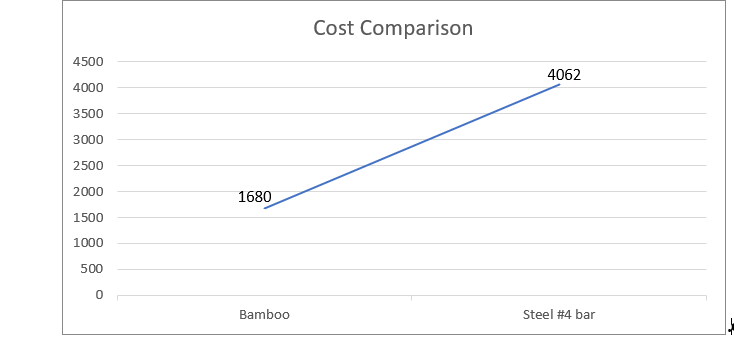
With regard to these specific objectives, the choice of materials and methods for carrying out this study was informed by guidelines on the testing of reinforced concrete. All the used materials were selected to be as uniform as possible and meet most of the industry requirements. The most important ingredient, that acted as the binder in the concrete mix, was Cement which is referred to as Ordinary Portland cement. Bolari sand was chosen as a fine aggregate due to its good grading and sustainability; which are crucial for shearing good concrete mixture. Coarse aggregate was crushed stone with a maximum size of 25mm which gave the concrete bulk and strength since they met the ASTM C31 requirement of the flexural strength. Bamboo culms of 12.5mm diameter were employed as reinforcing steel in the concrete beams. Primary reinforcement material used for comparison study: Steel bars, #4 steel bars (12.5 mm diameter). Most of these steel bars complied with the ASTM A615 requirements, thus they were stable in their performance. Fresh water was used in making the concrete and also in the curing of the concrete through satisfactory hydration and strength gain. Three types of specimens were prepared using concrete beams of 100 mm × 100 mm × 500 mm each. Normal concrete beams without any reinforcement formed part of the control beams needed for determining the characteristic flexural strength of the concrete mix. Concrete-bamboo composite Beams use two bamboo culms arranged along the length of the beam in the effective tensile stress region in the bottom part of the beam. Horizontal continuity reinforcing bars consisted of two #4 steel bars in the tension zone in the direction of the span, as is bamboo culm plies in bamboo composite beams, and in accord with the standard practice of concrete construction. The concrete mix was prepared using a 1:C:Sand: Coarse aggregate = 2:4 and the water-cement ratio is 0.55. The materials were thoroughly dry-mixed to ensure uniformity before water was added incrementally to achieve the desired consistency. The mix was then poured into molds and compacted using vibration for 50 seconds to eliminate air voids, ensuring proper compaction and bond between the concrete and reinforcement. After 24 hours, the specimens were de-molded and submerged in water tanks for curing. The curing process lasted for 7, 14, and 28 days, following ASTM C192 guidelines to facilitate adequate hydration and strength development. For tensile strength testing, bamboo culms and steel bars were subjected to tensile loading using a Universal Testing Machine (UTM). The stress-strain relationship, ultimate tensile strength, yield strength, and elastic modulus were recorded according to ASTM D143, ASTM D3039, ISO 22157 for bamboo, and ASTM A370, ISO 6892 for steel. Flexural strength testing assessed the performance of plain, bamboo-reinforced, and steel-reinforced concrete beams under center-point loading using a UTM following ASTM C293 standards. The load was applied gradually at a constant rate until failure, recording the maximum load and corresponding deflection. Finally, a cost analysis was conducted to evaluate the economic feasibility of using bamboo as a reinforcement material compared to steel. For a 12-foot beam, the cost of bamboo reinforcement was compared to that of steel reinforcement, considering the quantity and price per unit. Bamboo reinforcement was estimated to cost between 30-35 rupees per foot, whereas steel reinforcement cost 280 rupees per kilogram. The weight of steel reinforcement was calculated using the formula:
W=π/4×d2×L×490
Where,
d is the diameter in feet,
L is the length of feet, and
W is the weight in kilograms.
Results and Discussion:
Tensile Strength
The tensile strength tests highlighted clear differences between bamboo and steel reinforcement. Bamboo culms showed ultimate tensile strengths ranging from 149 to 204 MPa, depending on their diameter and treatment, with slight elongations resulting in strains of 0.01 to 0.02. On the other hand, steel #4 bars demonstrated a much higher ultimate tensile strength of 479 MPa and a yield strength of 328 MPa, with a strain of 0.14. Steel's significantly higher elastic modulus also confirmed its greater stiffness. While bamboo offers notable tensile strength, the results clearly show that steel outperforms it in terms of both maximum strength and rigidity.
Tensile Strength Test
| Material | Diameter (mm) | Length (cm) | Length after Elongation (cm) | Change in Length (cm) | Ultimate Stress (MPa) | Yield Stress (MPa) | Strain |
| Bamboo Culm | 11.4 | 50.9 | 51.6 | 0.7 | 149 | - | 0.01 |
| 12.6 | 47.2 | 47.7 | 0.5 | 161 | - | 0.01 | |
| 14.4 | 50.6 | 51.9 | 1.3 | 204 | - | 0.02 | |
| Bamboo Culm Folded with Wire | 12.4 | 50.7 | 50.7 | 0 | 37 | - | - |
| Steel #4 Bar | 12.6 | 45.6 | 52.1 | 6.5 | 479 | 328 | 0.14 |
Figure 2
Tensile strength test graph
The decrease in ultimate stress observed in bamboo culms folded with wire highlights how reinforcement techniques can influence mechanical performance. Untreated bamboo showed higher tensile strength compared to the folded configuration, emphasizing the critical role of preserving bamboo's structural integrity during reinforcement processes.
Flexural Strength
Flexural strength tests were conducted on concrete beams cured for 7, 14, and 28 days. The results are summarized in Tables 4.2, 4.3, and 4.3.
Flexural Strength Test @7 Days
| Material | Load (N) | Length (mm) | Breadth (mm) | Depth (mm) | Flexural Strength @7 Days (MPa) |
| Plain Concrete | 1890 | 300 | 100 | 100 | 0.85 |
| 1990 | 300 | 100 | 100 | 0.89 | |
| 2110 | 300 | 100 | 100 | 0.95 | |
| Bamboo Reinforced | 13990 | 300 | 100 | 110 | 5.20 |
| 14320 | 300 | 100 | 110 | 5.32 | |
| 14560 | 300 | 100 | 110 | 5.41 | |
| Steel Reinforced | 30730 | 300 | 105 | 155 | 5.48 |
| 31550 | 300 | 105 | 155 | 5.62 | |
| 31700 | 300 | 105 | 155 | 5.65 |
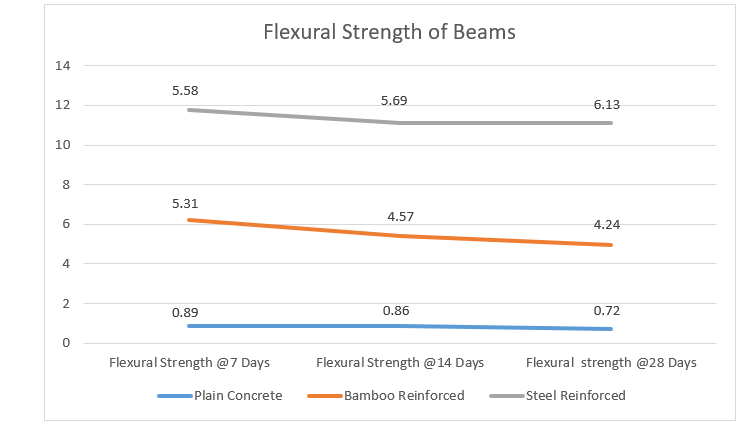
At 7 days of curing, bamboo-reinforced concrete beams demonstrated flexural strengths remarkably close to those of steel-reinforced beams, achieving performance levels between 94% and 96% of steel reinforcement. This finding underscores bamboo's potential as an effective alternative to steel in enhancing the early-stage flexural strength of concrete. Bamboo-reinforced beams achieved flexural strengths ranging from 5.20 to 5.41 MPa, while steel-reinforced beams exhibited strengths between 5.48 and 5.65 MPa. These results have shown that bamboo reinforcement offers significant early-age structural contribution which is very important where a quick construction program or strength gains are desired. Also, bamboo is environmentally friendly and cheaper making construction from it favorable especially for regions with bamboo reserves.
Flexural Strength Test @14 Days
| Material | Load (N) | Length (mm) | Breadth (mm) | Depth (mm) | Flexural Strength @14 Days (MPa) |
| Plain Concrete | 1890 | 300 | 100 | 101 | 0.79 |
| 2020 | 300 | 100 | 102 | 0.85 | |
| 2100 | 300 | 101 | 100 | 0.91 | |
| Bamboo Reinforced | 14100 | 300 | 100 | 113 | 4.48 |
| 14520 | 300 | 101 | 111 | 4.60 | |
| 14700 | 300 | 102 | 110 | 4.65 | |
| Steel Reinforced | 31850 | 300 | 106 | 155 | 5.58 |
| 32640 | 300 | 105 | 157 | 5.72 | |
| 32910 | 300 | 104 | 156 | 5.78 |
In the development of the desired flexural strength after 14 days of curing, the bamboo-reinforced concrete beams attained a range of 80.3% - 80.5% as that of the steel-reinforced beams. The measured flexural strength for bamboo-reinforced beams varied between 4.48 to 4.65 Mpa and steel steel-reinforced beams between 5.58 to 5.78 Mpa. Comparing bamboo with other construction materials, the decline in its relative performance from 7 to 14 days expresses the ability of the material to absorb moisture and deteriorate bond strength. However, this find shows that bamboo reinforcement further improves the flexural strength of concrete during that post-cruck intermediate curing period in a manner that would contribute to the early load-bearing characteristics of reinforced beams. Despite the fact that steel is available with higher absolute flexural strength by far than bamboo, the study pricks the ears of the possibility of bamboo as an effective and efficient reinforcement material for years to come in lieu of its absolute flexural strength where bamboo is an accessible material over several regions across the world and has other benefits over steel such as sustainability and cost-effectiveness. These results highlight the need for more improvements in practice approaches and design and treatment procedures to enhance the efficiency of bamboo for structural use.
Flexural Strength Test @28 Days
| Material | Load (N) | Length (mm) | Breadth (mm) | Depth (mm) | Flexural Strength @28 Days (MPa) |
| Plain Concrete | 1470 | 300 | 103 | 105 | 0.664 |
| 1600 | 300 | 102 | 106 | 0.712 | |
| 1690 | 300 | 104 | 105 | 0.76 | |
| Bamboo Reinforced | 10095 | 300 | 105 | 111 | 4.144 |
| 10640 | 300 | 104 | 110 | 4.256 | |
| 10870 | 300 | 105 | 111 | 4.328 | |
| Steel Reinforced | 32150 | 300 | 105 | 148 | 6.006 |
| 32870 | 300 | 104 | 147 | 6.182 | |
| 33100 | 300 | 105 | 146 | 6.215 |
The concrete beams with bamboo reinforcement developed flexural strength of 4.144 to 4.328 MPa at 28 days of compression, where it was about 68.9% to 69.6% of that of steel-reinforced beams, which ranged from 6.006 to 6.215 MPa. These declines are attributed to moisture uptake in aggregate and progressive failure of interfacial bonding between concrete and bamboo causing structural performance deterioration in flexure. Despite this reduction, bamboo continues to significantly enhance concrete strength compared to plain concrete, which achieved flexural strengths ranging from 0.664 to 0.76 MPa. Bamboo remains a sustainable and cost-effective option for structural reinforcement, particularly in regions where bamboo is locally available, and steel is less economically feasible. Ongoing research into improving treatments and bonding techniques will be essential to optimizing bamboo's performance for long-term applications.
Discussion
The results from flexural strength tests conducted over various curing periods highlight bamboo's promising potential as a reinforcement material for concrete. In the early stages (7 days), bamboo-reinforced beams demonstrated almost identical performance to steel-reinforced beams, showing that bamboo can provide strong structural support right from the start. However, the observed decline in flexural strength by 28 days points to a key limitation: bamboo's bond with concrete tends to weaken over time, likely due to moisture absorption and biological factors that affect its long-term durability.
From an economic standpoint, bamboo reinforcement presents a clear cost advantage. Each bamboo is approximately 58% cheaper than steel for a generally 12-foot beam, which may save considerable capital and have an outstanding promising potential - particularly in areas with a ready supply of bamboo and friendly prices. This makes bamboo ideal for use where economical and where steel reinforcement may be unaffordable or difficult to procure.
Nonetheless, the following advantages have been well illustrated: The long-term durability of concrete and a good bond between bamboo and concrete is still challenging. The steady reduction of flexural strength over time supports the call for better treatment measures to increase bamboo's durability against moisture and biome agents. To overcome these challenges, further studies need to be directed towards improving the treatment technology for extending the bamboo service life so that it would still remain ideal for use as a reinforcement material. Also, further research in the use of a heterogeneous reinforcement of bamboo and steel may also complement each other to offer better structural performance, economy, and sustainability.
Conclusion
Many researchers have suggested that bamboo as a reinforced material for concrete is more effective and sustainable than steel.• The suitability of the proposed method is even more apparent in operations with high costs and environmental effects.• Bamboo reinforced beams are also promising and have displayed good results in the early testing structures to establish their effectiveness as a reinforcing material.• However, the following long-term issues which include moisture absorption and eventual bond breakdown present themselves as critical issues for bamboo to respond to so as to meet a constant dependable performance.• These problems however can be dealt with through better treatment processes thus greatly improving the performance and strength of bamboos.•The results regarding the reinforcement of concrete using bamboo as a hybrid reinforcement scheme were encouraging.• The findings of this paper reveal how bamboo can be the best and most affordable reinforcement in the current market.• The results can specifically be employed to advocate for the use of sustainable construction practices through the usage of bamboo as a replacement for the typical reinforcement material. Implications where cost and environmental impact are significant concerns.
Recommendations
Appendices:
Appendix A: Standards and Codes Used in This Research
To ensure the accuracy, reliability, and reproducibility of the tests conducted in this study, internationally recognized standards and codes were utilized. These standards governed the preparation, testing, and analysis of the materials and specimens, allowing for a structured and consistent approach throughout the research process:
This standard defines the mechanical properties required for steel bars used in reinforced concrete, such as tensile strength, yield strength, and ductility. In this study, #4 steel bars (12.5 mm in diameter) were tested against these specifications. These steel bars served as a benchmark for comparing the performance of bamboo reinforcement in concrete beams.
The concrete beams used in this research were prepared and cured following ASTM C192. This standard specifies the processes for mixing, molding, and curing concrete specimens in controlled laboratory conditions. The curing durations of 7, 14, and 28 days ensured that the beams achieved the required hydration and strength development for accurate flexural testing.
This standard outlines the procedure for determining the flexural strength of concrete beams under center-point loading. It was used to evaluate the performance of plain concrete beams, bamboo-reinforced beams, and steel-reinforced beams. The methodology ensured precise measurement of maximum load and deflection, providing comparable data across all reinforcement types.
Bamboo, being a natural material similar to timber, was tested for its mechanical properties following ASTM D143. This standard provided detailed procedures for assessing tensile strength, elasticity, and the stress-strain behavior of bamboo culms under applied loads.
This standard was adopted to test bamboo culms due to their natural composite-like structure. It provided a comprehensive framework for measuring tensile strength and stress-strain relationships. The results were critical for understanding the tensile behavior of bamboo and comparing it to steel.
This international standard was specifically designed for evaluating bamboo. It included detailed guidelines for specimen preparation, testing conditions, and analysis of physical and mechanical properties, such as tensile strength, elasticity, and density. This standard ensured that bamboo's performance was measured accurately and consistently.
The tensile properties of steel reinforcement bars were determined using ASTM A370. This standard outlines the procedures for testing steel products to measure yield strength, tensile strength, elongation, and reduction in area. It provided robust data for comparing steel's mechanical properties with bamboo.
This international standard complements ASTM A370 by providing a framework for tensile testing of metallic materials under controlled conditions. It was used to ensure precise and reliable results for steel bars, particularly in evaluating their stress-strain behavior at room temperature.
References
- Adhikari, R., Shrestha, R., & Pokhrel, S. (2021). Comparative study of bamboo and steel reinforced concrete slabs: Structural performance and durability. Construction and Building Materials, 272, 121809.
- Afolayan, J. O., Fagbenle, O. A., & Oyedele, K. A. (2020). Economic feasibility of bamboo as reinforcement in concrete elements for developing countries. Sustainable Materials and Technologies, 24, e00172.
- Duarte, G., De la Rosa, I., Serrano, L., & Cordeiro, P. C. (2022). Life cycle assessment of bamboo-reinforced concrete slabs: A comparative study with steel reinforcement. Journal of Cleaner Production, 363, 132422.
- Kumar, P., Gautam, P., Kaur, S., Chaudhary, M., Afreen, A., & Mehta, T. (2021). Bamboo as reinforcement in structural concrete. Materials Today Proceedings, 46, 6793–6799. https://doi.org/10.1016/j.matpr.2021.04.342
- Rahman, M., Alam, M., & Hossain, M. (2019). Performance evaluation of bamboo-reinforced concrete beam. Journal of Engineering and Technology, 11, 142–146.
- Silva, J. A. B. O., Figueiredo, A. L., & Melo, C. R. (2022). Hybrid bamboo-steel reinforced concrete beams: Experimental and numerical investigations. Journal of Materials in Civil Engineering, 34(12), 04022243.
- Singh, S. B., Singh, B., & Rani, J. (2021). A review on the durability of bamboo reinforced concrete. Materials Today: Proceedings, 47, 1079–1084.
Cite this article
-
APA : Soomro, R., Abideen, Z. U., & Aqsa, A. U. (2024). Sustainable Reinforcement in Concrete: Evaluating Bamboo’s Flexural Strength, Cost Benefits, and Material Properties. Global Social Sciences Review, IX(IV), 231-240. https://doi.org/10.31703/gssr.2024(IX-IV).21
-
CHICAGO : Soomro, Rabia, Zain Ul Abideen, and Aqta Urf Aqsa. 2024. "Sustainable Reinforcement in Concrete: Evaluating Bamboo’s Flexural Strength, Cost Benefits, and Material Properties." Global Social Sciences Review, IX (IV): 231-240 doi: 10.31703/gssr.2024(IX-IV).21
-
HARVARD : SOOMRO, R., ABIDEEN, Z. U. & AQSA, A. U. 2024. Sustainable Reinforcement in Concrete: Evaluating Bamboo’s Flexural Strength, Cost Benefits, and Material Properties. Global Social Sciences Review, IX, 231-240.
-
MHRA : Soomro, Rabia, Zain Ul Abideen, and Aqta Urf Aqsa. 2024. "Sustainable Reinforcement in Concrete: Evaluating Bamboo’s Flexural Strength, Cost Benefits, and Material Properties." Global Social Sciences Review, IX: 231-240
-
MLA : Soomro, Rabia, Zain Ul Abideen, and Aqta Urf Aqsa. "Sustainable Reinforcement in Concrete: Evaluating Bamboo’s Flexural Strength, Cost Benefits, and Material Properties." Global Social Sciences Review, IX.IV (2024): 231-240 Print.
-
OXFORD : Soomro, Rabia, Abideen, Zain Ul, and Aqsa, Aqta Urf (2024), "Sustainable Reinforcement in Concrete: Evaluating Bamboo’s Flexural Strength, Cost Benefits, and Material Properties", Global Social Sciences Review, IX (IV), 231-240
-
TURABIAN : Soomro, Rabia, Zain Ul Abideen, and Aqta Urf Aqsa. "Sustainable Reinforcement in Concrete: Evaluating Bamboo’s Flexural Strength, Cost Benefits, and Material Properties." Global Social Sciences Review IX, no. IV (2024): 231-240. https://doi.org/10.31703/gssr.2024(IX-IV).21