
01 Pages : 1-12
- Does credit risk affect the profitability levels of Islamic banks operating in Pakistan?
- Is there any moderating effect of Sharia governance between credit risk and the profitability of Islamic banks operating in Pakistan?
- To what extent does the bank size influence the profitability of Islamic banking institutions?
Abstract
The research investigates how credit risk affects Islamic bank profitability in Pakistan while studying the influence of Sharia governance. Islamic banks manage credit risk differently from traditional banks because they follow Shariah principles that base their operations on profit-and-loss sharing while banning riba interest transactions. This research analyzes NPL effects on bank profitability (ROA) by studying five full-fledged Islamic banks from 2014 to 2023 using Multiple regression analysis. The study demonstrates that Sharia governance through Sharia Board Size and frequency of Sharia Board Meetings functions as a key moderator that enhances the link between credit risk and profitability. Such institutions demonstrate better financial performance because their solid governance systems help them convert their risk exposures into prosperity. Research findings demonstrate that larger bank institutions generate lower profitability because they encounter operational inefficiencies and scale-related operational challenges.
Keywords
Credit Risk, Non-Performing Loans, Return on Assets, Shariah Board Size, Shariah Board Meetings, Bank Size
Introduction
The Islamic banking industry has experienced substantial growth globally, including in Pakistan, where it operates alongside conventional banks under Sharia principles that prohibit interest (riba) and promote profit-sharing and ethical finance (Hassan & Aliyu, 2018; Chong & Liu, 2009). Despite its distinct framework, Islamic banks face traditional financial risks, especially credit risk, which arises when borrowers fail to meet obligations (Khan & Bhatti, 2008). Elevated credit risk reduces profitability by increasing non-performing financing and provisioning requirements (Ali & Puah, 2019). Sharia governance, measured through Sharia Board meeting frequency, plays a moderating role by enhancing compliance, transparency, and due diligence (Abdullah et al., 2011; Ahmed, 2009). Additionally, bank size influences risk and profitability, with larger banks typically possessing stronger risk management frameworks (Srairi, 2010). This study explores the impact of credit risk on Islamic bank profitability in Pakistan, with Sharia governance as a moderator and bank size as a control variable.
A developing country depends on its banking sector as its fundamental support structure. The banking infrastructure of Pakistan maintains both financial sustainability and economic growth. The Pakistan Financial Institutions Ordinance 1962 mandates banks to receive deposits, make investments, and provide services while ensuring proper return on payments. The Pakistani banking sector now contains Development banks (DBS), investment banks (IBs), conventional banks (CBs), Islamic banks (IBs), foreign banks (FBs), and other corporate configurations that have reshaped the sector through their recent integration. Modern technological advancements have increased banking sector performance by creating more competitive conditions between different banking models (Anees et al., 2023).
The global financial industry features Islamic banking as an essential component, particularly in regions where Muslim populations are significant. The financial system of Islamic banking operates differently from conventional banking by banning speculative deals, unclear transactions, and riba-based interest. Islamic banking systems base their operations on risk sharing, profit sharing, and asset-backed transactions (Chong & Liu, 2009; Hassan & Aliyu, 2018; Usmani, 2002). The risk of borrower default affects Islamic banks in the same way it impacts conventional banks and results in substantial damage to their profitability (Sundararajan & Errico, 2002). The implementation of good governance practices, especially Sharia governance, determines risk management strategies that maintain Islamic law compliance (Ahmed, 2009).
The study investigates how effective governance systems can minimize credit risk effects through Sharia governance analysis to maintain financial stability and Islamic principles compliance (Ahmed, 2009). The analysis becomes stronger through bank size control variables because these variables show how structural differences between banks influence both risk management strategies and profitability performance (Srairi, 2010).
The study delivers practical recommendations to Islamic bank managers, regulators, and policymakers through its evidence-based findings about governance and risk management system improvements. Stakeholders and investors can experience increased confidence in Islamic banking organizations because the research provides information about how governance practices boost financial stability (Abdullah et al., 2011). The presented study contributes to academic scholarship about Islamic banking through a detailed evaluation of essential risk management and governance elements. These study findings could be expanded with research examining similar approaches in various economic and geographic contexts. This study's main goals are to increase Islamic finance's awareness of credit risk while creating organizations with better management skills.
Research Questions
Literature Review
Credit risk is defined as the possibility that borrowers will fail to meet their repayment obligations fully or on time, resulting in financial losses to the lending institution (Ramadan et al., 2011). The reduction of such losses necessitates effective credit risk evaluation and management, especially in the context of Islamic banking, which operates under Shariah law prohibiting interest-based transactions and requiring risk-sharing through specific contracts (Mudarabah, Musharakah, Murabahah, Ijarah, Salam, and Istisna).
Numerous studies have identified key bank-specific and macroeconomic determinants of credit risk in conventional banking. For example, Kasana and Naveed (2016) found that capital adequacy ratio and loan loss provisions are positively associated with credit risk in Pakistani banks. Similarly, studies such as those by Riyazahmed and Baranwal (2021) have shown that increased credit risk negatively impacts managerial performance as measured by return on assets (ROA) in Indian banks. Morina (2020) underscores the importance of loan interest rates and ROA for credit risk analysis in Kosovo. Bank size frequently exhibits a negative relationship with credit risk in conventional banks, indicating that larger banks tend to experience lower credit risk, although this finding is not universal (Rajha, 2016; Shah et al.). Other factors such as net interest margin, loan-deposit ratio, and operating efficiency have also been linked to credit risk dynamics in conventional settings (Akram & Rahman, 2018).
Misman et al. (2015) conducted research to study the elements affecting credit risk in Malaysian Islamic banks. The research reveals that bank capital adequacy ratio and financing quality exhibit negative and significant relationships with credit risk. The research results show that Islamic bank ownership mix between local and foreign entities produces separate credit risk patterns when researchers incorporate ownership structure analysis. Islamic banks experience lower credit risks when foreign entities participate in ownership instead of local entities.
According to Ramadan et al. (2011), credit risk describes the potential for obtaining complete original funding or remaining debt payments or any amount of partial payment. The assessment of credit risk emerges as crucial when organizations aim to decrease their losses. Research efforts have concentrated on Islamic bank credit risk management. Islamic banks need specific evaluation procedures that focus on credit risk assessment. Research must be conducted to discover additional factors that contribute to the situation. These research studies include factors from both bank-specific domains and macroeconomic indicators. Islamic banks will be able to create advanced methods for reducing credit risk in the upcoming years. According to Al-Abedallat et al. (2013), board experience together with adverse agreements and influence play a critical role in Pakistani Islamic banks. The relationship between credit risk, growth rate, and size is minimal. Maharmah et al. (2015) established that financing cost, executive skill, credit arrangement, and liquidity have negative effects on credit risk. Organizations should focus on developing methods to minimize credit risk rather than solely relying on expansion and size increases.
Rajha (2016) discovers a favourable correlation between influence and non-performing loans in Pakistani banks. The absence of non-performing loans and advances directly caused credit risk to increase. The absence of a relationship between bank dimensions and credit default risk demonstrates that bigger institutions do not consistently perform better compared to smaller entities. The financial sector growth and development, together with economic expansion, show a clear relationship with credit risk. Abedallat (2016) shows that credit office staff expertise demonstrates a negative relationship with credit risk. In addition to following national bank standards, Pakistani business banks implement their own lending strategies.
The research by Kharabsheh (2019) proves that credit risk has direct links to both the 2008 financial crisis and operational inefficiencies, and loan growth, together with unemployment, bank capital ratios, and other elements. Credit risk consists of multiple components because bank size demonstrates a negative relationship with credit risk. The current state of bank liquidity does not change regardless of their credit risk exposure levels. The presence of credit risk leads to detrimental impacts on bank productivity as well as bank liquidity levels. Garr (2013) examines the elements that affect credit risk levels in Ghana. Government investment, together with financial improvement, has a negative correlation with CEO failures. A nation must reduce credit risk to achieve a healthy economic condition.
Makri et al. (2014) demonstrate that complete credit default arrangements qualify as recognized risk. The relationship between advanced credit debt arrangements proved to be direct with state debt, unemployment, and unpaid debt. The percentage of capital sufficiency demonstrated a negative relationship with credit risk. The success of economic growth and credit risk management requires the use of risky debt arrangements.
Asfaw et al. (2015) established through research that credit risk produces negative effects on profit from value and credit development rate in Pakistani Islamic banks from 2006 to 2012. Proper management of Islamic banks leads to successful risk implementation. Duong et al. (2017) proved that increased market share and size of Islamic banks lead to decreased credit risk. GDP expansion has a negative impact on available credit opportunities. Badly managed credit operations, along with their procedures, create future potential risks for credit. Islamic banks should maintain economic growth through enhanced credit risk management systems.
Duong and Huong (2017) determined through their research that the size and market share of Vietnamese commercial banks demonstrate a negative relationship with their credit risk exposure. This negative influence on corporate operations' risk-taking willingness defines the meaning of this statement. Research showed that GDP growth exhibits a negative relationship with credit risk. Future credit risk shows positive correlations with both rapid loan expansion and inefficient capital utilization, together with inefficient credit controls and management. Real lending interest rates, together with general management effectiveness, failed to demonstrate any effect on credit risk within Vietnamese banks.
Riyazahmed and Baranwal (2021) conducted a study to understand how managerial efficiency connects to credit risk levels in Indian public and private banking institutions. The research bases its credit risk assessment on gross non-performing loans to total advances, and it uses return on assets as the main indicator for managerial success evaluation. Research has shown that increased credit risks lead to negative performance indicators that assess management success levels. The study conducted by Morina (2020) analyzed commercial banking elements in Kosovo throughout quarters from 2012 to 2018. The research establishes interest rates on loans and the return on assets ratio for bank profitability as the primary factors that determine credit risk.
Kasana and Naveed (2016) conducted research that examined both bank-specific aspects and economic variables that impact credit risks in Pakistani banking institutions. Research data demonstrates that the capital adequacy ratio and loan loss provision in a bank create positive links to credit risk assessment. The analysis shows that credit risk develops positive relationships with GDP growth, advances, and operational inefficiency. Research findings show that Pakistan's commercial bank size, together with the bank's return on asset ratio, demonstrates negative and strong correlations with credit risk.
Adzimatinur et al. (2021) demonstrate that Musharakah creates opportunities for Islamic banking institutions to decrease their credit risks. This study investigates how Musharakah financing affects credit risk levels. The authors conclude that Musharakah financing produces positive results for credit risk through their analysis of Islamic institutions' data. The Musharkah ownership structure enables joint responsibility between investors, which leads borrowers toward making sound financial decisions. The problematic financing rate for sharia commercial banks averaged 3.97% throughout the 2012-2017 period, indicating a high risk level in Musharakah financing. The research emphasizes the necessity of proper risk assessment and risk management techniques to minimize funding risks in musharakah.
The literature assessment demonstrates that Islamic banking reduces credit risk when it implements musharakah financing. Credit risk management requires risk-sharing arrangements and ideal capital structures, together with adequate risk assessment frameworks and efficient monitoring systems, according to scholarly research. These study results provide essential knowledge to all financial institutions and investors who participate in Musharakah financing operations. By providing assistance, these institutions serve as tools for risk management plan development and well-educated decision making. Additional studies must explore other factors that affect the connection between credit risk and Musharakah. Musharakah proves effective as a financing method when investors and financial institutions understand all credit risks and their corresponding issues (Nouman et al., 2020).
Theoretical Framework
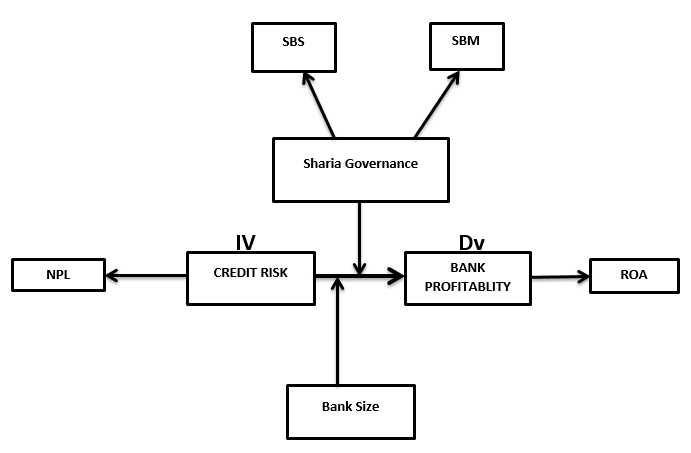
Research Methodology:
Research Design
This study uses a quantitative research approach to examine how credit risk affects Pakistani Islamic banks' profitability while accounting for the moderating effect of Sharia Governance. The correlation and causal research design is used to analyze the relationship between variables using statistical techniques.
Population and Sample
Population: The population for this Study includes All Banks Operating in Pakistan.
Sample Size: This study will use the "Purposive Sampling Technique", Selecting All full-fledged Islamic Banks operating in Pakistan.
Data Collection Period
The study will cover a 5-year period (e.g., 2019-2023). The data from this time frame is adequate to observe how credit risk and Sharia Governance presence affect the profitability of Islamic banks in Pakistan.
The model for this study is as follows:
MODEL1: Profitability= α+β1(CR)+ β2(SBS)+ β3(BS)+ Ɛ
MODEL 2: Profitability= α+β1(CR)+ β2(SBS)+ β3(SBM)+ β3(SBS) + Ɛ
Definition and Concepts of the Variables:
Credit Risk-Dependent Variable
Credit risk is the likelihood that a borrower will default on their loan obligations, leading to potential financial losses for the lender. In banking, it reflects the risk of non-payment of interest or principal by the borrower. Managing credit risk is crucial as it directly affects a bank's profitability and financial stability.
Profitability of Islamic Bank- Independent Variable
A company's ability to make money in relation to its revenue, assets, or equity over a given time period is measured by its profitability. It displays a company's operational efficiency and ability to generate profits after deducting costs. Stronger financial health is shown by higher profitability, which is necessary for long-term growth and sustainability.
Shariah Governance
Islamic banks, which adhere to Shariah laws and regulations, were taken into consideration as an analytical unit in this study. The main goal of shariah governance is to oversee corporate operations in accordance with shariah regulations under the direction of a religious board known as the shariah supervisory board. Conflicts between management and shareholders are intended to be resolved by Shariah governance. Shariah governance is evaluated in this study using the following criteria: Shariah board size, cross-membership, reputation, expertise, and Shariah board qualifications in terms of Fiqh, PhD, and law as safeguards for stakeholders.
Shariah Board Size (SBS)
Understanding Islamic law, contemporary banking and finance, and legal concerns are among the Shariah Board's decisions. Providing SB members with varied technical backgrounds would allow legal Shariah decision-making and greater compliance with Shariah standards, affecting Islamic banks' risk levels. Shariah board size is defined as "the number of members in a Shariah board".
SBS = Number of Shariah scholars on the board
Sharia Board Meeting
This metric indicates the frequency with which an Islamic bank's Sharia Supervisory Board (SSB) convenes. The SSB is responsible for reviewing contracts, ensuring compliance with Islamic financial principles, and providing guidance on Sharia-related matters. Regular meetings signify active oversight and stronger governance practices; therefore, the number of meetings serves as a proxy for the effectiveness of Sharia governance.
Bank Size
Numerous factors, such as the number of workers, total assets, capital expenditures, or share market value, can be used to determine a company's size. Many scholars of strategic management have become interested in firm size as a moderator (Hage, 1980; Ettlie& Rubenstein, 1987; Acs & Audretsch, 1990; Damanpour, 1992; Rothwell & Dodgson, 1994; Swamidass & Kotha, 1998; Stock et al., 2002; Noor et al., 2012; Varum & Rocha, 2012; Vij & Farooq, 2015; Beyene et al., 2016; and Vij & Farooq, 2016). Additionally, the current study calculates the bank's size as a
Size = Total assets of the bank
The Empirical Analysis of Results:
Table 1 Descriptive Statistics
| Variable | Obs | Mean | Std. Dev. | Min | Max |
| Risk | 50 | 9.464 | 1.107 | 5.863 | 10.36 |
| ROA | 50 | .697 | .766 | -1.155 | 2.805 |
| Bank Size | 50 | 11.35 | .573 | 8.971 | 12.479 |
| GI | 50 | 0 | 1.342 | -2.446 | 2.864 |
The analysis includes statistical descriptions that describe both fundamental characteristics and data distribution patterns of the study variables. Non-performing loans among banks demonstrate medium risk fluctuations (Risk) with a mean value of 9.464 and a standard deviation of 1.107. A modest financial performance of banks has been observed on the basis of average return on assets, which is 0.697. The mean value of bank size is 11.35, with a minimum of 8.971 and a maximum of 12.479, indicating that bank size is normally distributed. The Sharia Governance Index (GI), with a mean of 0 and a relatively high standard deviation of 1.342, depicts considerable variation in governance quality across banks in the sample.
Table 2 Correlation
| Variables | (1) | (2) | (3) | (4) |
| (1) Risk | 1.000 | |||
| (2) ROA | 0.263 | 1.000 | ||
| (3) BankSize | 0.695 | 0.300 | 1.000 | |
| (4) GI | 0.215 | 0.481 | 0.391 | 1.000 |
A correlation matrix reveals all the strong and directional relationships between variables. The connection between credit risk and ROA produces a weak statistical relationship (0.263). Risk presents a strong positive correlation with bank size (0.695), while ROA establishes a moderate positive connection (0.300). Sharia governance excellence within banks leads to higher profitability levels and larger bank sizes, according to the observed correlation values of 0.481 and 0.391. The analyzed variable relationships in this study do not demonstrate multicollinearity problems.
Table 3 Multicollinearity
VIF | 1/VIF | |
| GI | 1.425 | .702 |
| ROA | 1.327 | .754 |
| Bank Size | 1.204 | .831 |
| Mean VIF | 1.319 | . |
The research used the Variance Inflation Factor (VIF) to evaluate independent variable correlations. The VIF value for GI reaches 1.425 as the highest measurement yet; all other values stay below 5. The model exhibits minimal predictor correlation because the average VIF value amounts to 1.319. The regression models can effectively use the independent variables because they show sufficient variation between them.
Model Fit Assessment
Goodness of Model Fit
Akaike's information criterion and Bayesian information criterion
-----------------------------------------------------------------------------
Model | N ll(null) ll(model) df AIC BIC
-------------+---------------------------------------------------------------
. | 50 -47.39516 -36.3439 4 80.68781 88.3359
-----------------------------------------------------------------------------
Note: BIC uses N = number of observations. See [R] BIC note.
The model fit was assessed using Akaike's Information Criterion (AIC) and Bayesian Information Criterion (BIC), two commonly employed measures to evaluate the quality of statistical models while penalizing for model complexity. For the analyzed sample of 50 observations, the log-likelihood of the null model (a model with no predictors) was -47.39516, whereas the fitted model's log-likelihood improved to -36.3439, indicating that the inclusion of predictors significantly enhanced the explanatory power of the model. The AIC value for the model is 80.68781, and the BIC value is 88.3359. Lower AIC and BIC values generally indicate a better balance between model fit and parsimony. Although absolute thresholds do not exist for these criteria, comparison with alternative models can provide insight into which model is preferable.
Table 4 Regression Results Without Moderation
Table 5
| ROA | Coef. | St.Err. | t-value | p-value | [95% Conf | Interval] | Sig | ||||
| Risk | .459 | .172 | 2.67 | .011 | .113 | .806 | ** | ||||
| BankSize | -.573 | .295 | -1.94 | .059 | -1.169 | .022 | * | ||||
| Constant | 2.856 | 2.71 | 1.05 | .298 | -2.609 | 8.321 | |||||
| Mean dependent var | 0.697 | SD dependent var | 0.766 | ||||||||
| R-squared | 0.146 | Number of obs | 50 | ||||||||
| F-test | 3.662 | Prob > F | 0.005 | ||||||||
| Akaike crit. (AIC) | 92.927 | Bayesian crit. (BIC) | 98.663 | ||||||||
| *** p<.01, ** p<.05, * p<.1 | |||||||||||
Table 6
ROA | Coef. | St.Err. | t-value | p-value | [95% Conf | Interval] | Sig | ||||
| Risk | .222 | .148 | 1.50 | .133 | -.068 | .513 | |||||
| BankSize | -.048 | .276 | -0.18 | .861 | -.588 | .492 | |||||
| Constant | -.858 | 2.44 | -0.35 | .725 | -5.64 | 3.924 | |||||
| Mean dependent var | 0.697 | SD dependent var | 0.766 | ||||||||
| Overall r-squared | 0.061 | Number of obs | 50 | ||||||||
| Chi-square | 3.451 | Prob > chi2 | 0.178 | ||||||||
| R-squared within | 0.086 | R-squared between | 0.053 | ||||||||
| *** p<.01, ** p<.05, * p<.1 | |||||||||||
Hausman Test
Hausman Test
Coef. | |
| Chi-square test value | 25.439 |
| P-value | 0 |
The basic regression model reveals that credit risk produces a positive and significant connection with ROA through an effect of 0.459 (p = 0.011). Profitability increases with risk levels because risk and return share a direct correlation. The analysis indicates that profit decreases when banks expand their operations (coefficient = -0.573, p = 0.059) at a 10% significance level. The model demonstrates a successful prediction ability of 14.6% which is measured through R-squared (0.146).
Table 7 Regression Analysis with Sharia Governance (GI): Fixed Effect
Table 8
| ROA | Coef. | St.Err. | t-value | p-value | [95% Conf | Interval] | Sig | ||||
| Risk | .502 | .161 | 3.11 | .003 | .176 | .827 | *** | ||||
| GI | .237 | .089 | 2.68 | .01 | .059 | .416 | ** | ||||
| BankSize | -.693 | .28 | -2.48 | .017 | -1.257 | -.129 | ** | ||||
| Constant | 3.814 | 2.559 | 1.49 | .144 | -1.349 | 8.977 | |||||
| Mean dependent var | 0.697 | SD dependent var | 0.766 | ||||||||
| R-squared | 0.270 | Number of obs | 50 | ||||||||
| F-test | 5.191 | Prob > F | 0.000 | ||||||||
| Akaike crit. (AIC) | 87.021 | Bayesian crit. (BIC) | 94.670 | ||||||||
| *** p<.01, ** p<.05, * p<.1 | |||||||||||
Random Effect
Random Effect
| ROA | Coef. | St.Err. | t-value | p-value | [95% Conf | Interval] | Sig | |||||
| Risk | .502 | .161 | 3.11 | .003 | .176 | .827 | *** | |||||
| GI | .237 | .089 | 2.68 | .01 | .059 | .416 | ** | |||||
| BankSize | -.693 | .28 | -2.48 | .017 | -1.257 | -.129 | ** | |||||
| Constant | 3.814 | 2.559 | 1.49 | .144 | -1.349 | 8.977 | ||||||
| Mean dependent var | 0.697 | SD dependent var | 0.766 | |||||||||
| R-squared | 0.270 | Number of obs | 50 | |||||||||
| F-test | 5.191 | Prob > F | 0.000 | |||||||||
| Akaike crit. (AIC) | 87.021 | Bayesian crit. (BIC) | 94.670 | |||||||||
| *** p<.01, ** p<.05, * p<.1 | ||||||||||||
Coef. | ||||||||||||
| Chi-square test value | 21.668 | |||||||||||
| P-value | 0 | |||||||||||
Using the Sharia Governance Index (GI) as an addition to the model improves its ability to explain results. The analysis reveals that credit risk, together with GI, serves as a substantial positive indicators that predict ROA (coefficients of 0.502, p=0.003, and 0.237, p=0.01). The research findings indicate that bank size serves as a negative force that affects ROA (coefficient = -0.693, p = 0.017). The introduction of GI as a model component has improved its R-squared value to 0.270, thus demonstrating stronger capability in explaining profitability variations.
After Interaction Term - Fixed Affect with Robustness
Table 9
| ROA | Coef. | St.Err. | t-value | p-value | [95% Conf | Interval] | Sig | ||||
| Risk | .693 | .089 | 7.79 | .001 | .446 | .94 | *** | ||||
| GI | -2.161 | .964 | -2.24 | .088 | -4.838 | .515 | * | ||||
| Risk_GI_interaction | .246 | .093 | 2.64 | .057 | -.012 | .505 | * | ||||
| BankSize | -.889 | .506 | -1.76 | .154 | -2.294 | .516 | |||||
| Constant | 4.156 | 5.459 | 0.76 | .489 | -10.999 | 19.311 | |||||
| Mean dependent var | 0.697 | SD dependent var | 0.766 | ||||||||
| R-squared | 0.357 | Number of obs | 50 | ||||||||
| F-test | 121.112 | Prob > F | 0.000 | ||||||||
| Akaike crit. (AIC) | 80.688 | Bayesian crit. (BIC) | 88.336 | ||||||||
| *** p<.01, ** p<.05, * p<.1 | |||||||||||
The research includes an interaction term between credit risk and Sharia governance, which tests their impact on moderation. Research findings demonstrate that credit risk shows a positive correlation with profitability at a 0.001 significance level with a coefficient value of 0.693. The interaction term (0.246, p = 0.057) shows Sharia governance as a positive moderator between these variables. This model shows a negative relationship between GI and profitability, even though its individual impact is statistically significant at -2.161 (p = 0.088). The model achieves a 0.357% ROA variance explanation when its R-squared reaches 0.357 and demonstrates better model fit through lower AIC (80.688) and BIC (88.336). The results validate that high levels of Sharia governance create stronger positive relationships between credit risk and profitability.
Conclusion
The research design evaluated two fundamental propositions: credit risk creates negative impacts on Islamic bank profitability, and Sharia governance acts as a moderating factor in this relationship. Research results demonstrate that credit risk negatively impacts profit in Islamic banking operations, and Sharia governance actively strengthens this connection. The study also found a statistically significant negative connection between NPLs as a credit risk indicator and ROA as a profitability indicator. The data conformity aligns with traditional banking research because inadequate asset quality results in income reduction, while demanding higher provisions, harming investor trust.
Islamic banking institutions face intensified negative effects from credit risk exposure. Islamic banking institutions cannot utilize interest-based penalties to handle default risks because their operations follow Sharia principles. Profit-and-loss sharing methods that follow Sharia principles create business risks for banks because these risks cannot be easily distributed between different operations. Credit risk exposes Islamic financial institutions to substantial vulnerability because of their limited ability to manage such risks effectively.
Frequent Sharia Board Meetings demonstrated strong evidence to reduce the detrimental impact of Non-Performing Loans on bank profitability. When Sharia boards actively participate, they become vital elements that strengthen transparency, enable contract monitoring, and maintain ethical financial operations.
Sharia governance serves as an essential moderator in the Pakistani financial sector because Islamic banking institutions are expanding, yet their institutional systems require further development. Sharia boards serve as important contributors to both risk management and strategic decision processes beyond their regulatory duties. Through their supervisory responsibilities, these boards can minimize information discrepancies while creating better contracts and stopping unethical behavior that occurs in financing arrangements.
References
- Abdullah, W. A. W., Shahimi, S., & Ismail, A. G. (2011). Operational risk in Islamic banks: Examination of issues. Qualitative Research in Financial Markets, 3(2), 131–151. http://dx.doi.org/10.1108/17554171111155366
- Acs, Z., & Audretsch, D. (2005). Entrepreneurship and innovation. RePEc. https://www.researchgate.net/publication/5018255_Entrepreneurship_and_Innovation
- Adzimatinur, F., Manalu, V., & Rahimi, F. (2021). The Sharia Compliance of Gold-Backed-Cryptocurrency: Analysis of Volatility and Risk. . https://doi.org/10.4108/eai.12-12-2020.2304995
- Ahmed, H. (2009). Shari’ah governance in Islamic financial institutions. IRTI Working Paper Series. Islamic Research and Training Institute, Islamic Development Bank.
- Akram, H., & Rahman, K. U. (2018). Credit risk management. ISRA International Journal of Islamic Finance, 10(2), 185–205. https://doi.org/10.1108/ijif-09-2017-0030
- Al Abedallat, A. Z. (2016). Factors affecting credit risk: An empirical study of the Jordanian commercial banks. European Scientific Journal, 12(34), 307. http://dx.doi.org/10.19044/esj.2016.v12n34p307
- Al Abedallat, Z. A., & Al Shubiri, F. N. (2013). Analysis of the determinants of credit risk in Jordanian banking: An empirical study. Management Research and Practice, 5(3), 21–31.
- Anees, Z., Iftikhar, K., & Rizvi, S. Z. A. (2023). Impact of Basel Accord on bank lending: A case study of Pakistani commercial banks. Pakistan Journal of Social Research, 5(1), 381–391. https://pjsr.com.pk/wp-content/uploads/2023/01/41.-Vol.-5-No.-1-March-2023-Anees-Iftikhar-Rizvi-Impact-of-Basel-accord-on-Bank-Lending.pdf
- Asfaw, A. H., & Veni, P. (2015). Determinants of credit risk in Ethiopian private commercial banks. International Journal of Accounting and Financial Management Research, 5(3), 1–14.
- Chong, B. S., & Liu, M.-H. (2009). Islamic banking: Interest-free or interest-based? Pacific-Basin Finance Journal, 17(1), 125–144. https://doi.org/10.1016/j.pacfin.2007.12.003
- Damanpour, F. (1992). Organizational size and innovation. Organization Studies, 13(3), 375–402. https://doi.org/10.1177/017084069201300304
- Dodgson, M., & Rothwell, R. (1994). The handbook of industrial innovation. https://econpapers.repec.org/RePEc:elg:eebook:143
- Duong, N. T., & Huong, T. T. T. (2017). The analysis of major credit risk factors – The case of the Vietnamese commercial banks. International Journal of Financial Research, 8(1), 33–42. http://dx.doi.org/10.5430/ijfr.v8n1p33
- Ettlie, J. E., & Rubenstein, A. H. (1987). Firm size and product innovation. Journal of Product Innovation Management, 4(2), 89–108.
- Garr, D. (2013). Determinants of credit risk in the banking industry of Ghana. Developing Country Studies, 3(11), 64–77. https://core.ac.uk/download/pdf/234681334.pdf
- Hassan, M. K., & Aliyu, S. (2018). A contemporary survey of Islamic banking literature. Journal of Financial Stability, 34, 12–43. https://doi.org/10.1016/j.jfs.2017.11.006
- Kasana, I., & Naveed, M. (2016). The determinants of credit risk in commercial banks of Pakistan. Journal of Poverty, Investment and Development, 25, 65–72. https://iiste.org/Journals/index.php/JPID/article/view/31376
- Khan, M., & Bhatti, M. I. (2008). Development in Islamic banking: A financial risk-allocation approach. The Journal of Risk Finance, 9(1), 40–51. https://doi.org/10.1108/15265940810842401
- Kharabsheh, B. (2019). Determinants of banks' credit risk: Empirical evidence from Jordanian commercial banks. Academy of Accounting and Financial Studies Journal, 23(3), 1–12.
- Maharmah, M. H., & Saadeh, G. A. (2015). The determinants of banks’ credit default at Jordanian commercial banks (internal perspective). Research Journal of Finance and Accounting, 6(10), 102–110.
- Makri, V., Papadatos, K., Tsagkanos, A., & Bellas, A. (2014). Determinants of non-performing loans: The case of Eurozone. Panoeconomicus, 61(2), 193–206. http://dx.doi.org/10.2298/PAN1402193M
- Misman, F. N., Bhatti, I., Lou, W., Samsudin, S., & Abd Rahman, N. H. (2015). Islamic banks credit risk: A panel study. Procedia Economics and Finance, 31, 75–82. http://dx.doi.org/10.1016/S2212-5671(15)01133-8
- Morina, D. (2020). Determinants of credit risk in commercial banks of Kosovo. International Journal of Economics and Business Administration, 8(2), 179–190. http://dx.doi.org/10.35808/ijeba/450
- Noor, M. A. N. M., & Ahmad, N. H. B. (2012). The determinants of Islamic banks’ efficiency changes: Empirical evidence from the world banking sectors. Global Business Review, 13(2), 179–200. http://dx.doi.org/10.1177/097215091201300201
- Nouman, M., Ullah, K., & Gul, S. (2018). Why Islamic banks tend to avoid participatory financing? A demand, regulation, and uncertainty framework. Business & Economic Review, 10(1), 1–32. https://doi.org/10.22547/ber/10.1.1
- Rajha, K. (2017). Determinants of non-performing loans: Evidence from the Jordanian banking sector. Journal of Finance and Bank Management, 5(1), http://dx.doi.org/10.15640/jfbm.v5n1a5
- Ramadan, I. Z., Kilani, Q. A., & Kaddumi, T. A. (2011). Determinants of bank profitability: Evidence from Jordan. International Journal of Academic Research, 3(4), 180–191.
- Riyazahmed, K., & Baranwal, G. (2021). Determinants of credit risk. International Journal of Accounting & Finance Review, 6(1), 53–71. https://doi.org/10.46281/ijafr.v6i1.1005
- Srairi, S. A. (2009). Cost and profit efficiency of conventional and Islamic banks in GCC countries. Journal of Productivity Analysis, 34(1), 45–62. https://doi.org/10.1007/s11123-009-0161-7
- Stock, G. N., Greis, N. P., & Fischer, W. A. (2002). Firm size and dynamic technological innovation. Technovation, 22(9), 537–549. https://doi.org/10.1016/s0166-4972(01)00061-x
- Swamidass, P. M., & Kotha, S. (1998). Explaining manufacturing technology use, firm size and performance using a multidimensional view of technology. Journal of Operations Management, 17(1), 23–37. https://doi.org/10.1016/s0272-6963(98)00016-3
- Usmani, M. T. (2002). An introduction to Islamic finance.
- Varum, C. A., & Rocha, V. C. (2011). The effect of crises on firm exit and the moderating effect of firm size. Economics Letters, 114(1), 94–97. https://doi.org/10.1016/j.econlet.2011.09.015
- Vij, S., & Farooq, R. (2015). The relationship between learning orientation and business performance: Do smaller firms gain more from learning orientation? The IUP Journal of Knowledge Management, 13, 7–28.
Cite this article
-
APA : Fatima, N., Khan, Z. U., & Idrees, M. (2025). Evaluating the Influence of Credit Risk on Islamic Bank Performance: The Moderating Effect of Sharia Governance Mechanisms. Global Social Sciences Review, X(III), 1-12. https://doi.org/10.31703/gssr.2025(X-III).01
-
CHICAGO : Fatima, Noor, Zargham Ullah Khan, and Muhammad Idrees. 2025. "Evaluating the Influence of Credit Risk on Islamic Bank Performance: The Moderating Effect of Sharia Governance Mechanisms." Global Social Sciences Review, X (III): 1-12 doi: 10.31703/gssr.2025(X-III).01
-
HARVARD : FATIMA, N., KHAN, Z. U. & IDREES, M. 2025. Evaluating the Influence of Credit Risk on Islamic Bank Performance: The Moderating Effect of Sharia Governance Mechanisms. Global Social Sciences Review, X, 1-12.
-
MHRA : Fatima, Noor, Zargham Ullah Khan, and Muhammad Idrees. 2025. "Evaluating the Influence of Credit Risk on Islamic Bank Performance: The Moderating Effect of Sharia Governance Mechanisms." Global Social Sciences Review, X: 1-12
-
MLA : Fatima, Noor, Zargham Ullah Khan, and Muhammad Idrees. "Evaluating the Influence of Credit Risk on Islamic Bank Performance: The Moderating Effect of Sharia Governance Mechanisms." Global Social Sciences Review, X.III (2025): 1-12 Print.
-
OXFORD : Fatima, Noor, Khan, Zargham Ullah, and Idrees, Muhammad (2025), "Evaluating the Influence of Credit Risk on Islamic Bank Performance: The Moderating Effect of Sharia Governance Mechanisms", Global Social Sciences Review, X (III), 1-12
-
TURABIAN : Fatima, Noor, Zargham Ullah Khan, and Muhammad Idrees. "Evaluating the Influence of Credit Risk on Islamic Bank Performance: The Moderating Effect of Sharia Governance Mechanisms." Global Social Sciences Review X, no. III (2025): 1-12. https://doi.org/10.31703/gssr.2025(X-III).01