- How do linguistic choices serve to undermine the representation of 'others '?
- How does Donald J. Trump employ discourse to construct an "Us versus Them" mentality in his 2018 UN speech?
- CDA draws attention to social and political issues.
- It analyzes discourse in terms of power.
- CDA and discourse analysis interpret speech differently.
- CDA tells us how the structure of discourse affects society. That is why in this study, the CDA framework was used to analyze the discourses.
- Positive self-representation (US)
- Negative other-representation (Them)
- Emphasizing their bad things (Negative-other Representation)
- (De)emphasizing their good things (Negative-other Representation)
- Emphasizing our good things (Positive-Self Representation)
- (De)emphasizing our bad things (Positive-Self Representation)
- "In the years since the deal was reached, Iran's military budget grew nearly 40 percent" (Politico Staff, 2018, para. 34).
- "...Our trade deficit ballooned to nearly $800 billion a year" (Politico Staff, 2018, para. 43).
- "The United States lost over 3 million manufacturing jobs, nearly a quarter of all steel jobs, and 60,000 factories after China joined the WTO. And we have racked up $13 trillion in trade deficits over the last two decades" (Politico Staff, 2018, para. 47).
- "The United States has just announced tariffs on another $200 billion in Chinese-made
- goods for a total, so far, of $250 billion" (Politico Staff, 2018, para. 49).
- "More than 2 million people have fled the anguish inflicted by the socialist Maduro regime and its Cuban sponsors" (Politico Staff, 2018, para.66).
Abstract
This study conducts an analysis of Donald J. Trump's 2018 speech at the United Nations General Assembly through the lens of Van Dijk's (2005) Socio-Cognitive Model, with a particular emphasis on political and critical discourse analysis. It investigates the mechanisms by which Trump defends his positions and persuades his audience, notably through the use of hyperbole and numerical exaggerations to underscore his accomplishments. The research posits that political speech has a notable impact on influencing public ideology. The linguistic analysis reveals variations in Trump's communication strategies, highlighting his use of boastful and exaggerated statements to promote his achievements. The study employs Van Dijk's Ideological Square along with a socio-cognitive approach as its theoretical and analytical frameworks, focusing on four key strategies. The findings suggest that Trump prioritizes exaggeration over logical argumentation and frequently engages in aggressive rhetoric against nations that challenge America's superpower status.
Keywords
Critical Discourse Analysis (CDA); Ideological Square Framework (Van Dijk); Rhetoric in Politics, Donald J. Trump; Self-Representation (Positive); Other-Representation (Negative)
Introduction
On 25 September 2018, a speech was delivered by the US President Donald J. Trump for the second time in front of the United Nations after assuming office. In his first speech at the United Nations, he talked about America as a sovereign nation. Trump repeated a point he had initially articulated during his first address to the UN, stating that America is a sovereign nation and each country must act independently. According to the source (YouTube channel: News 19 WLTX), the speech lasted for about 34 minutes and contained approximately 3615 words. He started his speech by glorifying his accomplishments and the steps he took for the American people. His tone and lexical choice conveyed a confrontational stance toward multiple countries. He believed that nations in the world must not challenge the supreme power of the US of America or the consequences will be worse. He declared North Korea as his friend (unlike his first speech in which he called North Korea "Rocket Man") and China and Iran as his bitter enemies. He used hyperbole and exaggerated language and even false facts in order to make his statements look true in front of the world. But in contrast, most of the things addressed in his speech were based on false information.
One of the characteristics of political discourse used by politicians is persuasive language, the use of hyperbole, and boastful language, in order to manipulate people on their own ideologies. Most political figures utilize diverse linguistic and rhetorical strategies to advance their political objectives and ideological agendas. These strategies include gauging public stance and persuading people to agree with them, attacking other politicians, and acting out or appearing to represent the public in order to win over support. As a result, we should be mindful of how each sentence uses discursive strategies and how well it does so. As a consequence, by reviewing more than one of a politician's speeches, we may gain a more profound insight into how the politicians utilize language to support their beliefs and principles.
While differing in scope and methodology, Political Discourse Analysis and Critical Discourse Analysis both emphasize the role of power in discourse. Critical Discourse Analysis deals with the misuse of power, domination, and social status in society that is presented within the discourse and behind the discourse of the members of the upper class. On the other hand, Political Discourse Analysis deals with the politics and discourses (of the politicians) that have manipulative and persuasive rhetoric through which politicians try to mould the ideologies of the common people.
Critical Discourse Analysis is an area within linguistics that aims to uncover the ways in which language use in social and political discourse reinforces the power structure, dominance, and social abuse towards less powerful participants through texts and conversations (Fairclough, 1995). In light of such divergent research, Critical Discourse Analysts distinctly position themselves to comprehend, reveal, and ultimately challenge social inequality (Van Dijk, 1985).
Aims and Objectives of the Research
The study aims to find the rhetoric used by Donald Trump in his speech to praise his country, America, and also his administration, in comparison with the former administrations. Also, the study aims at finding Van Dijk's concept of "Us vs Them" in order to know how language has the power to show the ideology of the people, just by analyzing their word choice and tone. The researcher will analyze the positive self-representation of Trump for America and himself, and the negative other-representation for other nations of the world.
Positive self-representation and negative other-representation will be shown through the discourse analysis of political speech. It may also represent how knowledge and power are produced. In other words, speech analysis, speech order, and discourse should all be viewed as social creations with dynamic, mutable factors. Positive or negative effects might be had on social relationships and values by them. This type of discourse analysis must undoubtedly be socially critical since it must identify the causes of societal issues.
Research Questions
The study addresses the following research problems:
Significance of the Study
This research holds significance on multiple levels. Academically, it contributes to the growing domain of Critical Discourse Analysis (CDA), which examines the interplay between language, power, and ideology (Fairclough, 1995), especially in the context of political speeches. Van Dijk's socio-cognitive model is utilized here to scrutinize a notable UN General Assembly address. This study demonstrates how global political leaders employ linguistic tactics to validate their positions while discrediting opponents. It adds depth to existing literature by linking specific textual features such as diction, hyperbole, and character depiction to larger ideological constructs.
Practically, the results provide journalists, educators, and policy analysts with a framework to interpret political rhetoric and identify subtle manipulations within diplomatic language. In a time marked by rising populism and division, these analytical abilities are essential for cultivating informed and critical citizens.
Socially and politically, the study highlights how "Us vs Them" narratives, bolstered by consistent positive self-representation and negative depiction of others, can sway public opinion, justify foreign policy decisions, and influence international relations. By exposing these discursive strategies, the research empowers audiences to question political messaging and the ideological foundations of official narratives critically.
Ultimately, this study not only furthers theoretical discussions in CDA but also acts as a practical tool for those aiming to challenge manipulative rhetoric and encourage more balanced, evidence-based political discourse in the public domain.
Literature Review:
Critical Discourse Analysis
Critical Discourse Analysis is a field of Linguistics whose main purpose is to research and analyze the ways in which power is represented, in addition to dominance and social abuse towards less powerful participants, through texts and conversations in social and political contexts. With such dissenting research, critical discourse analysts clearly take a stand and want to understand, expose, and ultimately oppose social inequality. (Van Dijk, 1985). Van Dijk (2001) summarizes the goals of CDA as follows:
The purpose of Critical Discourse Analysis is to unleash power dynamics in political speeches, advertisements, newspapers, and official documents. It aims to analyze the relationship between linguistic practices, power, and ideological framework.
Van Dijk's Socio-Cognitive Perspective
According to Van Dijk (1995), ideologies have been described as fundamental ideas that support the widespread social representations of particular types of social groups. The foundation for conversation and other social acts is provided by these representations. The assumption has also been made that discourse, or spoken or written communicative engagement, is the primary means through which ideas are conveyed and acquired. Usually, group members use ideological speech to justify, explain, or otherwise support their (group-based) behaviour.
Usually, groups use ideological speech to justify, elaborate, or otherwise support their (group-based) behaviour. Accordingly, the four macro-analysis tactics suggested by Van Dijk (2006) include a focus on the good things about "us," (ii) a focus on the bad things about "them," and (iii) a combination of both. A reduction of "us'" negative traits; (ii) a reduction of "them'" good traits; and (iii) a reduction of "our'" positive traits. As a result, the research's emphasis on
The macro-analysis is on the self-other binary, as seen by the words below: Trump (self, we, us, in-group); Obama administration, Iran, and China (others, they, them, out-group).
Fairclough's 3D-Model
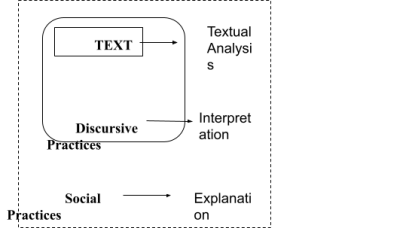
Fairclough introduced his 3D model for the purpose of critical discourse analysis. According to the Fairclough model, there are three stages of the process of CDA:
Description Stage, which studies the linguistic features of the written discourse (text). In this stage, the text being the product is analyzed in terms of grammar, vocabulary, semantics, phonology, phonetics, cohesion, and coherence.
Interpretation Stage / Discursive practice is concerned with the process of production and consumption. According to Fairclough (1995), this stage has two aspects. (i) Institutional Processes (Newspaper Agencies / Editorial Processes). (ii) Discourse Processes (Process of production and consumption, i.e., text as a product and text as a resource).
While interpreting the text, we must keep in mind the concept of intertextuality given by Fairclough. According to Fairclough (1995), intertextual analysis is concerned with the discourse behind the text. A discourse has background knowledge as well, and that is studied by intertextuality by analyzing the discursive activities in text. (p. 16).
Explanation Stage explores the relationship between interpretation and social context - social significance and relationship are studied at this level (Fairclough, 1989, p. 26). According to Fairclough (1995), this stage can be analyzed by these dimensions: Economic (media economy), Political (power and ideologies), and Cultural (value differences). (p. 62).
Political Discourse Analysis
Political discourse refers to the use of verbal and nonverbal communication, both in written or spoken form, within political contexts to manipulate the emotions of the audience in order to influence their ideas and perspectives. It differs from other types of discourse in that it is purposeful, functional, directed at a specific group of people, well-organized, and full of figurative language. Political discourse is important in moulding people's beliefs and attitudes, since some politicians use their rhetorical abilities and experiences to influence and manipulate public opinion. To be a successful politician, one must be an articulate orator who can guide and draw the emotions, attention, and thoughts of the audience. Politics can be viewed as the struggle for power between the government and opposition (Chilton, 2004, p. 3). Political activities greatly rely on discourse to influence language. As a result, language and politics are inextricably linked; it is nearly impossible to separate them (Chilton, 2004).
Power
According to Van Dijk (1996: 84), power is the relationship between institutions, social systems, and structures. Because social power has a significant impact on the conduct and cognition of manipulated groups, he calls attention to it. In this context, power signifies the supremacy of the governing groups over the social group members, achieved through either persuasion or force. Almost everyone holding a position of authority, such as presidents, doctors, lawyers, and prime ministers, enjoys distinct advantages. Consequently, they have the ability to highlight their power and its effects on the interactions among different social groups.
A Critical Discourse Analysis is carried out to examine how language exerts its power in a society. CDA is mainly concerned with the discourse and people of society. We need to know about people and how they act, think, and speak (Taiwo, 2007). Norman Fairclough has made great contributions in the field of Critical Discourse Analysis. In his work "Language and Power" (1995), Fairclough talks about power and language and its relationship with societal contexts. Power and language mean how a person is going to select the particular discourse type while talking to a powerful entity. It is basically a relation between the more powerful and the less powerful. Through the language, one has the power to control the mind and actions of the participants. Many politicians also use specific discourse to control the audience and to persuade them of their own ideologies and beliefs. They try to convince them by using persuasive strategies throughout their speech in order to make an impact on the minds of the consumers/audience/or participants. Fairclough has differentiated power into two categories, one of which is power behind discourse and the other is power within discourse.
Power in discourse refers to discourse as an area in which discourse is practically / physically exercised and enacted. Power behind discourse means that discourse is involved in a power struggle. The former deals with the discourse of strong participants when they have power, and the latter considers the discourse of strong participants when they are particularly struggling to own/maintain power with a similar intent.
In their 2024 study, Wajdi and Asrumi explored the impact of political slogans on electoral discourse by analyzing Indonesia's 2024 general election slogan "LUBER," which stands for Langsung (Direct), Umum (Public), Bebas (Free), and Rahasia (Secret). Utilizing document study and Critical Discourse Analysis, they investigated the slogan's structure, purpose, and significance, uncovering how it cleverly combines linguistic elements to advocate for transparency, inclusivity, freedom, and confidentiality in the voting process. Their research suggests that "LUBER" serves as a complex discourse tool that shapes public opinion, encourages civic duty, and upholds democratic values. This study highlights the influential role of political slogans in embedding ideological concepts into public awareness, a view that resonates with CDA's focus on the relationship between language, power, and ideology.
Massoud Sharififar and Elahe Rahimi (2015) analyzed the US President Barack Obama and Iranian President Hassan Rouhani's speeches at the UN. They used Halliday's Systemic Functional Linguistics for analysis. Speeches are analyzed by them on all three metafunctions, i.e., ideational metafunctions, interpersonal metafunctions, and textual metafunctions. They found that Obama's word choice in speech is way simpler and understandable to people of different calibers, but Rouhani's word choice in speech is difficult, and the language he uses is hard and formal.
Mehdi Dastpak and Ali Taghinezhad (2015) examine President Obama's public speech in order to analyze the persuasive strategies he used in his speeches. They have used Faircough's idea that belief systems reside in messages. The findings of their research are that Obama's speech has the idea of pragmatism, togetherness, inclusivity, and religious and ethnic acceptance. He also uses biblical references as well as individual pronouns to persuade people of his own ideologies and beliefs.
Emmanuel and Ewuresi (2013) examine six speeches of President Barack Obama and President George Bush on the topic of terrorism using a qualitative content analysis approach (Van Dijk's concept of Critical Discourse Analysis). Both presidents use emotional tone and vocabulary to have a particular and greater impact on their audience. Both portrayed terrorism negatively and anti-terrorism positively by intentionally using specific word choices for both terms.
Ahmad Mohammad Al-Harahsheh's (2013) study focuses on the application of the CDA method in the study of Arab political discourse in general. The paper is about the translatability of Khalid Mashaal's speech, in which the author shows that CDA also has a great impact on the translation of political speeches. He translated three speeches of Mashaal from Arabic into English. He says that the speeches may have many figures of speech, which make it difficult for translators to keep the language the same as the original while translating. Because most of the time, the translated version loses the originality, and we do not get the same feel from them as the original ones. He suggests some solutions to solve this problem as well.
The researchers (Hussain, A., Anwar, M. N., & Mian, M. Z., 2021) analyzed Imran Khan's maiden speech by emphasizing the politeness strategies that he used in his speech. Politeness is one of the strategies that help interlocutors to build good relations among themselves, and it is also one of the aspects in considering the emotions and feelings of others (Ward Haugh, 2006). Researchers used Systemic Functional Linguistics to pragmatically analyze the speech. The study claims that Imran Khan has used more positive politeness strategies than negative politeness strategies. Unlike Imran Khan's previous speeches, he used formal and appropriate language by considering the word choice. Politeness strategies can also be used by politicians to persuade people (Persuasive Strategy).
Another research was conducted on Imran Khan's power-play Dharna speeches in 2014. Authors use Fairclough's 3D-model (1989) as a tool for analysis and also his idea of two-dimensional power. The findings of this research are in terms of power within discourse. Imran Khan showed that the use of the personal pronoun "I" for power shows and the pronoun "We" to gain the support from the audience and build a positive face. Moreover, in terms of power behind discourse, researchers find that speeches dominate the ideology of Islam and the power of the West. Also, the use of the Urdu language by the speaker made him more connected to the common people, which is also a good persuasive strategy used by politicians and/or public speakers (Nusrat, A., Khan, S., & Shehzadi, M.S., 2020).
Research Methodology
Data collection: The transcript of Donald J. Trump's (25 September 2018) speech was taken from an internet source, i.e, www.politico.com ( Full text: Trump' s 2018 UN speech transcript - POLITICO ), and referred to the YouTube channel: News 19 WLTX (https://youtu.be/hO-fSfKq8vI) for the video speech. This speech was Trump's second political speech in the UN after becoming the President of America, in which he represented America as a sovereign nation in front of the whole world. The data of this study is analyzed by using the Qualitative research method.
Analytical Framework
The "ideological square" proposed by Van Dijk is used as a paradigm for the analysis and contextualization of speech production and understanding (society).
Theoretical Framework
Van Dijk's socio-cognitive theoretical framework:
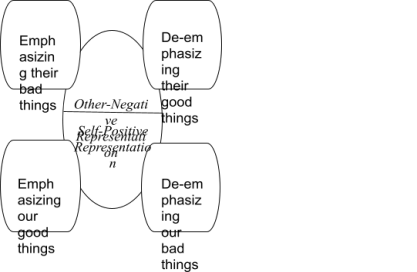
As the primary analytical framework, Van Dijk's (1998) ideological square (cognition) is used. He describes it as a segmentation of Us and Them in which the positive and negative characteristics of the in-group (Us) and out-group (Them) are (de)emphasized. In other words, all linguistic aspects of a text contribute to the division between Us and Them and are perceived as one of the following strategies:
Self-representation is the portrayal of oneself as a member of society in a very positive way, and glorifying oneself by using rhetorical language and describing others in a negative manner, and hiding their good things by exaggerating their bad things to make them look bad as a whole.
Analysis & Discussion:
A. The Micro-Level Analysis
At the micro-level analysis, discursive devices that are used in the data will be discussed and analyzed.
Statistics
One of the rhetorical strategies employed in political speech is this. To convince everyone that they have the facts and the proof, the politicians frequently employ statistics, which are sometimes based on false facts. In his address, Trump used several facts to support his claim of objectivity.
Extracts from the Data
Lexicalization
"Another discursive device is that in which words or lexical choices are used to describe someone/ something in a positive or negative manner."
Extracts from Donald Trump's Speech
Iran's leaders sow chaos, death, and destruction. They do not respect their neighbours or borders, or the sovereign rights of nations. Instead, Iran's leaders plunder the nation's resources to enrich themselves and to spread mayhem across the Middle East and far beyond (Politico Staff, 2018, para. 31).
Here, Trump's word choice shows that Iran is an out-group for America, and how Trump negatively portrayed the Iranian leaders by using adjectives like chaos, death, mayhem, and destruction.
"America's economy is booming like never before" (Politico Staff, 2018, para. 5).
Trump used the adjective "booming" for his country, and here he's praising his administration, which, in the history of America, no one has been capable of making America that much sovereign.
The Macro-Level Analysis
Positive-Self Representation Vs Negative-Others Representation
Extract 1: "Today, I stand before the United Nations General Assembly to share the extraordinary progress we've made" (Politico Staff, 2018, para. 2).
In the opening of his remarks, Donald Trump immediately establishes a positive self-representation by openly framing the remarkable advancements and accomplishments of his government as a period of "extraordinary progress." The use of the adjective extraordinary sets a tone of achievement and success, creating a positive impact of his leadership, emphasized by the use of the personal pronoun "I". He frequently referred to himself and his administration with the pronouns "I" and "my" as a way to support the viewpoint of the in-group. This aligns with Van Dijk's (2005) "Ideological Square," which emphasizes the positive representation of the in-group while downplaying the out-group simultaneously. Before detailing his accomplishments, Trump associated himself with the American people by using the plural word "we." Trump claimed significant progress in the history of the US in less than two years, projecting the US strength and competence to the international community.
Extract 2: From Warsaw to Brussels, to Tokyo to Singapore, it has been my highest honor to represent the United States abroad. I have forged close relationships and friendships and strong partnerships with the leaders of many nations in this room, and our approach has already yielded incredible change (Politico Staff, 2018, para. 14).
In this segment, Trump speaks in the mode of positive self-presentation and says that he relies on how many countries call him to help them solve their foreign policy problems. The repetition of the first-person pronoun "I" (the characteristic mark of every Trump speech) personalizes his leadership and casts him as the alpha dog that sat behind all these accomplishments, suggesting a divergence from earlier administrations, without ever naming them, but clearly meaning the Obama administration. Through Van Dijk´s (2005) Ideological Square, these factors play a role in the framing of the positive "character" of the in-group (here, Trump´s US), with other possible failures being sidelined by implication.
The use of the possessive pronoun "our" shifts the perspective from individual credit to teamwork, creating a positive in-group representation. Trump gave his accomplishments a global dimension (Warsaw, Brussels, Tokyo, Singapore), reinforcing a respected and proactive US presence on the world stage. The use of rhetoric (honor, incredible, strong) carried the positive connotation, projecting US influence as benevolent internationally.
Extract 3: In June, I travelled to Singapore to meet face to face with North Korea's leader, Chairman Kim Jong Un. We had highly productive conversations and meetings, and we agreed that it was in both countries' interest to pursue the denuclearization of the Korean Peninsula. Since that meeting, we have already seen a number of encouraging measures that few could have imagined only a short time ago (Politico Staff, 2018, para. 16).
In these statements, Trump used the discursive strategy "Actor description" proposed by Van Dijk. The first-person clause "I travelled" and the use of the temporal marker "In June" foreground Trump's personal agency: as an actor who initiated and carried out an action (I acted, Result followed). Instead of individual credit, he again used the pronoun (We, stating the mutual agreement, benefits, and interest of both countries, emphasizing shared accomplishments. Unlike his first speech at the UN General Assembly, he praised the North Korean leader and told the world about their good relations. He was revising the ideology, belief, and idea of the people that stemmed from his first speech (he used a metaphor, "Rocket Man," for the President of North Korea).
Extract 4: "In the Middle East, our new approach is also yielding great strides and very historic change" (Politico Staff, 2018, para. 21).
In this statement, Trump again used the possessive pronoun "our" to show the future agendas of his administration that his administration is the best, most experienced, and is working a lot for the prosperity of the American people. According to Van Dijk's ideological square, this portrays 'Our' side as more proactive, unified, and capable of achieving progress. The use of intensifying adjectives 'Great strides', 'historic change' further highlights the administrative accomplishments, promoting an optimistic narrative and credibility of the speaker (van Dijk, 2006).
Extract 5: Thanks to the United States military and our partnership with many of your nations, I am pleased to report that the bloodthirsty killers known as ISIS have been driven out of the territory they once held in Iraq and Syria. We will continue to work with friends and allies to deny radical Islamic terrorists any funding, territory, or support, or any means of infiltrating our borders (Politico Staff, 2018, para. 26).
While talking about terrorism, he portrayed his country (in-group) positively by boastfully exaggerating its accomplishments and portraying America in a positive manner. On the other hand, he portrays ISIS (out-group) as terrorists, violent, inhumane, and ideologically dangerous by labelling them as "bloodthirsty killers." Despite relationships with so many Muslim countries, he attacked the whole Islamic nation by portraying them as negative others (out-group). Trump employed Us vs Them by positioning the US and its allies (Us) as protectors of global peace and security, while portraying ISIS (Them) as terrorists and a big threat to global peace and security.
Extract 6: The Iran deal was a windfall for Iran's leaders. In the years since the deal was reached, Iran's military budget grew nearly 40 percent. The dictatorship used the funds to build nuclear-capable missiles, increase internal repression, finance terrorism, and fund havoc and slaughter in Syria and Yemen. The United States has launched a campaign of economic pressure to deny the regime the funds it needs to advance its bloody agenda (Politico Staff, 2018, para. 34).
In this extract, Trump used positive self-representation for his country, stating that they have done a lot to stop terrorism in the Middle East. On the other hand, Iran is portrayed as a brutal and corrupt regime through the use of lexical choices such as "windfall," "dictatorship," "bloodthirsty," "bloody agenda," and "havoc and slaughter." Such lexicalizations are a typical discursive strategy used for negative-other representation in van Dijk's framework. Also, the US President accused Iran of funding to destroy the neighbouring countries without giving any evidence - a tactic Van Dijk identifies as discursive manipulation.
Extract 7: We cannot allow the world's leading sponsor of terrorism to possess the planet's most dangerous weapons. We cannot allow a regime that chants "Death to America," and that threatens Israel with annihilation, to possess the means to deliver a nuclear warhead to any city on Earth. Just can't do it (Politico Staff, 2018, para. 36).
Trump used a discursive strategy, "Authority," in this statement, and warned the world nations to be aware before challenging the supreme power of America. Here, Trump clearly identified his in-groups and out-groups (from previous contextual statements), and no one dared to challenge the American economy. He framed Iran as an existential threat, "the world's leading sponsor of terrorism", evoking fear and urgency. He signaled a zero-tolerance policy for allowing Iran to own a nuclear weapon, "We cannot allow", leaving no room for negotiation and compromise while appealing for emotional solidarity for both America and Israel - a stance that reveals a contradiction in his authoritative statements.
Extract 8: "For decades, the United States opened its economy -- the largest, by far, on Earth -- with few conditions. We allowed foreign goods from all over the world to flow freely across our borders" (Politico Staff, 2018, para. 42).
Trump used hyperbole here by saying "the largest (economy)" for his country. He again used the positive self-representation that they are the ones who can allow the imports and exports in the world. His boastful expressions and exaggerated linguistic choices show his ideology about "them and others." By omitting US shortcomings and others' positive contributions, the speech sustains a polarized "us vs. them" narrative that strengthens nationalist sentiment.
Conclusion
The employment of adjectives to highlight, characterize, and glorify the accomplishments of Trump's administration is what gives his address its impact. From an ideological standpoint, Trump used 38 verbs to highlight bad traits and downplay good ones about "them," as opposed to seven verbs to highlight good traits and downplay bad ones about "us." Iran was also mentioned a lot in Trump's address. This represents Trump's steadfast conviction that Iran directly threatens both his government and the entire globe (according to Van Dijk's definition of ideology).
Donald Trump's speech serves as an example of how well-chosen rhetorical devices may construct political narratives, mobilise supporters, and magnify a leader's message. He creates an image of himself as a champion of national principles and a definitive problem-solver by fusing facts, patriotic pleas, and pointed judgments. In addition to persuading, this interaction of ethos, pathos, and logos mobilises. These speeches serve as a reminder that political rhetoric is about more than just disseminating facts; it's also about influencing public opinion, forming perceptions, and eventually affecting how democratic decisions are made.
References
- Al-Harahsheh, A. M. (2013). The translatability of figures of speech in Khalid Mashaal's political speeches: A critical discourse analysis. International Journal of English Linguistics, 3(3), 100–113. https://doi.org/10.5539/ijel.v3n3p100
- Chilton, P. (2004). Analyzing political discourse: Theory and practice. Routledge. https://doi.org/10.4324/9780203561218
- Dastpak, M., & Taghinezhad, A. (2015). Persuasive strategies used in Obama’s political speech: A CDA approach based on Fairclough’s framework. Journal of Applied Linguistics and Language Research, 2(6), 13–27. http://www.jallr.com/index.php/JALLR/article/view/152
- Hussain, A., Anwar, M. N., & Mian, M. Z. (2021). Politeness strategies in Imran Khan’s maiden speech as Prime Minister of Pakistan. Pakistan Social Sciences Review, 5(1), 1–15. https://pssr.org.pk/issues/v5/2/politeness-strategies-in-imran-khan-s-maiden-speech-as-prime-minister-of-pakistan.pdf
- Nusrat, A., Khan, S., & Shehzadi, M. S. (2020). Critical discourse analysis of Imran Khan's Dharna speeches in a socio-political perspective. Sir Syed Journal of Education & Social Research, 3(1), 9–19. https://doi.org/10.xxxxx (Add correct DOI or URL if available)
- POLITICO Staff. (2018, September 25). Full text: Trump’s 2018 UN speech transcript. Politico. https://www.politico.com/story/2018/09/25/trump-un-speech-2018-full-text-transcript-840043
- Sharififar, M., & Rahimi, E. (2015). Critical discourse analysis of political speeches: A case study of Obama’s and Rouhani’s speeches at the UN. Theory and Practice in Language Studies, 5(2), 343–349. https://doi.org/10.17507/tpls.0502.14
- Trump, D. J. (2018, September 25). Remarks by President Trump to the 73rd Session of the United Nations General Assembly. The White House. https://trumpwhitehouse.archives.gov/briefings-statements/remarks-president-trump-73rd-session-united-nations-general-assembly
- Van Dijk, T. A. (2001). Critical discourse analysis. In D. Schiffrin, D. Tannen, & H. E. Hamilton (Eds.), The handbook of discourse analysis (pp. 352–371). Blackwell.
- Van Dijk, T. A. (2005). Politics, ideology, and discourse. In R. Wodak (Ed.), Encyclopedia of language and linguistics (2nd ed., Vol. 9, pp. 728–740). Elsevier.
- Van Dijk, T. A. (2006). Discourse and manipulation. Discourse & Society, 17(3), 359–383. https://doi.org/10.1177/0957926506060250
- Wajdi, M., & Asrumi, A. (2024). Analysing the slogan “LUBER” in Indonesia’s 2024 general election: A critical discourse analysis. Journal of Language and Pragmatics Studies, 3(1), 53–65. https://jurnal.ympn2.or.id/index.php/JLPS/article/view/39
Cite this article
-
APA : Hussaini, M. F. A., & Noreen, N. (2025). Critical Discourse Analysis of US President Donald Trump's Speech in the UN General Assembly 2018. Global Social Sciences Review, X(III), 100-109. https://doi.org/10.31703/gssr.2025(X-III).09
-
CHICAGO : Hussaini, Maryam Fatima Al, and Naima Noreen. 2025. "Critical Discourse Analysis of US President Donald Trump's Speech in the UN General Assembly 2018." Global Social Sciences Review, X (III): 100-109 doi: 10.31703/gssr.2025(X-III).09
-
HARVARD : HUSSAINI, M. F. A. & NOREEN, N. 2025. Critical Discourse Analysis of US President Donald Trump's Speech in the UN General Assembly 2018. Global Social Sciences Review, X, 100-109.
-
MHRA : Hussaini, Maryam Fatima Al, and Naima Noreen. 2025. "Critical Discourse Analysis of US President Donald Trump's Speech in the UN General Assembly 2018." Global Social Sciences Review, X: 100-109
-
MLA : Hussaini, Maryam Fatima Al, and Naima Noreen. "Critical Discourse Analysis of US President Donald Trump's Speech in the UN General Assembly 2018." Global Social Sciences Review, X.III (2025): 100-109 Print.
-
OXFORD : Hussaini, Maryam Fatima Al and Noreen, Naima (2025), "Critical Discourse Analysis of US President Donald Trump's Speech in the UN General Assembly 2018", Global Social Sciences Review, X (III), 100-109
-
TURABIAN : Hussaini, Maryam Fatima Al, and Naima Noreen. "Critical Discourse Analysis of US President Donald Trump's Speech in the UN General Assembly 2018." Global Social Sciences Review X, no. III (2025): 100-109. https://doi.org/10.31703/gssr.2025(X-III).09