Abstract
This research treats contents of newspapers from America, China and India reporting on "Belt and Road Initiative" (BRI) with respect to US, India and China's foreign policies. The study investigates if unlike China, American and Indian press relatively report more 'risk' than 'opportunity' frames on BRI. Detailed literature on risks and opportunity frames is produced through media lenses, underpins regional and global significance and future status of BRI. Comparing framing techniques of The New York Times, Times of India and China Daily, contents of total 60 news articles are quantitatively analyzed. Finally, comparative research paradigm found both Indian and American press framing more risks than opportunities in news, therefore highlighting respective concerns of staying away from the signatory summit of BRI held in Beijing in May 2017.
Keywords
BRI, Silk Road, CPEC, News Framing, Content Analysis
BRI and CPEC
Belt and Road Initiative (BRI), is the Chinese President-Xi Jinping's strategic idea of overland transport corridors and maritime trade routes to widen economic activities of People's Republic of China (PRC) with Africa, Eurasia and Latin America. Primarily this initiative is based on mutual trades, finance, infrastructures, people-to-people interactions and cultural activities. BRI will build interest based relations between states (Aoyama, 2016). This research applies on reportage of signatory forum of BRI in the U.S, Chinese and Indian media. Beijing hosted BRI's signatory conference between 14-16 May 2017 welcoming more than 30 world leaders and nearly 68 ambassadors of the states to applaud the cooperation agreement. However, America and India stayed away from the summit expressing their wide-range of trepidations (Xin 2017; Blanchard and Wong 2017). For example, Chinese trillion-dollar spending roads, ports and energy projects are strongly objected by The New York Times (NYT, 2017). Similarly, Economic Times reported UN levitations of tagging red flags over financial, economic, social and environmental risks associated with BRI. The Guardian published EU repudiations on this multibillion-dollar project, litigating that BRI is not guaranteeing social welfare and environmental protections (Chaudhury, 2017; Phillips, 2017). Likewise, Hindustan Times warned China while publishing Indian isolation from the BRI's Summit (Patranobis, 2017).On other hand, the Australian Financial Review stated leaders from Russia, Australia, Indonesia, Greece, Vietnam, Spain and Italy greeted to brace the BRI, because it will heighten trade and business activities between Europe, Asia, Africa and Latin America (Grigg and Lisa 2017). To the same note, China Daily published that Beijing is seeking sustainable trust and backing from all the states connecting with the BRI (CD, 2017a).
Previously, in 2013 Islamabad and Beijing mutually agreed on $62 billion project -CPEC propositioning extensive network of trade routes, railways, power and wind houses, special economic zones. China-Pakistan Economic Corridor (CPEC) is known as one of the six economic corridors projected under premeditated Marshal Plan of BRI. This corridor will connect marine port in Gwader, Pakistan with Kashgar city in China. The dominant public opinion in the two countries consider CPEC as a landmark proposal of expediting economic and trade activities in the region. Two scholars from Pakistan mentioned CPEC-a game changer project creating nearly one million jobs in Pakistan to alter the fate of the region by overcoming energy crisis and economic revolutions (Abid & Ashfaq, 2015). On other hand two scholars Alam (2015) and Hu (2017), mentioned Strait of Malacca route if blocked, CPEC would function as a marginal trade route when conflict in Asian-pacific region is unceasing (Ali, 2015). Irrespective of 'win-win' scenario conferred by both Islamabad and Beijing, CPEC has provoked India on the trade route passing through Gilgit Baltistan. Likewise, two British newspapers, The Telegraph and The Guardian reported Chinese confrontation on Indian intrigue against this mega project and to reconsider its status (Xin, 2017; Connor, 2017). Newspapers from several other countries blamed the BRI for rapping New Delhi and Washington over their interferences in Asia. Both India and America tended to isolate themselves from the global initiative-BRI. Therefore, this study investigates international media encounters of reporting risks or opportunities of the BRI associated with international powers.
Mainly this research is aiming to discover framing strategies applied by the newspapers from America, China and India while reporting on the BRI. Thus, this study is supposed to depicts Sino-India and Sino-America relations accordingly to rate risk and opportunity frames published in the American, Indian and Chinese media. One of the objectives of the study is to examine how American, Indian and Chinese foreign policies on BRI are projected in the leading press. Finally, the study explores how the selected press framed the strategic process of reporting on BRI.
Literature on Framing Risks and Opportunities
To stabilize of power system in Asia, American foreign policy has eagerly cheered expansion of India against the rising China (Xiaoyu 2012). Likewise, China's card is widely played by the American media and politicians during election campaigns (Aldrich, Lu, & Kung, 2015). Golan and Lukitu (2015) found editorials of two American press framing emerging China a warning to the U.S uni-polarity. The most quoted researcher on framing studies, Entman mentioned frames have various locations of writing scripts, cultural background, message sender and target audiences. In communication process, frame focuses on some features of apparent information establishing them more prominent to highlight any problem. Based on ethical assessments, frames interpret treatments and recommendations for the problem reported. Therefore, by highlighting some portions of truth, media viewers are appealed to certain aspects and misled to disregard others. What is added in news is as significant, what is vanished from the news (Entman, 1993, 2003). To comprehend cross-national differences in news contents, generic framing is commonly applied technique to exceed thematic boundaries of a story (Semetko & Valkenburg, 2000; Vreese, 2002; Vreese, 2005). Another study on structure and characteristic of contents of journalism declared typology of generic framing is conflict', 'attribution', 'moral values', 'economics' , and 'human impact' (Neuman et al. 1992). Commonly, the concept of 'valence of frames' generated the idea of reporting risks and opportunities (Vreese and Boomgaarden 2003) incredibly indicating the choice between two contrasting characteristics- destructive or constructive and unworthy or worthy (Levin et al. 1986), dangers or prospects (Jackson and Dutton 1988), and lastly damaging or benefiting (Rutter 1987). Therefore ,journalists are continually cognisant about risks and opportunities frames while reporting news on gains or losses , threat or prospect , win or defeat and finally, giving or taking (Schuck & Vreese, 2006).
Pragmatically, risk framing is frequently applied, the idea of which is predominately derived from the prospect theory (Kahneman & Tversky, 1979) a process of decision making in risky conditions. For, example, BRI is framed in The New York Times reporting a fear that China will emerge as a new Colonial Clout (LARMER, 2017), similarly, Times of India, framed BRI with reference to possible intimidations to Baluchistan-a territory of Pakistan from where CPEC route is planned (TOI, 2017). Based on mentioned above literature on news framing, this study examines not only risk frames-unfavourable pictures of the BRI, such as reporting on the environmental risks claimed by the U.S along with Indian regional apprehensions on China-Pakistan Economic Corridor. But also opportunity frames -a ray of hope and countries mutual reliance, probably highlighting favourable pictures. In fact, BRI proposing recompenses to the states associating with multi-billion projects. For example, BRI is positively framed in China Daily, calming a prosperous future for the least developed countries (CD, 2017b).
Quantitative Analysis
Since this study evaluates communication cryptograms denoted by numeric values, pragmatically quantitative research technique is desirable for social scientists to discover intrinsic values from communication contents. The quantitative research estimations are constantly believed as reliable even if they produce some acceptable errors in data processing (Kuhn, 1962, p.186). Noted by a group of researcher, to replicate framing numbers from newspapers, quantitative content analysis helps in accumulating and ordering data to discover symmetrical trends in news contents (as cited in May, 1997, p.171). Technique of quantitative contents analysis is essential to measure impacts in communication research (Riffe, Lacy & Fico, 2005). Considerably this method is recommended to compare similarities and variations between the communication features (frames). Commonly, communication researchers consider this method in deductive research to test a hypothesis derived from a literary belief (Riff, Lacy & Fico, 2014, p.17). Primarily this method is applied to discover themes of matters from words, sentences, and pictures, appearing in press, legitimate papers, journals, snapshots, and websites, audio and visual media (Kohlbacher 2006). Predominantly, depending on nature of research questions, cultural artefacts from news contents are discovered (Bryman, 2012, p.295). Likewise, this study investigates emerging defiance of the U.S, Indian and Chinese media reporting on BRI, therefore quantifying to measure positive or negative aspects of China factor appearing in contents. This way the scope and complexity of press is vibrantly depicted to comprehend the future status of Chinese dream plan-the BRI.
Hypothesis and Research Questions
Q1: What framing techniques on BRI are produced by the American, Chinese and Indian media?
Q2: How framings on BRI differ by the U.S, Indian and Chinese Press?
Q3: How do international media differ in reporting risk and opportunity frames?
Research Method
In this study content analysis technique is applied to quantitatively analyse 60 selected articles from Indian, Chinese and American press each. Predominantly, these leading international newspapers are treated as nominal variables, whereas framing scores are considered as the scaled variables. This study proceeds with Bryman (2012, p.74) comparative design of carrying simultaneously two or more cross-sectional variables. Primarily, while investigating existing factors, the researcher compares differences and similarities between countries (cited in May 1997, p.187). Same as Schuck and Vreese (2006) study of comparing risk and opportunity frames and Camaj (2010) studying international press reporting on Kosovo's status negotiations, this study also compares the amplitudes of risks and opportunities framed by the prominent selected international newspapers from America, India and China.
Unit of Analysis and Sampling
The Factiva database by applying the keywords 'China' and 'Belt' and 'Road 'produced total 1302 news articles in favour of the three-English language selected newspapers reporting on BRI from May 01, 2017 to May 31, 2017. This retro follows news stories on "Signatory Summit", of BRI held in Beijing. Primarily, The New York Times granted 52 news reports, Times of India 152 reports, and China Daily 1098 reports. Despite spotting online news feeds, articles printed from the head offices are considered. The New York Times illustrated 42 articles originated from the New York City. The Times of India showed 82 articles appeared from Mumbai. And, the China Daily presented 312 articles published from Beijing. Predominantly, this research ponders a sample of total 60 articles designated on a criterion of absolute occurrence of keywords 'China', 'Belt' and 'Road'. Based on chosen criterion, 20 out of 312 articles are carefully extracted from China Daily. Following the same patron, 20 out of 42 articles are nominated from The New York Times. And finally 20 out of 82 articles are entitled from Times of India. This method revealed overall 60 news articles, 20 each nominated from Times of India, The New York Times, and China Daily. To process this research each news article is cautiously considered as a unit of study. While noticing reactions of units of studies on participant replies to the research questions (Bryman, 2012, p.295), this study carefully code (1) if requisite news frame appeared otherwise (0).
Data Constructions and Methodological Issues
Kuder-Richardson (KR-20) alpha testing tool is processed to scale internal consistency of the available data in dichotomous-binary form (Cronbach, 1951, 1990; Semetko & Valkenburg, 2000; Vreese et al. 2001; Acock, 2008, p.293). Alpha value with of conflict or risk framing scored 0.705, economic and opportunity 0.765, attribution of responsibility 0.724 and human interest 0.851. All 05 generic frames collectively provided Alpha value 0.822.Mentioned above higher than 0.70 values indicate adequate reliability or consistency levels between all the frames other than morality frame missing from the entire study. To make cluster analysis, 20 multiple research questions-RQ1.RQ2.RQ3...RQ20 are applied on a sequence of 60 news stories received from the Factiva database system. These rotating questions revealed some deeper clusters of original framing. A criterion of at least 03 out of 20 rotating questions on each generic frame is applied. For example, risk or conflict frames are dignified with a scale of 4 questions, opportunities or economic frames with 03, attribution of responsibility with 05, human interest with 05 and finally morality frame with 03 questions. Hence, binary data representing yes (1) occurrence and no (0) absence of frame aggregately provided 6000 framing clusters accumulated by number of generic frames (5) x rotating questions (20) x articles (60). Purposefully, scaled data is derived by summing binary statistics of an individual article divided by 20-number of questions applied. The processed data scored against these all frames are now demonstrated into original positions ranging from 0 to 1(frame missing to frame significant). Higher scores manifest higher occurrence of frames. Finally, values of all 60 news articles are now designed with respect to 05 generic frames-opportunities, attribution, risk, human interest and morality. Other than Camaj (2010), Kruskal-Wallis and Mann-Whitney Utests are applied as ANOVA alternative techniques and nonparametric approaches to compare statistics when normality assumptions are violated (Ghasemi, Zahediasl, 2012; Urdan, 2016, p.205). To proceed, in first phase Kruskal-Wallis test is applied to compare scores within international media and framing. Mann-Whitney U test is applied in the second phase to compare scores between international media and the framing strategies.
International Media | Risk Framing | Opportunity Framing | Attribution Framing | Human Interest Framing | Morality Faming | |
New York Times | Mean | .6100 | .4250 | .5575 | .4775 | .0000 |
N | 20 | 20 | 20 | 20 | 20 | |
Std. Dev. | .13338 | .23255 | .13404 | .21304 | .00000 | |
| Times of India | Mean | .6600 | .4000 | .6675 | .4875 | .0000 |
N | 20 | 20 | 20 | 20 | 20 | |
Std. Dev. | .08367 | .15131 | .18937 | .21143 | .00000 | |
| China Daily | Mean | .4400 | .5275 | .5525 | .3625 | .0000 |
N | 20 | 20 | 20 | 20 | 20 | |
Std. Dev. | .19908 | .17508 | .16818 | .26846 | .00000 | |
| Total | Mean | .5700 | .4508 | .5925 | .4425 | .0000 |
N | 60 | 60 | 60 | 60 | 60 | |
Std. Dev. | .17252 | .19430 | .17119 | .23557 | .00000 | |
Q1: What framing techniques on BRI are produced by the American, Chinese and Indian media?
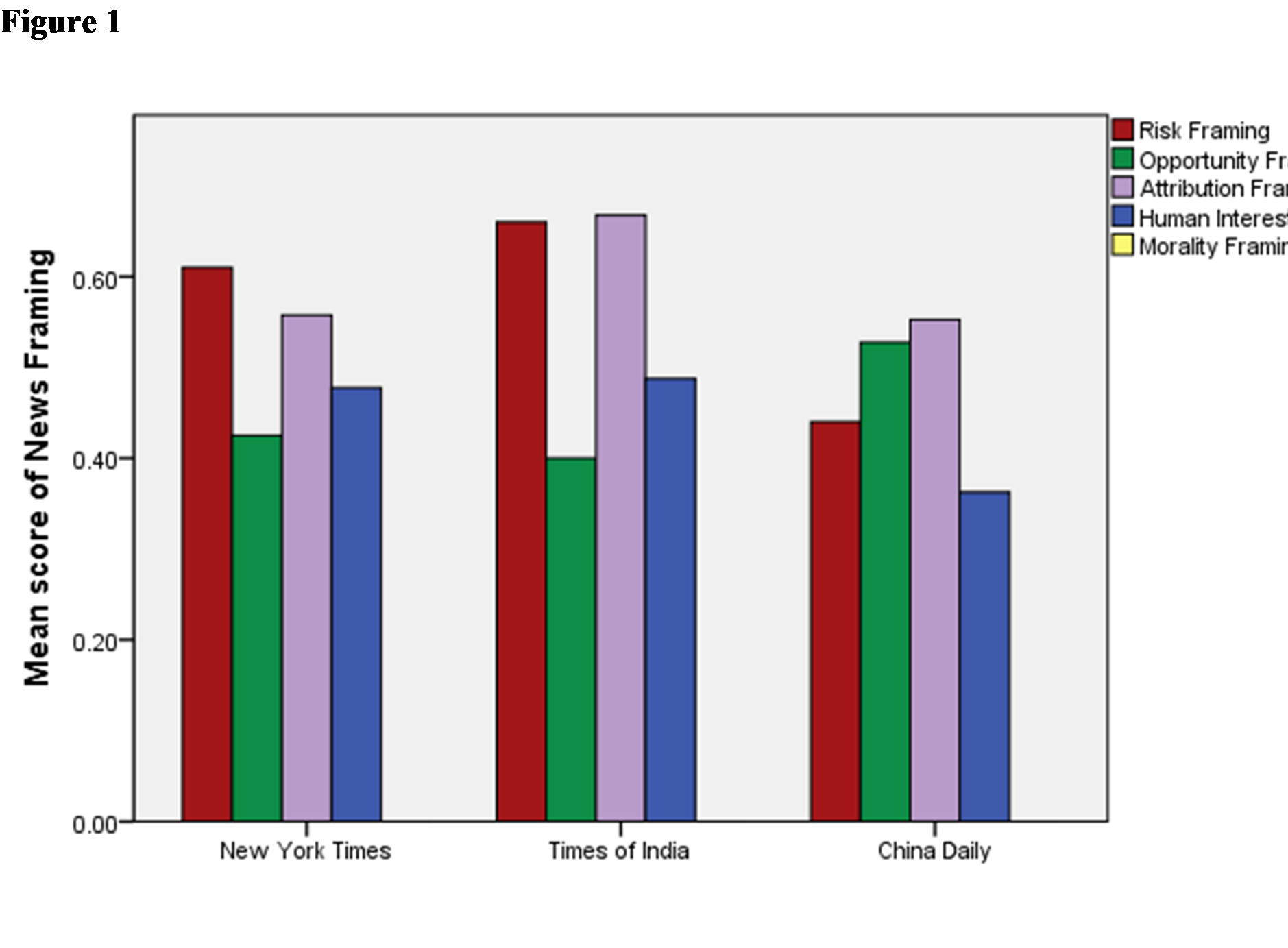
Figure-1 labelling red bars to risk frames, green to opportunities, pink to attributions, blue to human interests and yellow to morality frames are actually displaying typology of generic frames. Relatively, The New York Times is revealing higher devotion to risk frames, followed by attribution, human interest, and opportunity frames. The Times of India is found more committed to attribution of responsibility frames followed by risk, human interest, and opportunity frames. Likewise, China Daily is eager to attribution of responsibility frames followed by opportunity, risk, and human interest frames.
Table-1 further estimate Figure-1 by displaying standard deviations and mean scores of the newspapers attributing higher values of responsibility frames (M: 0.59, SD: 0.17), chased by risks (M: 0.57, SD: 0.17), opportunities (M: 0.45, SD: 0.19), human interests (M: 0.44 SD: 0.23), and morality frames producing no score. Principally, mentioned below average scores of 20 articles determined dictions of press to certain frames, while providing less attention to others, for example, The Times of India is eagerly reporting attribution frames (Mean: 0.67) pursued by risk (M: 0.66), human interest (M: 0.49), and opportunity frames (M: 0.40). Likewise, Risk frames (Mean: 0.61) are highly reported by The New York Times, chased by the attribution (Mean: 0.58), human interest (M: 0.48), and opportunity frames (M: 0.43). Finally, China Daily is more attributed to responsibility frames (Mean: 0.55) as compared to the opportunity frame (M: 0.53), risks (M: 0.44), and human interests (M: 0.36).
Lastly, data displayed in table-2 and 3 is derived after application of statistical tools tested under 5% level of significance, describing difference in result if p-values is lesser than 0.05, or otherwise not.
Table 2.
| Kruskal Wallis Test Results | ϰ2 | Df | P-Value |
| Generic Frames | 26.219 | 3 | 0.000 |
| Newspaper | 3.358 | 2 | 0.187 |
Q2: How framings on BRI differ by the U.S, Indian and Chinese press?
Table-2 is referred to differences and similarities within the press and generic framings. In this regard, Kruskal Wallis' result χ2 (3) = 26.219, p < 0.001 indicating generic frames expressively different. On other hand, χ2 (2) = 3.358, p =0.187 argues, irrespective of framing categories, aggregate volume of press reporting is not significantly different. Based on the above conclusions, The New York Times, China Daily and Times of India are claimed as framing BRI differently.
Table 3. Reporting Risk and Opportunity Frames
Mann-Whitney U Test | Opportunity | Risk | ||||
Results | U | Df | P-value | ϰ2 | Df | P-value |
| The New York Times & Times of India | 174.00 | 38 | 0.495 | 149.50 | 38 | 0.174 |
| Times of India & China Daily | 109.50 | 38 | 0.013 | 69.50 | 38 | 0.000 |
| The New York Times & China Daily | 151.00 | 38 | 0.192 | 106.00 | 38 | 0.01 |
Q3: How do international media differ in reporting risk and opportunity frames?
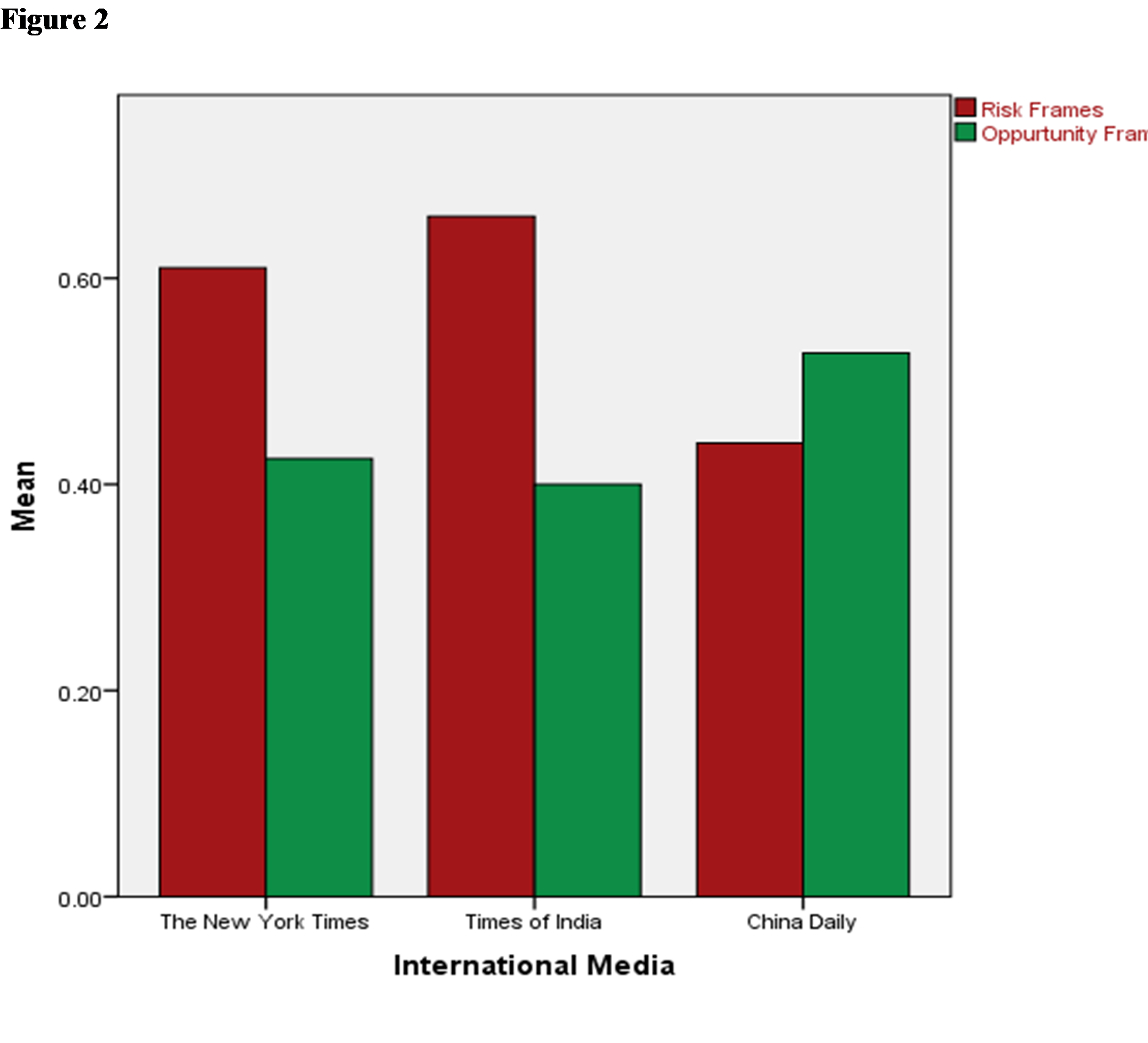
Table-3 illustrates cross-sectional research investigating comparisons between frames and international press. While applying Mann-Whitney U test on data of risk frames, results U (38) = 149.50, p=0.174 indicate The New York Times and Times of India provide similar scores. On other hand, U (38) = 69.50, p <0.001 argue, the press in India and China score differently followed by the American and Chinese media U (38) = 106.00, p =0.01. Different from Chinese media, both American and Indian press are discovered with nearly similar devotion to risk frames-confirming the argument produced in figure-2. Now, after testing opportunity framing data, following phenomena produced parallel results, for example, American and Indian media U (38) = 174.00, p=0.495,Indian and Chinese media U (38) = 109.50, p =0.013, and American and Chinese media U (38) = 151.00, p =0.192 .The three newspapers are exclusively found posturing parallel attentions to opportunity framing. While associating cited above outcomes with the results displayed in figure-2, China Daily executed frames on opportunities, higher than both American and Indian Press .Finally, based on above findings research hypothesis can safely be defended that: contrary to Chinese, American and Indian press are relatively publishing more 'risk' than 'opportunity' frames.
Discussion
The study delivers a pragmatic validation of existing generic frames-risk, opportunity, responsibility and human interests. However, morality frame does not appear in the entire research, possibly because selected newspapers have not produced any ethical or moral angle on BRI. Following Schudson (2001)'s claim of U.S media reporting the nature of conflict frames with objective journalism, this study also finds U.S media is paying relatively less attention to risk frames than the Indian media while reporting on BRI. Interestingly, results demonstrate three newspapers almost similarly projecting opportunity frames. However, above all China Daily is relatively considering more frames opportunities. Surprisingly, regardless of the geo-political hesitations, both American and Indian media report opportunities associated with the BRI. Additionally, a thorough analysis on the bar chart discovers American press reasonably more committed to objective journalism than in Indian because of relative attention to opportunity frames. Therefore, in the entire study attribution of responsibility frame is repeatedly published in Indian press referring China as responsible for their strategic distress on CPEC. Unexpectedly, media in both America and China are correspondingly less devoted to responsibility frames. Other than reporting opportunities, Chinese media is comparatively more focussed on the attribution frames. Likewise, China claimed that BRI is planned for non-hegemonic international collaboration for economic development. Finally, unlike China, both American and Indian press dominantly apply human interest frames while reporting on the environmental risks.
References
- Abid, M., & Ashfaq, A. (2015). CPEC: Challenges and opportunities for Pakistan. Journal of Pakistan Vision, 16(2), 142-169.
- Acock, A. C. (2008). A Gentle introduction to Stata. Stata press.
- Alam, O. (2015). China-Pakistan economic corridor: towards a new ‘heartland’? South Asia@ LSE.
- Aldrich, J., Lu, J., & Kang, L. (2015). How do Americans view the rising China? Journal of Contemporary China, 24(92), 203-221.
- Ali, A. (2015). China Pakistan Economic Corridor (CPEC): Prospects and challenges for regional integeration. International Journal of Social Sciences and Humanity Studies, 7(1), 1-15.
- Aoyama, R. (2016). “One Belt, One Road”: China's New Global Strategy. Journal of Contemporary East Asia Studies, 5(2), 3-22.
- Bardhan, P. K. (2012). Awakening giants, feet of clay: Assessing the economic rise of China and India. Princeton University Press.
- Baylis, J., Smith, S., & Owens, P. (Eds.). (2017). The globalization of world politics: an introduction to international relations. New York: Oxford University Press.
- Bhattacherjee, A. (2012). Social science research: Principles, methods, and practices.
- Brewster, D. (2011). Indian strategic thinking about East Asia. Journal of Strategic Studies, 34(6), 825-852.
- Bryman, A. (2012). Social research methods. Oxford university press.
- Bryman, A., & Cramer, D. (2012). Quantitative data analysis with IBM SPSS 17, 18 & 19: A guide for social scientists. Routledge.
- Bryman, A., & Cramer, D. (2011). Quantitative data analysis with IBM SPSS 17, 18 & 19—a guide for social scientists east sussex. Routdedge, UK.
- Camaj, L. (2010). Media framing through stages of a political discourse: International news agencies’ coverage of Kosovo’s status negotiations. International Communication Gazette, 72(7), 635-653.
- Chaban, N., &Elgström, O. (2014). The role of the EU in an emerging new world order in the eyes of the Chinese, Indian and Russian press. Journal of European Integration, 36(2), 170-188.
- Chandra, P. (2016). Impact of temporary trade barriers: Evidence from China. China Economic Review, 38, 24-48.
- Chaudhry, R, D. (2017, May 25). UN warns about financial risks in China’s One Belt One Road project. The ECONOMIC TIMES, Retrieved from https://economictimes.indiatimes.com/news/defence/un-warns-about-financial-risks-in-chinas-one-belt-one-road-project/articleshow/58831087.cms (Accessed 12 June 2017).
- China Daily (2017a, April 14).Countdown to Belt and Road forum, China aims high for shared prosperity. CHINA DAILY, Retrieved from http://www.chinadaily.com.cn/business/2017-04/14/content_28930395.htm .
- China Daily (2017b, April 14).China's investments help least developed countries pursue brighter future. CHINA DAILY, Retrieved from http://www.chinadaily.com.cn/business/2017-08/03/content _30341477.htm .
- Chong, D., &Druckman, J. N. (2011). Identifying frames in political news. Sourcebook for political communication research: Methods, measures, and analytical techniques, 238-67.
- Connor (2017, May 15). Chinese media warn India over Belt and Road project. THE TELEGRAPH, Retrieved from https://www.telegraph. co.uk/news/2017/05/15/chinese-media-warn-india-belt-road-project/ .
- Cronbach, L. J. (1951). Coefficient alpha and the internal structure of tests. psychometrika, 16(3), 297-334.
- Cronbach, L. J. (1950). Statistical methods for multi‐score tests. Journal of clinical psychology, 6(1), 21-26.
- H. De Vreese, Jochen Peter, Holli A. Semetko, C. (2001). Framing politics at the launch of the Euro: A cross-national comparative study of frames in the news. Political communication, 18(2), 107-122.
- De Vreese, C., &Boomgaarden, H. (2003). Valenced news frames and public support for the EU. Communications, 28(4), 361-381.
- De Vreese, C. H. (2005). News framing: Theory and typology. Information Design Journal & Document Design, 13(1).
- Diener, E., & Crandall, R. (1978). Ethics in social and behavioral research. Chicago: University of Chicago Press.
- Ding, S. (2011). Branding a rising China: An analysis of Beijing’s national image management in the age of China’s rise. Journal of Asian and African Studies, 46(3), 293-306.
- Doerge, R. W., & Churchill, G. A. (1996). Permutation tests for multiple loci affecting a quantitative character. Genetics, 142(1), 285-294.
- Entman, R. M. (1993). Framing: Toward clarification of a fractured paradigm. Journal of communication, 43(4), 51-58.
- Entman, R. M. (2003). Cascading activation: Contesting the White House's frame after 9/11. Political Communication,, 20(4), 415-432.
- Fynn, S.I. (2015).Growth of nations in global economy research starters, Business (online edition), EBSCOhost, viewed 20 July 2017.
- Garver, J. W. (2002). The China-India-US triangle: strategic relations in the post-Cold War era. National Bureau of Asian Research.
- Ghasemi, A., &Zahediasl, S. (2012). Normality tests for statistical analysis: a guide for non-statisticians. International journal of endocrinology and metabolism, 10(2), 486.
- Golan, G. J., &Lukito, J. (2015). The rise of the dragon? Framing China’s global leadership in elite American newspapers. International Communication Gazette, 77(8), 754-772.
- Gordon, A. D., & Gordon, S. (2014). India's rise as an Asian power: nation, neighborhood, and region. Georgetown University Press.
- Guthrie, G. (2010). Basic Research Methods: An entry to social science research. New Delhi: SAGE Publications India.
- Grig, A and M, Lisa.(2017, August 20).The era of crazy Chinese acquisitions is over as Beijing cracks down on offshore deals.THE AUSTRALIAN FINANCIAL REVIEW, Retrieved from https://www.afr.com/news/world/asia/the-era-of-crazy-chinese-acquisitions-is-over-as-beijing-cracks-down-on-offshore-deals-20170820-gy0cbu(Accessed 10 July 2017).
- He, Z. (2003). How do the Chinese Media Reduce Organizational Incongruence. Chinese media, global contexts, 196-214.
- Hu, R. W. (2017). China’s ‘One Belt One Road’Strategy: Opportunity or Challenge for India?. China Report, 53(2), 107-124.
- Jackson, S. E., & Dutton, J. E. (1988). Discerning threats and opportunities. Administrative Science Quarterly, 370-387.
- Jackson, R., &Sørensen, G. (2016). Introduction to international relations: theories and approaches. Oxford university press.
- Johnson-Cartee, K. S. (2004). News narratives and news framing: Constructing political reality. Rowman & Littlefield Publishers.
- Kahneman, D. (1979). Prospect theory: An analysis of decisions under risk. Econometrica, 47, 278.
- Kohlbacher, F. (2006). The use of qualitative content analysis in case study research. In Forum Qualitative Sozialforschung/Forum: Qualitative Social Research (Vol. 7, No. 1, pp. 1-30). Institutfür Qualitative Forschung.
- Kuhn, T. (1962). The structure of scientific revolutions. Chicago: Univ. Press, Chicago.
- Kuhn, T. (1970). The structure of scientific revolutions, 2nd. Chicago: University of Chicago Press.
- Larmer, B. (2017). Is China the world’s new colonial power. The New York Times Magazine, 2.
- Levin, I. P., Johnson, R. D., Deldin, P. J., Carstens, L. M., Cressey, L. J., & Davis, C. R. (1986). Framing effects in decisions with completely and incompletely described alternatives. Organizational Behavior and Human Decision Processes, 38(1), 48-64.
- Li, R. (2008). A rising China and security in East Asia: Identity construction and security discourse. Routledge.
- Li, R. (2016). China’s Sea power aspirations and strategic behaviour in the South China Sea from the theoretical perspective of identity construction. In Power Politics in Asia’s Contested Waters (pp. 117-137). Springer, Cham.
- Li, A. H. (2017). China Facing the Trump Presidency. Opportunities for Global Power Projection? China Perspectives, 2017(2017/2), 69-73.
- Lim, Y. H. (2014). China's naval power: an offensive realist approach. Ashgate Publishing, Ltd.
- Lim, A. C. H. (2015). Africa and China's 21st Century Maritime Silk Road. East Asian Institute, National University of Singapore.
- Luft, G. (2017). China's infrastructure play. Foreign Affairs.
- Luther, C. A., & Zhou, X. (2005). Within the boundaries of politics: News framing of SARS in China and the United States. Journalism & Mass Communication Quarterly, 82(4), 857-872.
- McChesney, R. W. (2002). The US news media and World War III. Journalism, 3(1), 14-21.
- Meyer, H. K., Marchionni, D., & Thorson, E. (2010). The journalist behind the news: credibility of straight, collaborative, opinionated, and blogged “news”. American Behavioral Scientist, 54(2), 100-119..
- Nadkarni, V. (2010). Strategic partnerships in Asia: Balancing without alliances. Routledge.
- Norris, W. J. (2016). Chinese economic statecraft: Commercial actors, grand strategy, and state control. Cornell University Press.
- NYT. (2017, May 18). China’s Trillion-Dollar Foreign Policy. Retrieved June 05, 2017, from https://www.nytimes.com/2017/05/18/opinion/china-xi-jinping-foreign-policy.html
- Pant, H. V. (2006). Indian foreign policy and China. Strategic Analysis, 30(4), 760-780.
- Patranobis, S. (2017). China has a message for India and Japan: Form partnership, not alliance. The Hindustan Times, 14, 95-120.
- Patranobis, S. (2017, May 17). India absent at Belt and Road Forum but its presence felt at China’s mega show. Retrieved July 09, 2017, from https://www.hindustantimes.com/world-news/india-the-elephant-at-china-s-grand-belt-and-road-forum/story-LED5b2tXRFBF6XpVSiG5gL.html.
- Pattnayak, S. R. (2007). India as an emerging power. India quarterly, 63(1), 79-110.
- Petrič, E. (2013). Foreign Policy. Holland: Brill Publications.
- Phillips, T. (2017). EU Backs Away from Trade Statement in Blow to China’s “Modern Silk Road” Plan’. The Guardian, May, 15, 2017.
- Price, V., Tewksbury, D., & Powers, E. (1997). Switching trains of thought: The impact of news frames on readers' cognitive responses. Communication Research, 24(5), 481-506.
- Rai, V., & Simon, W. L. (2007). Think India: The rise of the world's next superpower and what it means for every American. Penguin Publictions..
- Rutter, M. (1987). Psychosocial resilience and protective mechanisms. American journal of orthopsychiatry, 57(3), 316-331.
- Rubin, B. R., & Rashid, A. (2008). From great game to grand bargain: Ending chaos in Afghanistan and Pakistan. Foreign Affairs, 30-44.
- Schuck, A. R., & De Vreese, C. H. (2006). Between risk and opportunity: News framing and its effects on public support for EU enlargement. European Journal of Communication, 21(1), 5-32.
- Schudson, M. (2001). The objectivity norm in American journalism. Journalism, 2(2), 149-170.
- Schweller, R. L., & Pu, X. (2011). After unipolarity: China's visions of international order in an era of US decline. International Security, 36(1), 41-72.
- Semetko, H. A., &Valkenburg, P. M. (2000). Framing European politics: A content analysis of press and television news. Journal of communication, 50(2), 93-109.
- Sridharan, E. (2017). Where is India headed? Possible future directions in Indian foreign policy. International Affairs, 93(1), 51-68.
- Stempel, G. H., & Westley, B. H. (1989). Research methods in mass communication. Prentice Hall.
- Thomas, P. (2014). Communication & Global Power Shifts| The Ambivalent State and the Media in India: Between Corporate Compulsions and the Public Interest. International Journal of Communication, 8, 17.
- Tian, Y., & Stewart, C. M. (2005). Framing the SARS crisis: A computer-assisted text analysis of CNN and BBC online news reports of SARS. Asian Journal of Communication, 15(3), 289-301.
- Time of India. (2017, August 07).Baloch activists up the ante against China-Pakistan Economic Corridor . Retrieved August 18, 2017, from https://timesofindia.indiatimes.com/world/europe/ baloch-activists-up-the-ante-against china-pakistan-economic-corridor/articleshow/59955669.cms
- Tracy, E. F., Shvarts, E., Simonov, E., &Babenko, M. (2017). China’s new Eurasian ambitions: the environmental risks of the Silk Road Economic Belt. Eurasian Geography and Economics, 58(1), 56-88.
- Yüksel, Y. (2013). An analysis of the media and government relationship. SelçukÜniversitesiİletişimFakültesiAkademikDergisi, 8(1), 57-70.
- Wan, M. (2016). The Asian Infrastructure Investment Bank: the construction of power and the struggle for the East Asian international order. Springer.
- Xiaoyu, P. (2012). Socialisation as a two-way process: Emerging powers and the diffusion of international norms. The Chinese Journal of International Politics, 5(4), 341-367.
- Xin, L. (2017, May 15). India should rethink its position of its position on B&R initiative, find soultions: experts. Retrieved from http://www. globaltimes.cn/content/1047057.shtml.
Cite this article
-
APA : Jan, I., Mehmood, T., & Hussain, S. (2018). American, Indian and Chinese Media on "Belt and Road Initiative". Global Social Sciences Review, III(IV), 31-48. https://doi.org/10.31703/gssr.2018(III-IV).03
-
CHICAGO : Jan, Inamullah, Tariq Mehmood, and Shabir Hussain. 2018. "American, Indian and Chinese Media on "Belt and Road Initiative"." Global Social Sciences Review, III (IV): 31-48 doi: 10.31703/gssr.2018(III-IV).03
-
HARVARD : JAN, I., MEHMOOD, T. & HUSSAIN, S. 2018. American, Indian and Chinese Media on "Belt and Road Initiative". Global Social Sciences Review, III, 31-48.
-
MHRA : Jan, Inamullah, Tariq Mehmood, and Shabir Hussain. 2018. "American, Indian and Chinese Media on "Belt and Road Initiative"." Global Social Sciences Review, III: 31-48
-
MLA : Jan, Inamullah, Tariq Mehmood, and Shabir Hussain. "American, Indian and Chinese Media on "Belt and Road Initiative"." Global Social Sciences Review, III.IV (2018): 31-48 Print.
-
OXFORD : Jan, Inamullah, Mehmood, Tariq, and Hussain, Shabir (2018), "American, Indian and Chinese Media on "Belt and Road Initiative"", Global Social Sciences Review, III (IV), 31-48
-
TURABIAN : Jan, Inamullah, Tariq Mehmood, and Shabir Hussain. "American, Indian and Chinese Media on "Belt and Road Initiative"." Global Social Sciences Review III, no. IV (2018): 31-48. https://doi.org/10.31703/gssr.2018(III-IV).03